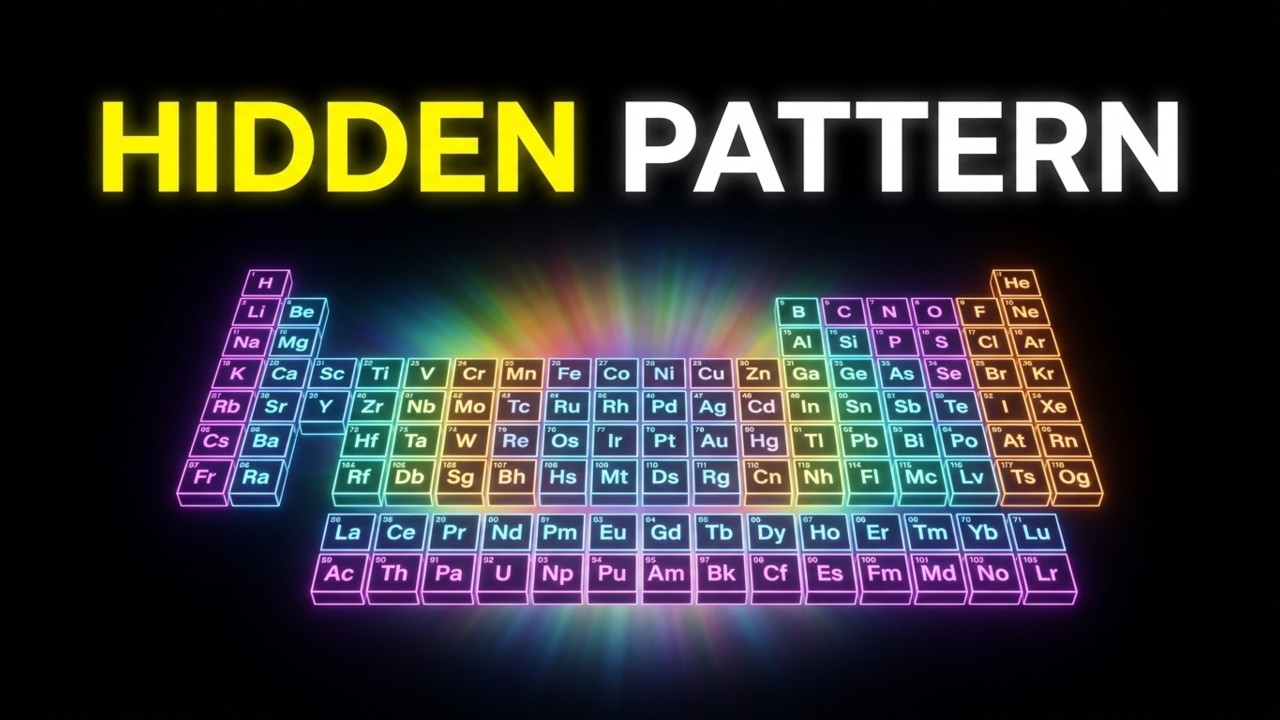
Nobody Ever Explained PERIODIC TABLE Like THIS!
Title history
- Nobody Ever Explained PERIODIC TABLE Like THIS! — observed on 20261101-0045 UTC (YouTube)
Keywords
Summary
166 words
Critical Evaluation
Value of the Information & Strength of the Argument
The video effectively conveys the deep structure underlying the periodic table, transforming it from a rote memorization tool into a coherent physical map. The step-by-step build-up, from Mendeleev’s intuitive ordering to quantum mechanical explanations, strengthens the argument. However, certain statements are oversimplified: describing atomic number as ‘just a label’ disregards its fundamental role in defining elements. The video also compresses historical events, potentially misleading viewers about the order of discoveries. Despite these flaws, the core reasoning is sound, and the analogies (floors, rooms) provide a powerful mental model. The video succeeds in making complex quantum concepts accessible, and its narrative arc is compelling.
Scientific Rigor, Source Quality, Title Accuracy
The video references key historical figures (Mendeleev, Bohr, Pauli) but does not provide primary source citations or external links in the description. While the concepts are accurately conveyed in general, some simplifications border on inaccuracies. For instance, the claim that atomic number is merely a label conflicts with its definition as the number of protons. The title ‘Nobody Ever Explained…’ is exaggerated, as many commenters note that this is standard high school material. Public comments reflect a mix of appreciation and criticism, with some pointing out factual errors and others praising the clarity. Overall, the video is a good educational resource but lacks rigorous sourcing and precise historical detail.
227 words
Title / Content Match
The title is somewhat sensationalized ('Nobody Ever Explained...') but the video does offer a structured, insightful explanation. It lives up to its claim of explaining the periodic table's shape, though the novelty is not as extreme as suggested.
Quality & Reliability
7/10
The video provides a clear and engaging explanation of the periodic table's structure based on electron shells and quantum mechanics. It synthesizes known scientific knowledge into a coherent narrative. However, some statements are oversimplified or slightly inaccurate, such as calling atomic number just a label, and the historical narrative omits some nuances (e.g., Mendeleev not knowing about noble gases).
Chapters
Cited Sources
- Mendeleev, D. (1869). Periodic Table of the Elements. — Original publication of the periodic table.
- Bohr, N. (1913). On the Constitution of Atoms and Molecules. — Bohr's model of electron shells.
- Pauli, W. (1925). Exclusion Principle. — Pauli exclusion principle explaining shell capacities.
Concurring Sources
- Periodic table - Wikipedia — Provides overview of periodic table structure and electron configuration.
- Electron configuration - Wikipedia — Discusses how electron shells and subshells fill.
Dissenting Sources
- Atomic number - Wikipedia — Defines atomic number as the number of protons, which is fundamental, not just a label as the video implies.
Contribution & Novelties
The video’s primary contribution is its pedagogically effective framing of the periodic table as a direct map of electron configuration, using the apartment analogy to demystify why the table has its characteristic shape. It makes the link between quantum subshells and the table’s layout explicit, which clarifies the gap and separated rows. The narrative connecting Mendeleev, Bohr, and Pauli emphasizes that the structure was independently discovered from different tracks, reinforcing the idea of a fundamental physical order. For further exploration:
- Electron shell (Wikipedia) - Explains shells and subshells.
- Aufbau principle (Wikipedia) - Governs electron filling order.
- Pauli exclusion principle (Wikipedia) - Explains why shells have fixed capacities.
- Mendeleev’s predicted elements (Wikipedia) - Highlights his correct predictions.
116 words
Radar Profile
The radar profile shows strong scores in quantity of information and technical level, indicating a content-rich and technically advanced presentation. The quality of information and global reliability are slightly lower, reflecting minor simplifications and inaccuracies. This suggests a video that is informative and engaging but may require critical viewing for full accuracy.
💬 Balanced. Based on the 30 comments analyzed, the climate is mixed: while some viewers praise the clarity and depth, many note that the content is standard high school material and point out minor factual errors. A recurring criticism is the artificial AI voiceover.