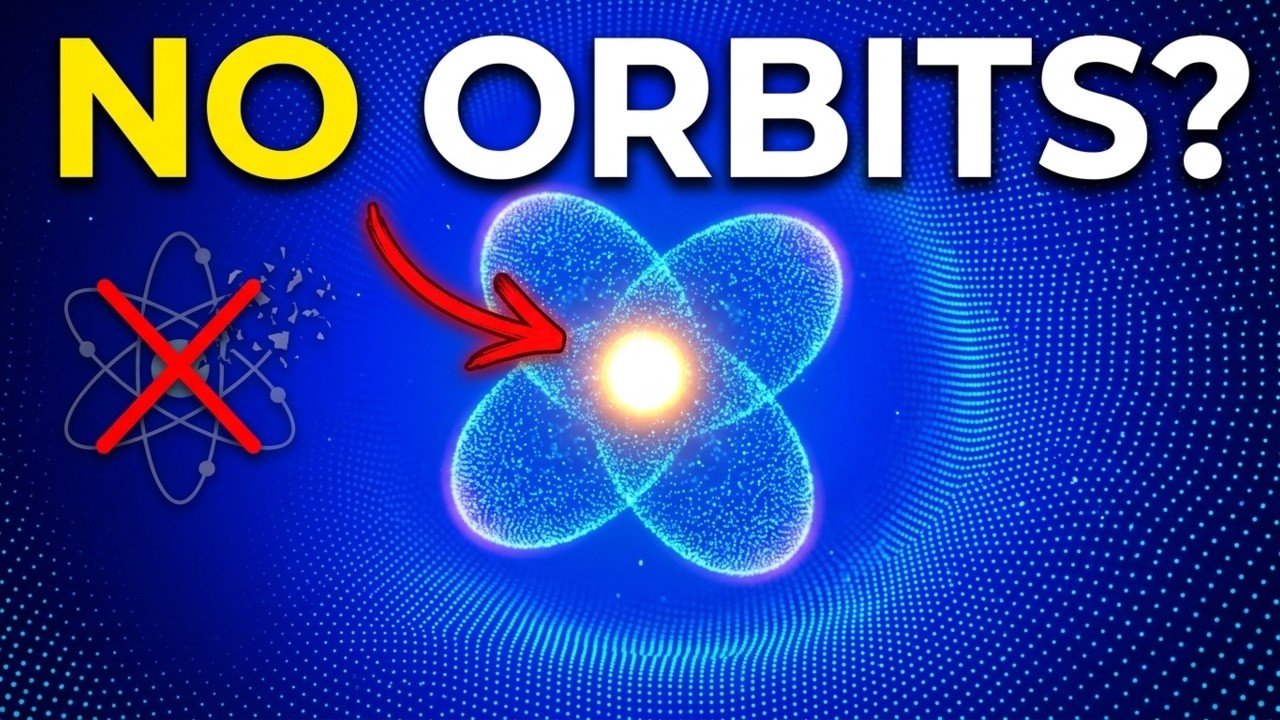
Nobody Explained the ATOM Like This BEFORE!
Title history
- Nobody Explained the ATOM Like This BEFORE! — observed on 20261101-2218 UTC (YouTube)
Keywords
Summary
133 words
Critical Evaluation
Value of the Information & Strength of the Argument
The video excels in presenting complex quantum mechanical concepts with clarity and narrative cohesion. The argumentation is logically structured: starting from the classic model’s failure, it introduces each historical step as a resolution to the previous problem, culminating in a coherent picture of the atom. Analogies like the guitar string and the lottery for proton collisions effectively make abstract physics tangible. The explanation of why atoms don’t collapse (balance of attractive force and squeezing energy) is particularly strong, and the treatment of quantum tunneling is both accurate and engaging. The video does not shy away from acknowledging limitations, such as the unsolved measurement problem and the impossibility of exact solutions for helium, which adds credibility to its scientific value.
Scientific Rigor, Source Quality, Title Accuracy
The video demonstrates high scientific rigor by referencing the foundational papers of Rutherford (1911), Bohr (1913), de Broglie (1924), Pauli (1925), Schrödinger (1926), Heisenberg (1927), and Gamow (1928). It accurately describes the historical progression and the theoretical underpinnings. The AI disclosure is transparent, and the animations are clearly flagged as simplified models. The title accurately reflects the content, which revisits atomic structure from an explanatory perspective, though the claim of being ‘first’ is stylistic. The content adheres to established physics, and the limitations (e.g., helium approximation) are honestly noted. Overall, the sources are appropriate and the title matches the video’s scope.
235 words
Title / Content Match
The title is catchy but accurate: 'Nobody Explained the ATOM Like This BEFORE!' claims a fresh explanation, which the video delivers through a narrative approach and clear analogies.
Quality & Reliability
8/10
The video provides a historically accurate account of atomic theory development, correctly explains quantum mechanical concepts like orbitals, quantization, and quantum tunneling, and cites original papers. Simplified analogies are clearly presented as such.
Key Moments
Markers derived by PSI from the transcript: the creator did not define chapters.
- Introduction: The classic atom model is impossible.
- Maxwell's equations and electron collapse.
- Rutherford's gold foil experiment.
- Bohr's model and quantization rules.
- de Broglie's matter waves and wave-particle duality.
- Schrödinger equation and electron clouds.
- Guitar string analogy for quantization.
- Why atoms don't collapse: Heisenberg uncertainty principle.
- Strong force and Pauli exclusion principle.
- Quantum tunneling and the Sun's fusion.
Cited Sources
- Rutherford, E. (1911). The Scattering of α and β Particles by Matter and the Structure of the Atom. — Cited as the basis for Rutherford's gold foil experiment.
- Bohr, N. (1913). On the Constitution of Atoms and Molecules. — Cited for Bohr's quantization rules.
- de Broglie, L. (1924). Recherches sur la théorie des quanta. — Cited for the concept of matter waves.
- Pauli, W. (1925). Exclusion Principle. — Cited for the Pauli exclusion principle.
- Schrödinger, E. (1926). Quantisierung als Eigenwertproblem. — Cited for the Schrödinger equation.
- Heisenberg, W. (1927). Über den anschaulichen Inhalt der quantentheoretischen Kinematik und Mechanik. — Cited for the uncertainty principle.
- Gamow, G. (1928). Zur Quantentheorie des Atomkernes. — Cited for quantum tunneling and radioactivity.
Concurring Sources
- Atomic orbital — Confirms the description of electron clouds and orbitals.
- Quantum tunnelling — Supports the explanation of tunneling and its applications.
- Uncertainty principle — Aligns with the video's explanation of why electrons don't collapse.
Contribution & Novelties
The video’s original contribution lies in its integrated narrative that connects atomic model failures, quantum wave mechanics, and quantum tunneling to explain everyday phenomena such as the Sun’s energy and why matter doesn’t collapse. It demystifies core concepts with intuitive analogies while honestly addressing unresolved questions.
Pour aller plus loin :
- Atomic orbital — Useful to understand the spatial probability distributions of electrons.
- Quantum tunnelling — Explains the tunneling effect used in devices like flash memory and STM.
- Bohr model — Historical context for the quantization rules that preceded the wave model.
- Schrödinger equation — The fundamental equation governing quantum wavefunctions.
101 words
Radar Profile
The radar profile shows high scores (8-9) in information quantity, quality, and reliability, with a slightly lower technical level (8) reflecting the accessible analogies used. This suggests a well-balanced, reliable educational video that is both informative and comprehensible.