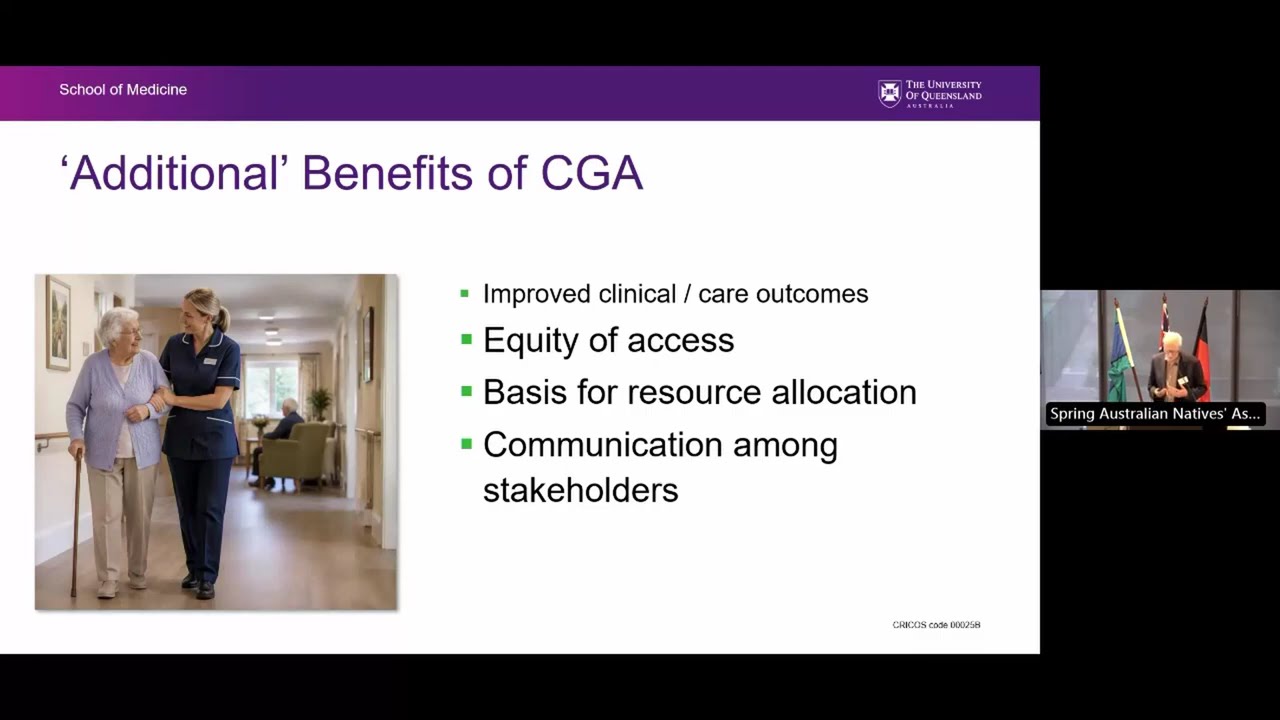
Professor Len Gray - NARI MARC 2026 Annual Summit Keynote Presentation
Title history
- Professor Len Gray - NARI MARC 2026 Annual Summit Keynote Presentation — observed on 20261030-1054 UTC (YouTube)
- NARI MARC 2026 Annual Summit Keynote Presentation - Professor Len Gray — observed on 20261028-0743 UTC (YouTube)
Keywords
Summary
173 words
Critical Evaluation
Value of the Information & Strength of the Argument
The information provided is highly valuable for understanding the evolution and current state of geriatric assessment. Gray offers a comprehensive historical narrative supported by key landmark publications and personal participation in the development of assessment systems. His argumentation is well-structured: he contrasts the ideal of CGA with its regulatory applications, and critically evaluates evidence from RCTs and reviews. He does not oversell positive findings, acknowledging the limitations and real-world constraints. The discussion of future AI is forward-looking yet grounded in current challenges. Overall, the value lies in integrating history, evidence, and policy, making a strong case for rethinking assessment to serve both clinical care and resource allocation.
Scientific Rigor, Source Quality, Title Accuracy
The presentation demonstrates strong scientific rigor: Gray cites specific RCTs, Cochrane reviews, and legislative acts, and draws on his own experience with interRAI and ACAT. He clearly distinguishes evidence strength and acknowledges controversies. The sources referenced are credible (NEJM, Cochrane, US legislation). The title directly matches the content, delivering exactly the promised examination of geriatric assessment’s past, present, and future. No major discrepancies are noted.
187 words
Title / Content Match
The title accurately reflects the content: the keynote covers the historical roots, evolution, current state, and future possibilities (including AI) of geriatric assessment.
Quality & Reliability
8/10
The presentation is grounded in decades of clinical and research experience, references landmark trials and reviews, and offers a balanced evaluation of evidence. Some historical details are anecdotal but overall highly reliable.
Key Moments
Markers derived by PSI from the transcript: the creator did not define chapters.
- Marjorie Warren's foundational work and birth of geriatric medicine
- Rubenstein's 1984 RCT on geriatric evaluation units
- Cochrane review outcomes and sobering evidence on CGA
- Regulatory use of CGA in Australia: MacLeod report and ACAT
- Evolution to structured assessment and introduction of decision support tools
- US OBRA 1987 and development of the RAI MDS
- interRAI's growth and worldwide implementation
- Future with AI: opportunities and threats for geriatric assessment
Cited Sources
- Effectiveness of a Geriatric Evaluation Unit: A Randomized Clinical Trial — Cited as the landmark 1984 trial by Rubenstein et al. showing benefits of CGA.
- Comprehensive geriatric assessment for older adults admitted to hospital — Referenced as the Cochrane review (2017/2018) that updates evidence on CGA outcomes.
- Designing the National Resident Assessment Instrument for Nursing Homes — Discussed as the 1990 paper describing the RAI MDS development.
- interRAI official website — Mentioned as the collaborative developing standardized assessment systems.
Concurring Sources
- Comprehensive geriatric assessment in the emergency department — Supports the effectiveness of CGA in specific settings, echoing Gray's balanced view.
Contribution & Novelties
Gray provides a unique synthesis of historical milestones, personal involvement, and future directions in geriatric assessment. He clarifies the dual purpose of CGA in clinical care and regulatory allocation, and highlights the tension between these roles. His call to integrate AI while maintaining clinical relevance offers a fresh perspective. The talk emphasizes the need to move beyond ‘1980s technology’ to adaptable, data-driven assessment systems.
Pour aller plus loin :
- Comprehensive geriatric assessment — Background and definition of CGA.
- interRAI — Official site with suite of instruments and research.
- Artificial intelligence in healthcare — Overview of AI applications, relevant to future assessment tools.
- Minimum Data Set — Description of the RAI MDS used in US nursing homes.
116 words
Radar Profile
The profile shows high scores across information quantity, quality, technical level, and reliability, indicating a well-rounded, evidence-based presentation. The low score in technical level relative to others suggests the content is accessible while still rigorous.