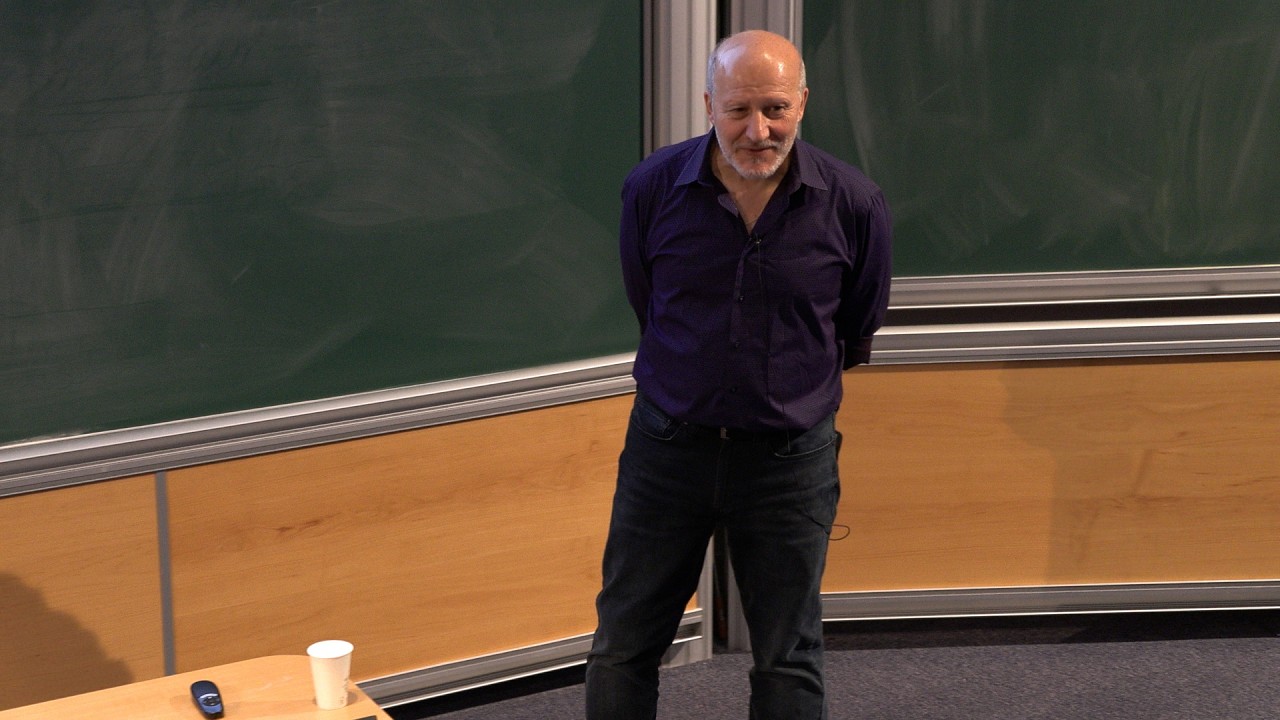
Sergei Tabachnikov - Movable n4 Configurations
Title history
- Sergei Tabachnikov - Movable n4 Configurations — observed on 20261027-1851 UTC (YouTube)
Keywords
Summary
164 words
Critical Evaluation
Value of the Information & Strength of the Argument
The value of the talk lies in presenting original constructions and theorems that connect several classical areas of geometry: configurations, Poncelet porism, pentagram maps, and integrable billiards. The argumentation is rigorous and follows a clear logical structure, building from known results to new ones. The speaker provides proof sketches and illustrates the main ideas with examples. The use of the Poncelet grid as a tool to prove commutativity statements is elegant and demonstrates the synergy between geometry and dynamics.
Scientific Rigor, Source Quality, Title Accuracy
The speaker cites classic works by Klein, Grünbaum and Rigby, Sylvester, Darboux, and Kasner, indicating a solid scholarly foundation. The talk is a research presentation, and the speaker acknowledges joint work, referring to a recent publication. The title ‘Movable n4 Configurations’ accurately describes the content, as the talk indeed focuses on constructing configurations that are not rigid. The presentation is precise, though some details are left to the published papers. The only minor issue is a few typos in the slides, which do not affect the mathematical content.
182 words
Title / Content Match
The title accurately reflects the content: the talk is entirely focused on constructing movable n4 configurations using Poncelet polygons, pentagram maps, and related structures.
Quality & Reliability
8/10
The talk presents original research results with rigorous mathematical definitions and references to classical works by Klein, Grünbaum, Rigby, Sylvester, Darboux, and Kasner. The speaker is a recognized expert, and the logical structure is clear. However, some proofs are only sketched, and technical details are delegated to the associated paper, which slightly affects completeness.
Key Moments
Markers derived by PSI from the transcript: the creator did not define chapters.
- Introduction to the talk, joint work, and outline.
- Definition of n4 configurations and Klein's complex example.
- Grünbaum-Rigby real construction based on a regular heptagon.
- Sylvester problem and its relation to complex counterexamples.
- Introduction to Poncelet porism and notation for operations.
- Statement of Theorems 1 and 2 about fixed points and commuting pentagram maps.
- Proof sketch of Theorem 2 using Poncelet grid and linear maps.
- Kasner's pre-war theorem and his contribution to pentagon operations.
- Theorem 3 and illustration with a 10_4 configuration.
- Poncelet grid and Darboux's theorem on concentric sets lying on conics.
- Proof of Theorem 1 using Poncelet grid and local lemma with billiard maps.
- Conclusion, connection to integrable billiards, and final remarks.
Cited Sources
- Carmin.tv - Scientific videos — Platform hosting the video and offering additional mathematical lectures.
Contribution & Novelties
The talk presents new constructions of movable n4 configurations using Poncelet polygons, which fill a gap since the Grünbaum-Rigby example was thought to be rigid. It also establishes a connection between configurations and the pentagram map, which is a central object in projective geometry and discrete integrable systems. The proofs using the Poncelet grid and billiard maps provide a novel approach.
Pour aller plus loin :
- Poncelet porism — Fundamental theorem about polygons inscribed in one conic and circumscribed about another, used throughout.
- Pentagram map — A map on polygons that plays a key role in the talk.
- Configuration (geometry) — General definition and examples of configurations.
- Elliptic billiards — The billiard problem in ellipses, which commutes with the Poncelet map.
121 words
Radar Profile
The radar shows high scores in quantity and technical level, with slightly lower but still high scores in quality and reliability, indicating a dense and advanced talk that is well-supported but assumes expertise.