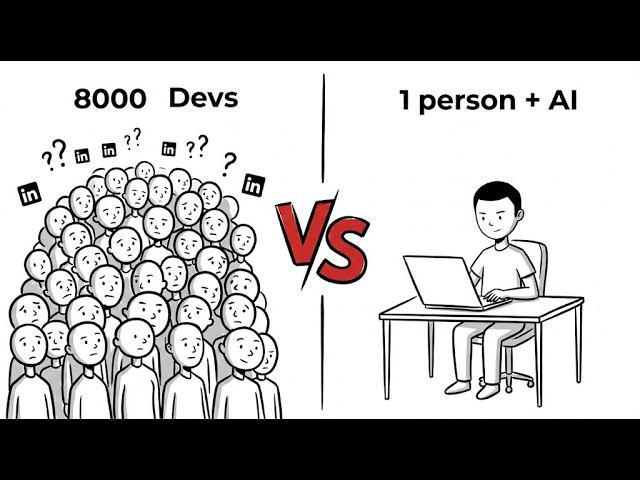
8000 devs vs 1 person + l'IA : qui gagne ?
8000 devs vs 1 person + AI: who wins?
Title history
- 8000 devs vs 1 person + l'IA : qui gagne ? — observed on 20261110-0318 UTC (YouTube)
Keywords
Summary
201 words
Critical Evaluation
Value of the Information & Strength of the Argument
The video offers a coherent and accessible synthesis of how AI is reshaping software economics. It builds a strong analogy between cloud-native and AI-native transformations, grounding the argument in personal entrepreneurial experience. The enumeration of protective moats is valuable and well-structured, helping to differentiate between companies that are defensible and those that are vulnerable. However, the argumentation at times feels tilted toward a deterministic narrative, and the lack of quantitative evidence (e.g., cost comparisons, market data) weakens the logical force. The reasoning is mostly qualitative, with occasional appeals to authority (Y Combinator, Forrester) without detailed references. Still, the central thesis — that code becomes a commodity and value shifts to data, trust, and distribution — is persuasive and clearly argued.
Scientific Rigor, Source Quality, Title Accuracy
The video mentions several sources and data points (Forrester, Satya Nadella, Y Combinator report) but does not provide direct links or detailed citations in the body. The description links are mostly to the creator’s own tools and profiles, offering no external validation. The title-content alignment is good: the video answers the ‘who wins’ question by explaining why incumbents may lose in specific segments but survive due to non-code moats. The quality of sourcing is moderate: it relies on examples and general claims rather than verifiable references, which affects the scientific rigor. The use of his own tools as resources does not contribute to the core argument. Overall, the title is catchy and the content is relevant, but the absence of traceable sources prevents a higher rating.
261 words
Title / Content Match
The title directly asks who wins between a large team and one person with AI, and the video addresses this by analyzing moats and the commoditization of code, though the answer is nuanced rather than a simple head-to-head.
Quality & Reliability
7/10
The video provides a reasoned argument with relevant examples (LinkedIn, Palantir, Y Combinator) but lacks direct citations or links to data. The personal experience adds credibility but the evidence is anecdotal and industry claims are not independently verified.
Chapters
Cited Sources
- Bloggrify - Static blog generator — Mentioned as an open-source tool the creator develops, illustrating his involvement in software creation.
- Eventually Coding Blog — Link to the creator's blog for further content and contact.
- Hakanai — Toolkit for bloggers, cited as a product developed by the creator, related to the theme of building with less code.
- Bluesky Profile — Social media presence of the creator, for discussion.
- Mastodon Profile — Another social medium for engagement, showing the creator's identity.
- Writizzy — A blogging platform described as a European alternative to Medium and Substack, also developed by the creator.
Contribution & Novelties
The video’s original contribution lies in framing AI as a commoditization engine for software development, systematically contrasting the historical value of writing code with the new economics of trust, distribution, and data. It synthesizes familiar concepts (moats, build-or-buy) into a forward-looking model of AI-native companies, drawing a direct parallel to the cloud-native era and its cultural impact. The discussion of non-code moats (e.g., regulatory certifications, physical infrastructure) adds depth to the usual AI-disruption narrative.
Pour aller plus loin :
- Cloud-native computing — The video references this as the previous paradigm, useful for comparing to AI-native.
- Zero Trust Architecture — Mentioned as a natural consequence of cloud-native, now becoming a standard security model.
- Y Combinator — The video cites the 2025 report indicating 25% of startups use AI to build >95% of software, a key statistic.
- Moat (business) — The concept of competitive advantage is central to the video’s analysis.
- LinkedIn — The example of a large platform with network effects, directly discussed.
162 words
Radar Profile
The radar profile shows a balanced distribution with high quality and moderate quantity, indicating a well-reasoned opinion piece rather than a data-rich study. The technical level is moderate, suitable for a broad audience, while reliability is constrained by the lack of verifiable sources. The overall shape suggests a thoughtful but not deeply rigorous analysis.