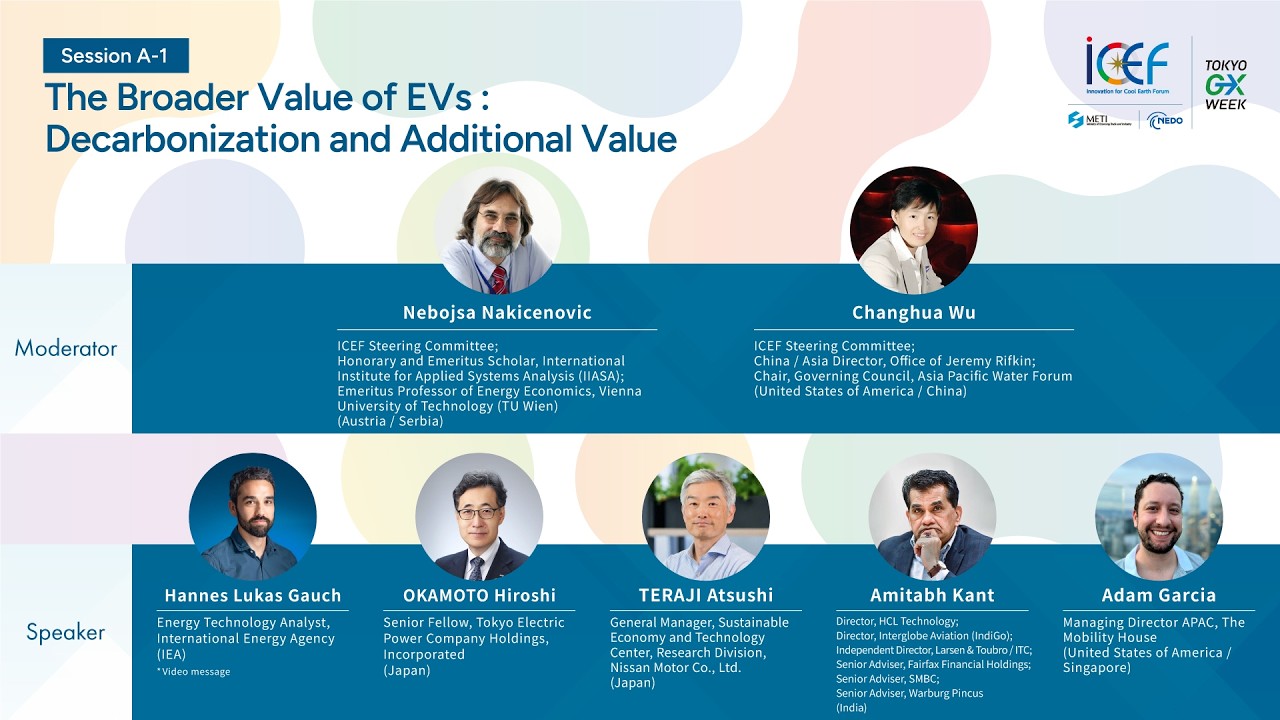
ICEF2026 | Session A-1
Title history
- ICEF2026 | Session A-1 — observed on 20261030-0852 UTC (YouTube)
Keywords
Summary
187 words
Critical Evaluation
Value of the Information & Strength of the Argument
The session provides high value by bringing together diverse expert perspectives: IEA data, Nissan’s practical V2X projects, The Mobility House’s commercial programs, TEPCO’s vision of connected society, and India’s policy framework. The argumentation is solid, grounded in real data (e.g., IEA Global EV Outlook, specific pilot projects) and practical examples. Speakers build a coherent case for EVs as flexible assets that can support grid stability and renewable integration, while also addressing challenges like interoperability and investment needs. The discussion is well-moderated and each presentation contributes unique insights, though some claims are made without deep technical detail.
Scientific Rigor, Source Quality, Title Accuracy
The rigor is generally high: the IEA report is a reputable source, and panelists cite their own projects and analyses. However, some statements are based on ongoing commercial activities without peer-reviewed evidence. The title ‘ICEF2026 | Session A-1’ is non-illuminating, but the description provides the session’s focus on broader value of EVs. The content aligns well with the description, covering technical, economic, and policy aspects. No contradictory sources are mentioned, and the overall reliability is good, though the format is a conference discussion rather than a formal scientific review.
200 words
Title / Content Match
The title is generic but the description clearly states the session's focus; content matches the session theme.
Quality & Reliability
7/10
High credibility of speakers (IEA, Nissan, TEPCO, etc.) and use of official IEA data, but content is a conference panel without peer review and low viewership.
Key Moments
Markers derived by PSI from the transcript: the creator did not define chapters.
- Hannes Gauch (IEA) presents Global EV Outlook findings: EV sales growth, grid integration challenges, smart charging and V2G potential.
- Teraji Atsushi (Nissan) discusses V2X technologies, grid balancing, disaster backup, and Nissan Blue Switch program.
- Adam Garcia (The Mobility House) highlights energy-system volatility, need for storage, and EV batteries as distributed storage, with examples from Europe and Asia.
- Okamoto Hiroshi (TEPCO) introduces all-electric and connected society, emphasizing EVs as nodes of power and digital networks, and physical AI.
- Amitabh Kant (India) presents India's EV adoption strategy, manufacturing ambitions, and policies like Delhi's mandate for all-electric new vehicles by 2028.
- Panel discussion on grid integration, V2G value, and lessons from pilots.
- Q&A session with audience questions on EV economics, interoperability, and global deployment.
Cited Sources
- IEA Global EV Outlook — Hannes Gauch references the report's findings on EV sales and grid integration.
- Nissan Blue Switch — Atsushi describes Nissan's disaster relief and community energy sharing program.
- RWTH Aachen University analysis — Gauch mentions a study with RWTH Aachen on EV flexibility using German mobility data.
Contribution & Novelties
This session adds value by synthesizing multiple perspectives on the ‘broader value’ of EVs, moving beyond decarbonization to include grid flexibility, energy security, and industrial opportunity. It provides concrete examples of V2G pilots and commercial programs, and highlights the concept of EVs as nodes in an ‘all-electric and connected society’. The discussion also addresses policy and supply chain issues, particularly for emerging markets like India.
Pour aller plus loin :
- Vehicle-to-grid — A key technology discussed, enabling EVs to feed electricity back to the grid.
- Smart charging — Essential for managing EV load and integrating renewables.
- Electric vehicle — Overview of EV technology and adoption trends.
- Demand response — Related concept for grid flexibility and balancing.
116 words
Radar Profile
The profile shows high scores in information quantity (8) and fiabilité (7), with moderate technical level (6). This reflects a well-rounded expert discussion that is accessible but not deeply technical, providing substantial reliable content.