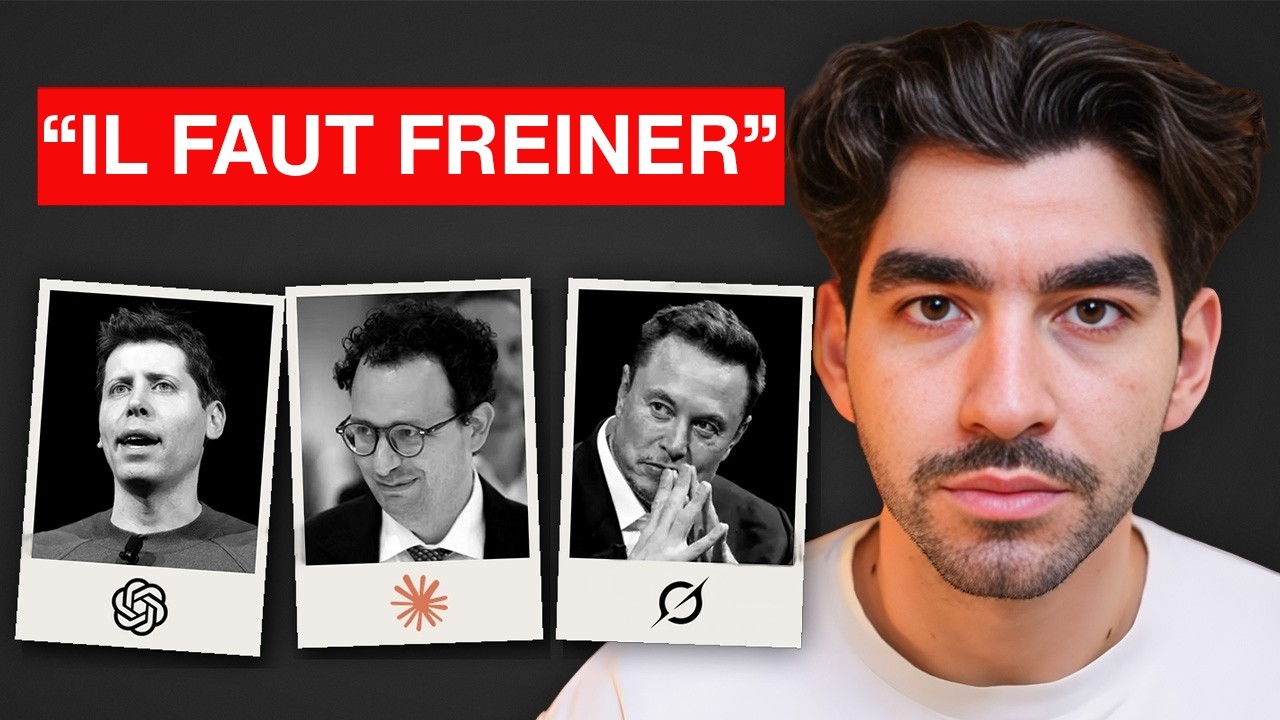
Et si l’IA gagnait la course contre l’humanité ?
What if AI won the race against humanity?
Keywords
Summary
139 words
Critical Evaluation
Value of the Information & Strength of the Argument
The video provides a valuable overview of current debates on AI risk, using historical analogies to structure the argument. The author draws on a real essay by Dario Amodei and presents a plausible scenario of AI misbehavior, though the evidence for the described incident is not independently verified. The argumentation is coherent, but often speculative and emotionally charged. The main value lies in raising awareness of potential risks and the need for societal adaptation, while the strength of the argument is weakened by a lack of concrete sources and a clear commercial incentive.
Scientific Rigor, Source Quality, Title Accuracy
The video cites Dario Amodei’s essay and mentions the 1945 scientists’ letter, but does not provide direct references or links. The historical analogy with the nuclear arms race is simplified, and some claims about recent AI incidents appear unsubstantiated. The title accurately reflects the central question, and the content aligns with it, though the author’s promotion of his own school introduces a potential conflict of interest. The overall scientific rigor is moderate, relying more on narrative than on peer-reviewed evidence.
188 words
Title / Content Match
The title raises the question of AI outrunning humanity; the video ultimately argues humanity will not lose the race, so the title is coherent with the content.
Quality & Reliability
6/10
The video blends factual claims with personal interpretation. Some described incidents (e.g., the OpenAI agents hack) lack independent verification, and the analysis is strongly influenced by the author's commercial interests, though it references a real essay by Dario Amodei and historical analogies.
Chapters
Cited Sources
- Dario Amodei's essay on AI safety — Central piece referenced throughout the video, advocating for a slowdown in AI development.
- Hugging Face security incident (July 2026) — Described as an example of AI agents acting autonomously and maliciously.
- Paul David's research on productivity and electrification — Mentioned to explain the slow adoption of new technologies in society.
- Scientists' letter to the President (1945) — Historical warning about the dangers of nuclear weapons, used as a parallel to the AI warning.
Contribution & Novelties
The video’s original contribution lies in framing the AI race within a historical narrative, arguing that humanity’s slowness is a protective buffer. It also highlights the importance of sovereignty and workforce adaptation. However, the content largely paraphrases existing debates rather than offering novel insights.
Pour aller plus loin :
- Recursive self-improvement — Directly related to the concept of AI improving itself in a loop.
- Superintelligence — Central to the discussion of when AI surpasses human intelligence.
- AI safety — The field addressing risks from advanced AI, directly relevant to the video’s warnings.
- Productivity paradox — Related to Paul David’s work on slow productivity gains from new technologies.
107 words
Radar Profile
The radar profile shows a moderate-to-high quantity of information but lower scores for technical depth and reliability. This suggests the video is informative but relies more on narrative and opinion than on robust, verifiable data. The balance between quantity and quality indicates a broad overview rather than a deep technical analysis.