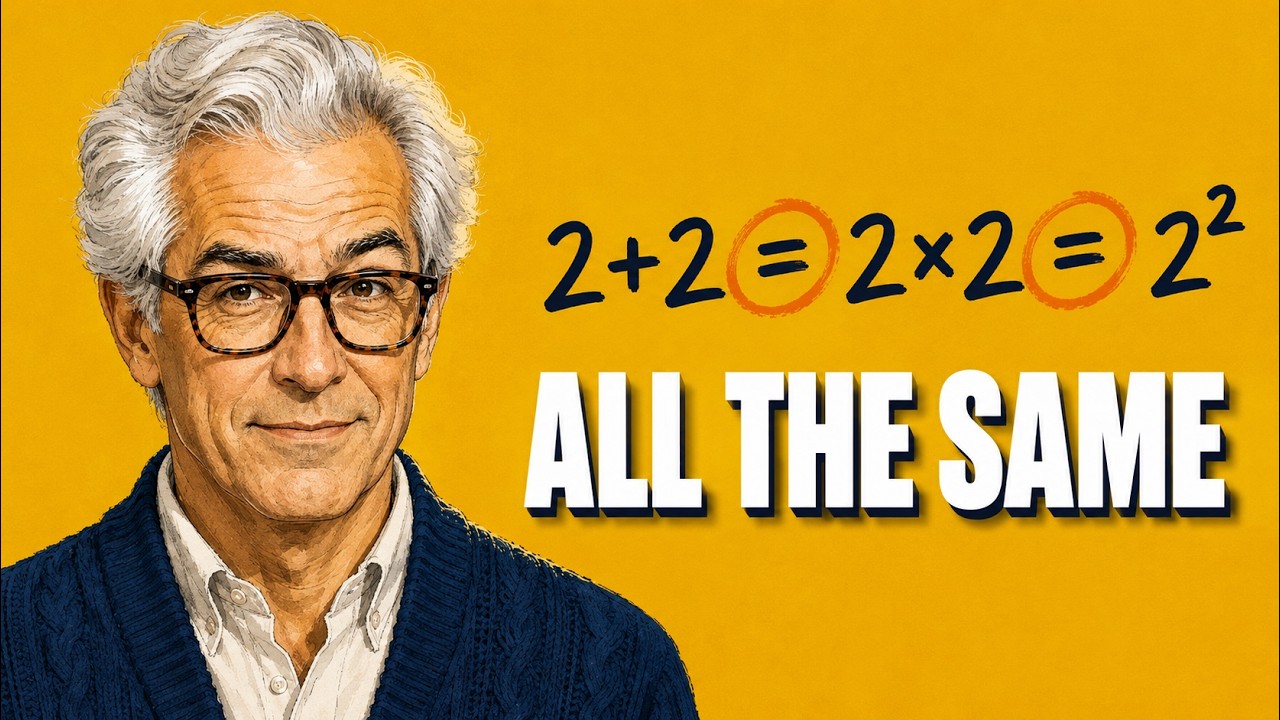
That's Right, it Goes in the 4 Hole!
Title history
- That's Right, it Goes in the 4 Hole! — observed on 20261101-0040 UTC (YouTube)
Keywords
Summary
186 words
Critical Evaluation
Value of the Information & Strength of the Argument
The video provides high educational value by connecting a popular meme to advanced mathematical concepts, making abstract ideas accessible. The argumentation is solid: the recursive definition of hyperoperations is rigorously explained, and the proof that 2•n 2 always equals 4 is logical and intuitive. The breakdown of other numbers (3, 1, 0) further reinforces the uniqueness of 2. The historical context adds credibility and depth. The step-by-step reasoning from successor up to pentation is clear and free of logical gaps.
Scientific Rigor, Source Quality, Title Accuracy
The video demonstrates strong scientific rigor. It correctly attributes the development of hyperoperations to Wilhelm Ackermann (1928), Reuben Goodstein (1947, who coined the terms tetration, pentation, etc.), Donald Knuth (1976, up-arrow notation), and John Conway (1996, chained arrow notation, in ‘The Book of Numbers’). These historical facts are accurate. The explanations of tetration’s right-associativity and the collapse property are mathematically correct. The title effectively encapsulates the meme and the mathematical outcome, without overclaiming. The video includes no experimental data but relies on established mathematical proofs and definitions. Overall, the content is reliable and well-sourced for its scope.
192 words
Title / Content Match
The title is catchy and directly related to the meme referenced in the content, while also hinting at the mathematical conclusion. It fits the video's theme well.
Quality & Reliability
9/10
The video presents a mathematically accurate and well-structured explanation of hyperoperations, correctly identifying why 2 works for all levels. Historical attributions (Ackermann, Goodstein, Knuth, Conway) are correct and sources are mentioned by name. The argumentation is rigorous and easy to follow.
Chapters
- A cartoon meme, three separate operations, and the answer they all share
- Why addition, multiplication and exponents were never separate rules
- Building the hyperoperation ladder from the successor step up to tetration
- Ackermann, Goodstein, Knuth and Conway, and the notation for enormous numbers
- The one line of logic that makes every rung collapse into the one below it
- Running 3, 1 and 0 up the same ladder to see how each one fails
- What the meme actually reveals about the structure of arithmetic
Cited Sources
- Ackermann function (1928) — Wilhelm Ackermann defined a three-variable function that resembles the hyperoperation hierarchy, foundational for fast-growing functions.
- Transfinite ordinals in recursive number theory (1947) by Reuben Goodstein — Goodstein coined the names tetration, pentation, hexation, etc., for the higher hyperoperations.
- Knuth up-arrow notation (1976) by Donald Knuth — Introduced a compact notation for expressing very large numbers and higher operations.
- The Book of Numbers (1996) by John Horton Conway and Richard K. Guy — Conway extended the notation with chained arrow notation, allowing even larger expressions.
Contribution & Novelties
The video’s original contribution lies in linking a viral meme to the entire hyperoperation hierarchy, demonstrating that the meme’s principle is mathematically universal for the number 2. It presents a clear, visual explanation of why 2+2, 2×2, 2^2, and all higher operations equal 4, using a recursive argument. This provides a fresh, memorable way to understand the structure of arithmetic and the relationship between operations. The examples of 3, 1, and 0 highlight boundary cases, enriching the viewer’s appreciation.
Pour aller plus loin :
- Hyperoperation — General definition and history.
- Tetration — Detailed treatment of the fourth operation.
- Ackermann function — Early recursive function that defines the ladder.
- Knuth up-arrow notation — The notation introduced by Donald Knuth.
- Conway chained arrow notation — Extension by John Conway.
127 words
Radar Profile
The radar profile is balanced with high scores in quality, reliability, and technical level, while quantity of information is slightly lower but still substantial. The video excels in clarity and accuracy, making it an excellent resource for mathematical communication.