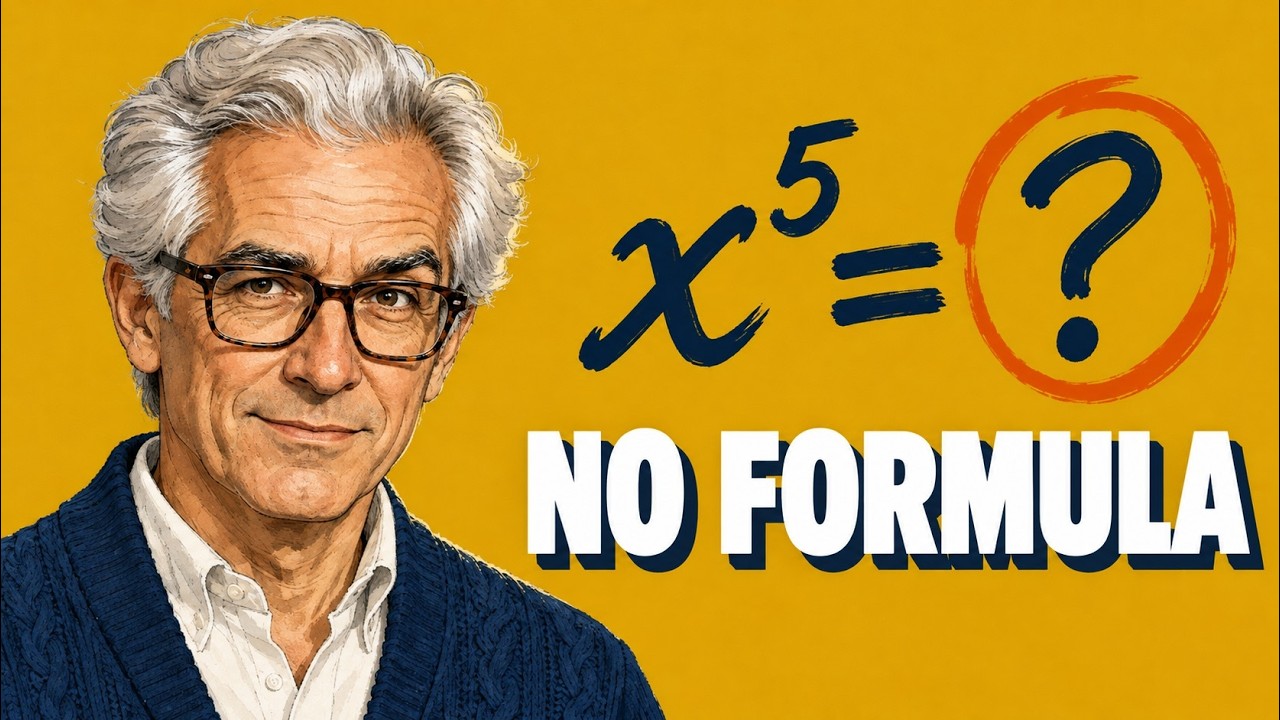
Why There's No Formula for the Quintic (Galois)
Title history
- Why There's No Formula for the Quintic (Galois) — observed on 20261031-2309 UTC (YouTube)
Keywords
Summary
237 words
Critical Evaluation
Value of the Information & Strength of the Argument
The video’s value lies in its ability to make a deep mathematical result both intuitive and engaging. It successfully translates the abstract concept of normal subgroups and solvability into the concrete metaphor of shuffling roots and breaking tie-breaks. The argumentation is sound: it carefully builds from the quadratic case, demonstrates how the number of permutations grows, and explains why the block of 60 is impenetrable to root extraction. The historical anecdotes not only add color but also illustrate the human struggle and the shift in perspective from ‘finding a formula’ to ‘asking what symmetries allow’. The acknowledgment that the presented proof is a simplification and that the full Galois theory is a university course enhances its honesty and reliability.
Scientific Rigor, Source Quality, Title Accuracy
The scientific rigor is high: the video accurately states the Abel-Ruffini theorem and correctly identifies the role of the icosahedral group as the simple group of 60 rotations. It clearly distinguishes the special case x^5=2 from the general quintic and mentions the need for non-radical methods (e.g., elliptic functions) for solving some quintics. The sources referenced, such as Felix Klein’s ‘Lectures on the Icosahedron’, are historically and mathematically relevant. The title matches the content precisely; the video delivers exactly what it promises. No external links are provided in the description, but the internal references are trustworthy and consistent with established mathematics.
235 words
Title / Content Match
The title exactly matches the content, which focuses on explaining why there is no general quintic formula and introduces the Galois perspective.
Quality & Reliability
8/10
The video provides a correct and accessible explanation of the Abel-Ruffini theorem, supported by historical context and the core ideas of Galois theory. It clearly distinguishes intuition from proof, references key mathematicians, and uses accurate visual analogies, though it deliberately simplifies some rigorous details.
Chapters
- Where is the formula for x to the fifth
- Fifth root of 2 vs an equation no recipe can solve
- Tartaglia, Cardano and the race for the cubic and quartic formulas
- What a formula really does with the roots of an equation
- The plus or minus sign in the quadratic formula explained
- Counting permutations of the roots and the block of 60
- Watching roots swap places as an equation moves
- Ruffini, Abel and Galois prove the impossible
- Solving the quintic anyway and the birth of group theory
Cited Sources
- Lectures on the Icosahedron — Felix Klein's book, mentioned as connecting the quintic solution to icosahedral symmetry.
- Abel-Ruffini theorem — The central theorem discussed, proving the impossibility of a general quintic formula.
Contribution & Novelties
This video offers a distinctive visual and intuitive walkthrough of a result that is usually taught via advanced algebra. It translates the group-theoretic concept of solvability into the concrete imagery of permuting roots and ‘peeling off’ cyclic layers, making the underlying idea accessible to a broad audience. It also weaves in historical context and the evolution of Galois’s question, which is a valuable pedagogical addition.
Pour aller plus loin :
- Galois theory — The formal framework behind the video’s explanation.
- Abel–Ruffini theorem — The specific theorem, with full proof details.
- Group theory — The mathematics of symmetry developed from this problem.
101 words
Radar Profile
The video scores high on information quantity and reliability, moderate on quality and technical depth. This suggests a well-researched and accurate explanation that is comprehensive yet remains accessible, without diving into the full rigorous details.