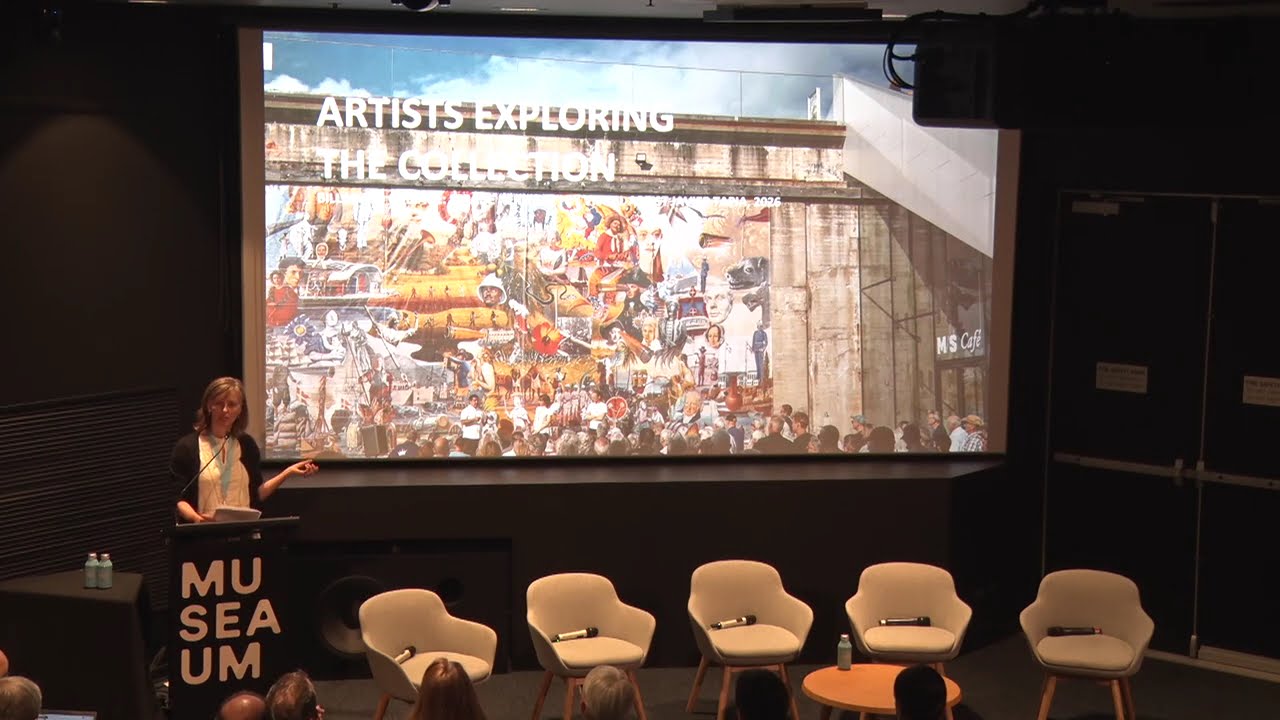
ICMM Congress 2026: Tomorrow's Museums Plenary Session
Title history
- ICMM Congress 2026: Tomorrow's Museums Plenary Session — observed on 20261029-1506 UTC (YouTube)
Keywords
Summary
176 words
Critical Evaluation
Value of the Information & Strength of the Argument
The value of the information lies in the concrete, real-world examples of museum innovation. Sarah Giersing provides a compelling argument for incorporating artistic interventions to humanize archival records that otherwise dehumanize individuals, such as the 1789 slave trade ledger. She supports her approach with examples like the artwork by Javier Tapia and a sound piece giving voice to the enslaved, demonstrating a thoughtful, evidence-based reasoning. Jason Fair’s argument for shared VR is equally grounded; he identifies a common problem (isolation in VR) and presents a solution (synchronized multi-headset experiences) with measurable outcomes (150,000 viewers for Antarctica, 100,000 for the Kimberley). His reasoning is practical and persuasive, stressing the importance of partnerships and the social nature of museums.
Scientific Rigor, Source Quality, Title Accuracy
The speakers rely on their professional experience and institutional work rather than external citations, which is acceptable for a conference presentation. The title accurately reflects the content, as the session directly addresses future-oriented museum practices. The discussion is focused and on-topic, with each speaker providing a well-structured case study. No external sources are cited, but the arguments are internally consistent and benefit from the speakers’ authority as museum leaders. The inclusion of international perspectives (Denmark, Australia, Korea, Poland) strengthens the credibility of the session as a global overview.
220 words
Title / Content Match
The title accurately reflects the content, as the session directly addresses future-oriented museum practices, encompassing inclusivity and technological innovation.
Quality & Reliability
7/10
The session presents practical case studies from experienced museum professionals, with transparent reasoning and grounded examples. While no external sources are cited, the argumentation is internally consistent and based on institutional experience.
Key Moments
Markers derived by PSI from the transcript: the creator did not define chapters.
- Sarah Giersing begins her talk on using creative arts to diversify maritime narratives.
- Discussion of the museum's strategy shift beyond maritime industry to broader cultural roots.
- Introduction of the 1789 slave trade document and the accompanying sound intervention.
- Jason Fair begins his presentation on shared virtual reality experiences.
- Details of the Antarctica VR experience and its success with over 150,000 viewers.
Contribution & Novelties
The session contributes original insights into how museums are evolving to become more inclusive and technologically integrated. The emphasis on shared VR experiences challenges conventional individualistic VR designs, proposing a model that aligns with museums’ social functions. Similarly, the use of creative collaborations to address archival silences offers a replicable methodology for other institutions.
Pour aller plus loin :
- Virtual reality applications in museums — Broad context on VR technology, relevant to Jason Fair’s shared VR model.
- Museum education and community engagement — Theoretical background on audience engagement, supporting Sarah Giersing’s inclusive approach.
- Postcolonial museum studies — Addresses the need to incorporate marginalized voices, directly linked to the session’s theme.
110 words
Radar Profile
The scores indicate a strong emphasis on information quantity and quality, with moderate technical depth and good reliability. This profile suggests a content-rich session that is accessible to a general audience while providing substantive insights.