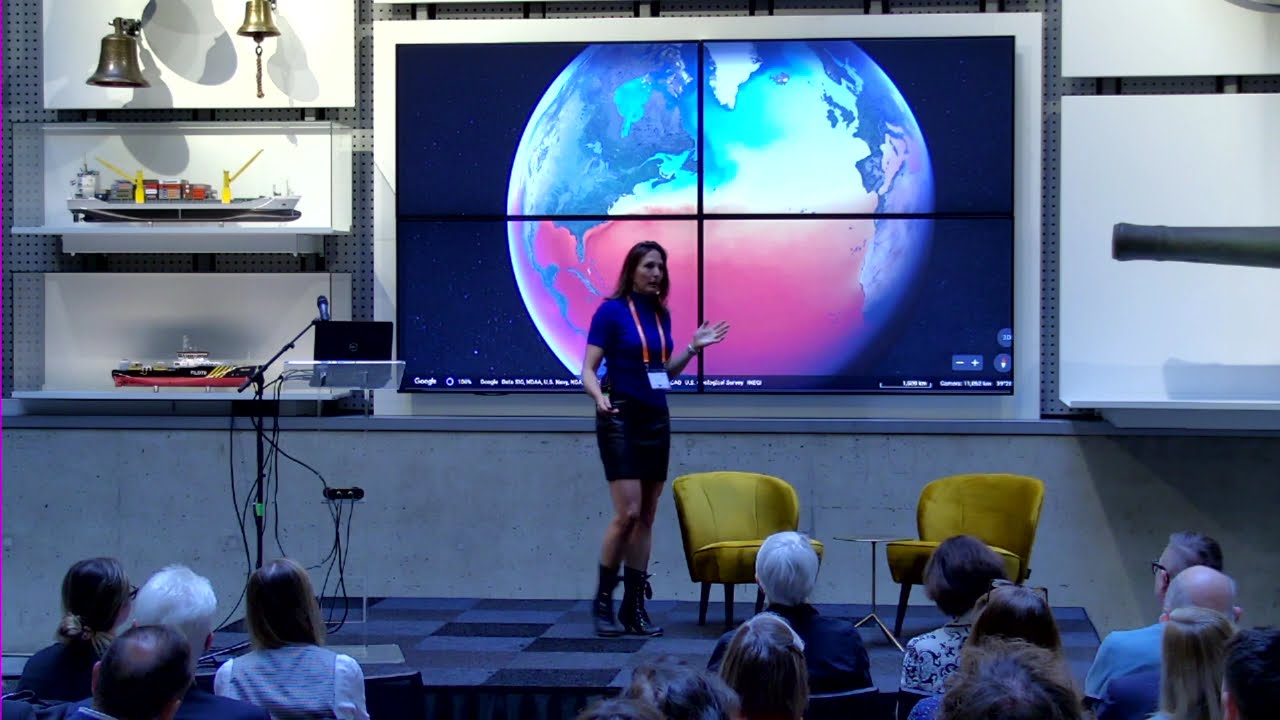
ICMM Congress 2024: Dr Helen Czerski, Blue Machine: Seeing Ourselves as Citizens of an Ocean World
Title history
- ICMM Congress 2024: Dr Helen Czerski, Blue Machine: Seeing Ourselves as Citizens of an Ocean World — observed on 20261030-1154 UTC (YouTube)
Keywords
Summary
161 words
Critical Evaluation
Value of the Information & Strength of the Argument
The talk provides valuable insights by connecting physical oceanography to everyday life and global history. Czerski’s argumentation is strong: she uses concrete examples like the Greenland shark found in the Gulf of Mexico to illustrate ocean stratification, and the Humboldt Current to explain upwelling and its geopolitical consequences through guano and anchoveta fisheries. She effectively demonstrates how the ocean’s physical engine drives ecosystems and human activities. The narrative is coherent and persuasive, building from basic principles to broader implications. Her classification of messengers, passengers, and voyagers offers a useful framework for understanding ocean dynamics and the role of human agency.
Scientific Rigor, Source Quality, Title Accuracy
The scientific rigor is high: Czerski is a respected physicist and oceanographer, and her examples are consistent with established oceanographic knowledge. She references her own book ‘Blue Machine’ and mentions Andrea Wulf’s ‘The Invention of Nature’ as a source on Humboldt. However, she does not provide explicit in-talk citations, which limits immediate verification. The title ‘Blue Machine: Seeing Ourselves as Citizens of an Ocean World’ accurately captures the thesis and content of the presentation. The talk neither overstates nor understates scientific claims, and it appropriately acknowledges uncertainty where needed, such as the behavior of Greenland sharks.
211 words
Title / Content Match
The title accurately reflects the content: a keynote addressing the ocean as a unified engine and the role of humans as citizens of an ocean world, as presented by Dr Helen Czerski.
Quality & Reliability
8/10
The talk is given by an expert physicist and oceanographer, presenting well-established oceanographic concepts with vivid examples. No formal citations are provided during the speech, but the content aligns with current scientific knowledge and her published book. The presentation is highly informative and reliable.
Key Moments
Markers derived by PSI from the transcript: the creator did not define chapters.
- Introduction: Paddy Rodgers introduces Dr Helen Czerski, her background, and her book 'Blue Machine'.
- Discussion of Earthrise and Blue Marble photographs, highlighting humanity's limited view of the ocean.
- Example of Greenland shark in the Gulf of Mexico illustrates ocean stratification and temperature layers.
- Humboldt Current, upwelling, anchoveta fisheries, and guano trade with geopolitical impact.
- Mesoscale eddies in the Gulf Stream and how tuna swim along these structures to hunt.
- Concluding remarks on human voyaging, from Cutty Sark to Polynesian navigation, and call for maritime museums to highlight the ocean.
Cited Sources
- Blue Machine: How the Ocean Works — Her book, which the talk is based on.
- The Invention of Nature: Alexander von Humboldt's New World — She recommends this book about Alexander von Humboldt, a key figure in understanding connections in nature.
Concurring Sources
- Blue Machine: How the Ocean Works — Her book provides in-depth scientific background and extends the talk's themes.
- The Invention of Nature — Used as an example of interdisciplinary thinking and connections in nature.
Contribution & Novelties
The talk offers a refreshing perspective by framing the ocean as a unified physical engine and emphasizing the deep connections between ocean physics, ecosystems, and human history. It challenges the audience to see the ocean not just as a backdrop but as an active, indispensable component of planetary life. The discussion of maritime museums’ role in presenting the ocean is also an innovative angle.
Pour aller plus loin :
- Ocean upwelling — Relevant to the Humboldt Current example and how nutrient-rich waters drive productivity.
- Mesoscale eddies — Correlates with the Gulf Stream eddies she describes and their impact on marine life.
- Guano — Historical and geopolitical significance of guano as a resource.
- Deepwater Horizon oil spill — Context for the Greenland shark discovery near the Gulf of Mexico.
128 words
Radar Profile
The radar profile shows high scores in information quantity and quality, indicating a dense and substantive talk. The technical level is moderate-high, suitable for an informed audience. The reliability is strong given the expert speaker and well-established concepts, though no formal citations are given. The overall profile suggests a highly informative and trustworthy presentation.