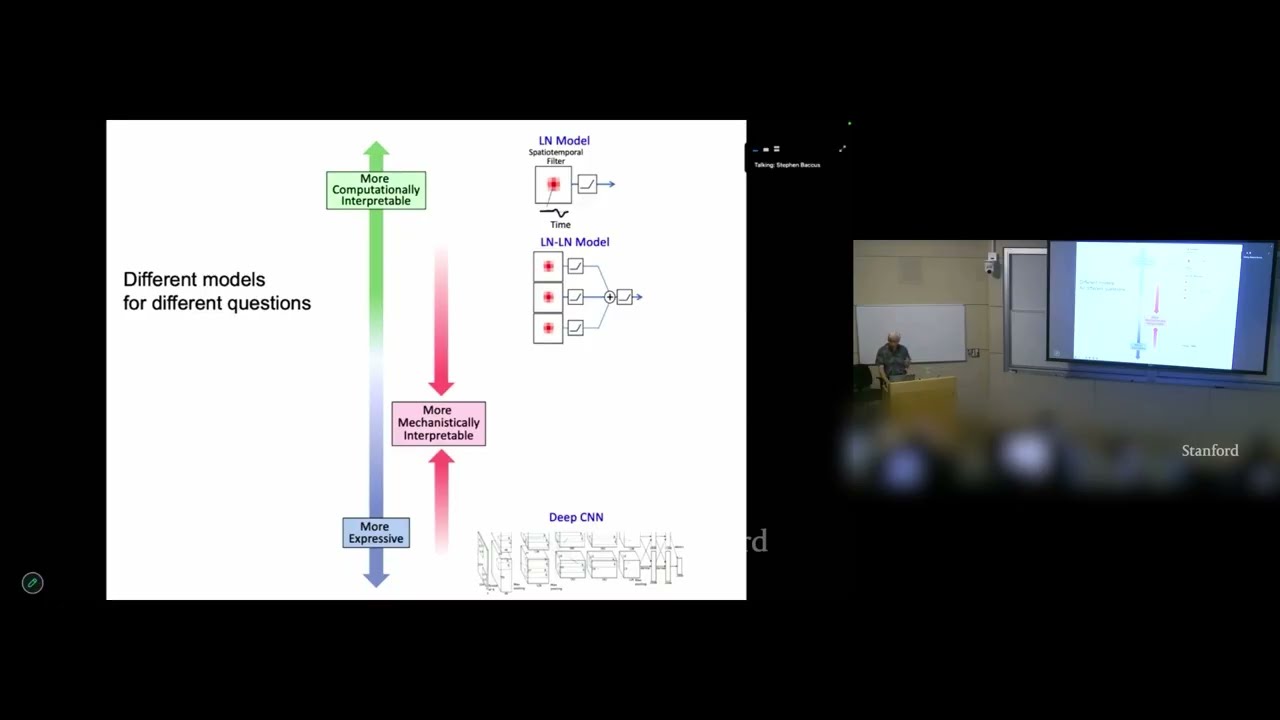
Stanford EE292R AI and Data for Science | Autumn 2026 | Models of Computation in the Retina
Keywords
Summary
240 words
Critical Evaluation
Value of the Information & Strength of the Argument
The value of the information is exceptionally high in the context of computational neuroscience and AI interpretability. The lecture demonstrates a clear, powerful pipeline: using naturalistic stimuli to build predictive models, then rigorously dissecting those models to extract biological insights. The argumentation is solid because it relies on quantitative validation: model predictions are correlated with real biological recordings, the number of cell types in the model is systematically varied to find a minimal set, and internal representations are mapped onto biologically identified cell types. The authors do not just claim the models work; they prove it by reproducing dozens of known phenomena and by making novel, testable predictions (e.g., retinal OMS cells preferring high-frequency tremor stimuli) that are subsequently confirmed. The reasoning is self-consistent, acknowledges limitations (e.g., models fail with white-noise stimulus or when simulation doesn’t include certain movement types), and adeptly bridges machine learning concepts with biological neural circuits.
Scientific Rigor, Source Quality, Title Accuracy
The scientific rigor is outstanding. The speaker presents work from his own lab and collaborations, with explicit mention of experiments, statistical scores (correlation coefficients ~0.6), and validation procedures. The lecture does not overstate claims; it explicitly notes when a phenomenon is not reproduced in certain models, reinforcing the scientific honesty. The quality of the sources is high: the lecture is part of an official Stanford course on AI for Data Science, and the direct sources cited are the Stanford program pages and the course schedule. The title/contenu adequacy is perfect; the title promises an in-depth look at models of computation in the retina, and the lecture delivers exactly that, with mathematical, biological, and experimental detail.
280 words
Title / Content Match
The title is perfectly faithful to the content: the lecture precisely addresses computational models of the retina within the 'AI and Data for Science' course framework.
Quality & Reliability
9/10
This is a high-quality academic lecture from Stanford, featuring a renowned professor in neurobiology. The content is based on published experimental work, presents exact methodological details (e.g., correlational analyses around 0.6, comparison with neural noise), and describes validated modeling approaches. The sources cited are official Stanford program pages. The rigor is characteristic of a peer-validated scientific presentation, even if the video is a single lecture rather than a full meta-analysis.
Key Moments
Markers derived by PSI from the transcript: the creator did not define chapters.
- Introduction and presentation of the lecture objectives: understanding biological systems via computational models.
- Definition of what it means to compute in the retina; the retina as an ideal system; three-layer structure and cell types.
- The classical approach using synthetic stimuli versus the new naturalistic stimulus approach; challenges of natural scenes.
- Introduction of minimal CNNs as models; mapping retinal architecture to convolutional layers; model fitting to spike trains.
- Internal model neurons are compared to real interneurons; high correlation (~0.5-0.6) proving mechanistic similarity.
- Reproduction of known phenomena (adaptation, prediction, object motion sensitivity) from natural scene training.
- Generation of new hypotheses in silico (retina vs cortex OMS cells) and subsequent experimental validation.
Cited Sources
- Course Schedule - Fall 2026 | Stanford EE292R — Official course schedule for the lecture series; confirms the institutional context and curriculum.
- Stanford Online Graduate Education — General information about Stanford's graduate programs, including the EE292R course.
Concurring Sources
- Course Schedule - Fall 2026 | Stanford EE292R — Confirms the lecture is part of a well-structured, published academic curriculum.
Contribution & Novelties
The primary novelty is the systematic demonstration that minimal CNN architectures, trained solely on naturalistic stimuli to predict retinal output, spontaneously converge to biologically realistic internal representations. This turns the network from a mere predictor into a ‘silicon circuit’ that can be probed to discover new biological mechanisms. The discovery of distinct types of Object Motion Sensitive (OMS) cells in model retina vs. model cortex, and their subsequent experimental confirmation, is a standout original contribution. The lecture also details the use of integrated gradients for cell attribution, offering a tangible method to derive biological function from neural network analysis.
Pour aller plus loin :
- Convolutional Neural Networks — Provides the foundational context of the CNN architecture employed in the modeling.
- Mechanistic Interpretability — General discussion on interpreting machine learning models, aligning with the lecture’s core theme.
- Retina — Covers the biological architecture and cell types referenced throughout the lecture.
- Neuropixels — The recording technology used for in-vivo cortical recordings, relevant to the experimental validation section.
165 words
Radar Profile
The radar profile is highly balanced with strong scores in all dimensions: Quantitative Information is high (8), while Quality and Technical Sophistication are maximally strong (9 each). Fiabilité Globale reaches 9, reflecting the institutional backing and experimental rigor. Overall, this indicates a lecture that is both highly informative and technically deep, with a solid scientific provenance.