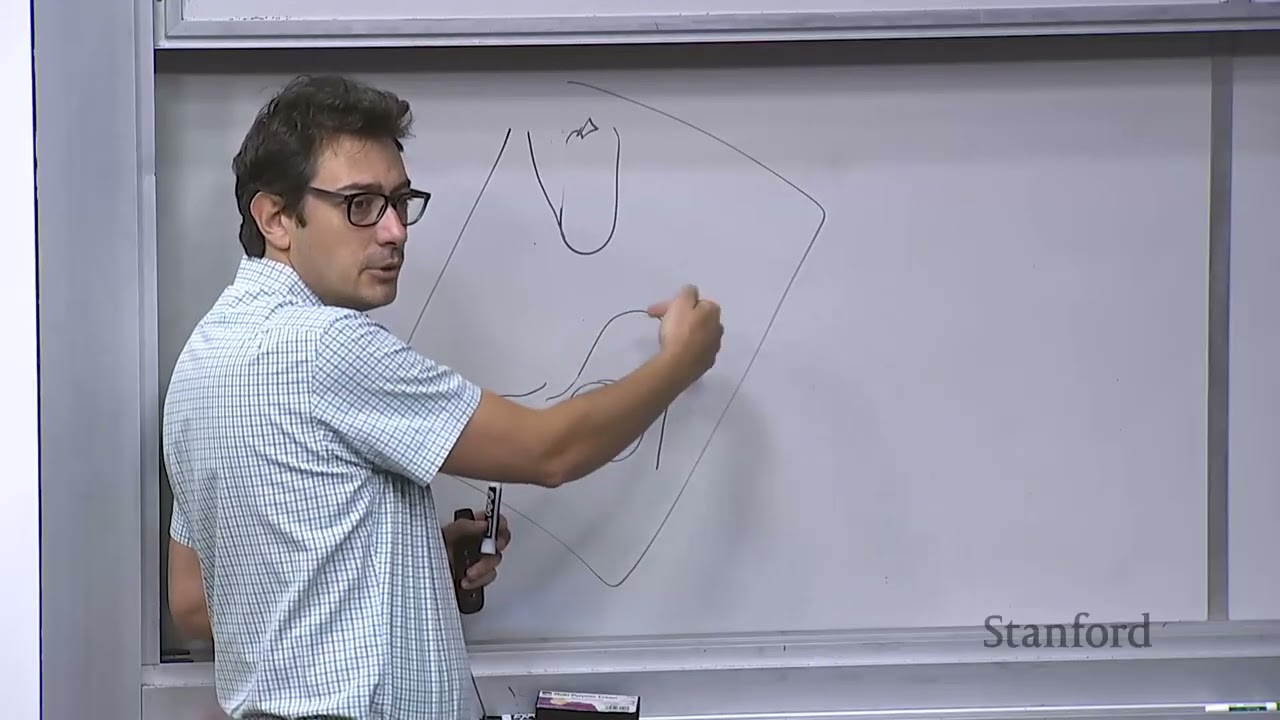
Stanford AA274A Principles of Robotic Autonomy | Autumn 2019 | Motion Planning Graph Search Methods
Keywords
Summary
147 words
Critical Evaluation
Value of the Information & Strength of the Argument
The lecture provides strong pedagogical value by clearly structuring the problem and contrasting different planning paradigms. The argumentation is rigorous: starting from a formal definition of motion planning, it builds intuition through examples and identifies key limitations. The discussion of grid-based methods highlights resolution vs. computational cost trade-offs, and the neighborhood selection example effectively demonstrates a subtle failure mode. The transition from continuous to discrete search is well-motivated, and the label-correcting algorithm is explained with step-by-step reasoning. Potential fields are evaluated for their speed and vulnerability to local minima, giving a balanced perspective. The lecturer also addresses practical considerations like obstacle inflation and map knowledge, reinforcing real-world applicability.
Scientific Rigor, Source Quality, Title Accuracy
The lecture relies on authoritative references: LaValle’s ‘Planning Algorithms’ (2006) and Bertsekas on dynamic programming, both pillars in the field. The companion textbook ‘Principles of Robot Autonomy’ is offered free online. The title accurately reflects the content—motion planning with graph search methods—and the presentation stays within that scope. The lecturer’s background (Stanford professor, NVIDIA senior director) further supports credibility. No other external sources are cited; the content is self-contained and based on established knowledge.
197 words
Title / Content Match
The title accurately describes the lecture's content: motion planning with a focus on graph search methods.
Quality & Reliability
9/10
Content is based on authoritative textbooks (LaValle, Bertsekas) and delivered by a Stanford professor. The explanations are mathematically sound and reference established algorithms. No obvious inaccuracies or unverified claims.
Key Moments
Markers derived by PSI from the transcript: the creator did not define chapters.
- Introduction to the lecture and difficulty assessment of course.
- Definition of motion planning and application examples.
- Historical overview and complexity of exact algorithms.
- Potential field approach and its local minima issue.
- Grid-based discretization and graph construction.
- Explanation of label-correcting algorithms and cost-to-arrive.
- Discussion on neighborhood selection and resolution trade-offs.
Cited Sources
- Stanford Graduate Education — Description link for Stanford graduate programs.
- Principles of Robot Autonomy (Companion Textbook) — Free online textbook referenced as companion to the course.
- PoRA-I Course Schedule — Latest course syllabus and schedule.
- Full Playlist: Principles of Robotic Autonomy — Playlist containing all lectures of the course.
Concurring Sources
- Planning Algorithms (LaValle) — Referenced in the lecture as a main reference for motion planning.
Contribution & Novelties
This lecture offers a clear and accessible exposition of classical motion planning methods, particularly grid-based and graph search algorithms, with a rigorous academic perspective. It bridges theoretical foundations and practical application, illustrated with examples from Mars rovers and autonomous vehicles. The pedagogical approach of progressively introducing complexity—from potential fields to combinatorial planning—provides a solid mental model for students and practitioners.
Pour aller plus loin :
- A* search algorithm — Fundamental graph search algorithm widely used in motion planning.
- Dijkstra’s algorithm — The basis for many graph-based planners discussed in the lecture.
- Motion planning — General concept and overview of methods in robotics.
102 words
Radar Profile
The radar profile shows high scores in information quantity, quality, and reliability, with a moderately high technical level, indicating a comprehensive and authoritative lecture that is technically demanding but well-explained.