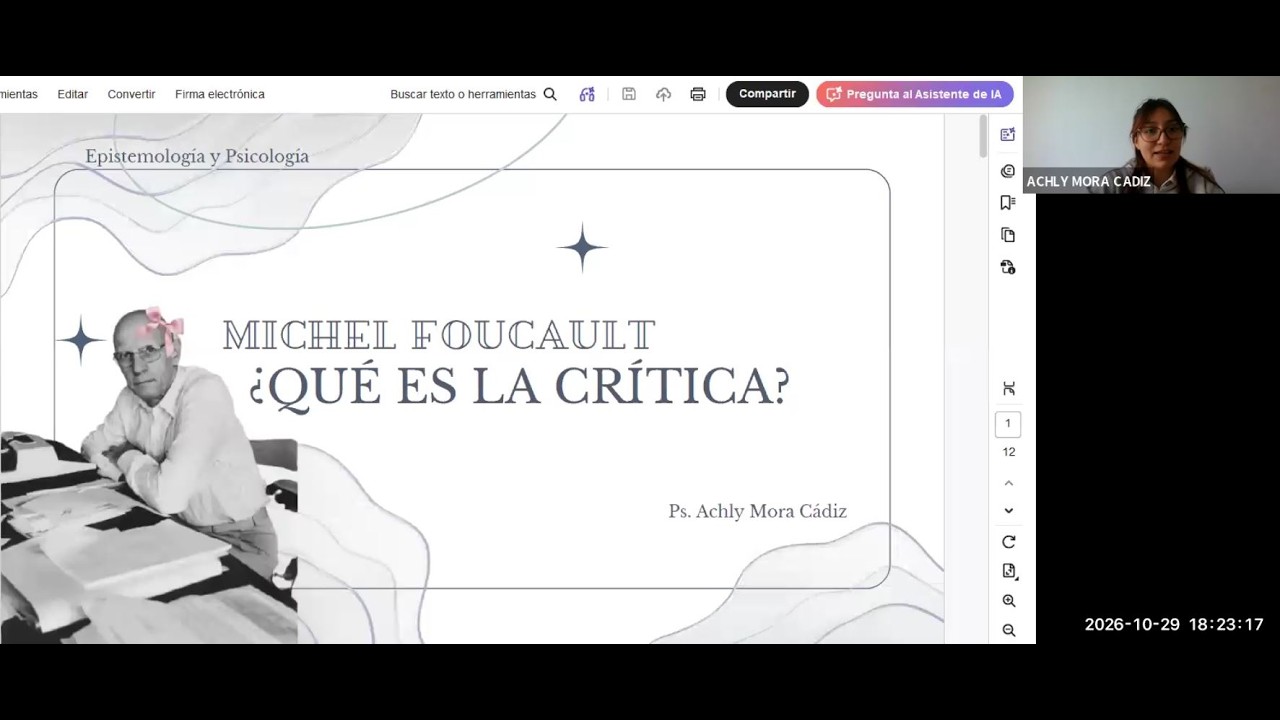
MICHEL FOUCAULT - ¿QUÉ ES LA CRÍTICA? | EPISTEMOLOGÍA CRÍTICA
MICHEL FOUCAULT - WHAT IS CRITIQUE? | CRITICAL EPISTEMOLOGY
Title history
- MICHEL FOUCAULT - ¿QUÉ ES LA CRÍTICA? | EPISTEMOLOGÍA CRÍTICA — observed on 20261101-0213 UTC (YouTube)
Keywords
Summary
203 words
Critical Evaluation
Value of the Information & Strength of the Argument
The video provides a clear and structured exposition of Foucault’s dense philosophical text, making it accessible to students without oversimplifying the core ideas. The argumentation is solid: the speaker traces the development of critique historically and logically, and uses concrete examples (e.g., Nazi rise to power, Luther’s reform) to illustrate abstract concepts. She also builds a bridge to contemporary psychology, which enhances the relevance. However, the analysis is primarily descriptive; the speaker rarely engages critically with the text or offers counterarguments, and she sometimes conflates her own commentary with Foucault’s original points. The argumentation would be stronger if it distinguished exegesis from personal interpretation, but overall it is coherent and grounded in the source material.
Scientific Rigor, Source Quality, Title Accuracy
The video is based directly on Foucault’s original lecture, which she explicitly names and dates. It also references Kant’s ‘Answering the Question: What is Enlightenment?’ and touches on Marx’s concept of false consciousness. The speaker accurately reports Foucault’s key ideas, and although she does not cite page numbers or external academic works, she stays close to the primary source. The title faithfully matches the content, as the video is indeed about Foucault’s conception of critique. The presentation is rigorous in its overall structure, but some inaccuracies—such as the misspelling of ‘Henri Gouhier’ and a few tangential digressions—slightly reduce the precision. Sources are primarily the original texts, and no supplementary academic sources are provided.
243 words
Title / Content Match
The title accurately reflects the content: it explicitly announces Foucault's concept of critique within the framework of critical epistemology, and the video indeed covers that topic.
Quality & Reliability
7/10
The video is a faithful, systematic explanation of Foucault's 1978 lecture 'What is Critique?', drawing on primary text and historical context. It is structured and pedagogically effective, though it contains minor simplifications and some informal digressions. The speaker communicates clearly but does not always distinguish her own interpretations from Foucault's original arguments, and occasional factual slips (e.g., mispronouncing names) do not affect substance.
Key Moments
Markers derived by PSI from the transcript: the creator did not define chapters.
- Introduction: presenter introduces herself and the topic (Foucault's 'What is Critique?'), provides biographical context.
- Defines critique as an attitude, emerging in 15th–16th centuries, against epochal transformation of power.
- Discusses historical origin of governmentality via Christian pastoral power and medieval feudal structure.
- Explains the first anchor: critique against religious authority, including return to scripture and Lutheran reform.
- Second anchor: critique against law, refusal of unjust laws, appeal to inalienable rights (social contract).
- Third anchor: critique against scientific authority, refusal to accept truth solely because of authority.
- Introduction of 'art of voluntary inservitude' and 'reflective indocility' as essence of critique.
- Connection to Kant's 'What is Enlightenment?' and the concept of minority; discussion of public/private use of reason.
- Analysis of Foucault's suspicion of reason, link to Enlightenment excesses, and historical examples of fascism and Stalinism.
- Relevance to psychology: psychologists must question power–truth discourse, and the importance of problematization.
Cited Sources
- Michel Foucault – 'Qu'est-ce que la critique?' (1978) — The primary text discussed in the video.
- Immanuel Kant – 'Answering the Question: What is Enlightenment?' (1784) — Comparison of Foucault's critique with Kant's concept of enlightenment and minority.
- Michel Foucault – 'Surveiller et punir' (1975) — Mentioned in relation to power asymmetry and panopticism.
Contribution & Novelties
The video offers an accessible yet faithful introduction to Foucault’s notion of critique, emphasizing its historical emergence and its relevance to contemporary psychology. It synthesizes complex ideas without oversimplifying, and connects them to modern issues like inclusion in schools and the role of psychologists. The novelty lies in the pedagogical approach that integrates visual aids and real-life examples, making a challenging philosophical text digestible.
Pour aller plus loin :
- Governmentality — A core concept in Foucault’s lecture, essential for understanding modern power.
- Panopticon — Foucault’s metaphor for disciplinary power, discussed in ‘Discipline and Punish’.
- Critical theory — A broader intellectual tradition that builds on Kant and Foucault, relevant to the theme of critique.
- Biopolitics — Related to Foucault’s later work and the governance of populations, touched upon in the video’s historical examples.
132 words
Radar Profile
The profile shows high quantity (8) and moderate quality (7) and reliability (6), indicating a content-rich video with good educational value but some interpretative liberties. The technical level (6) suggests it is accessible to a broad audience while retaining intellectual depth.