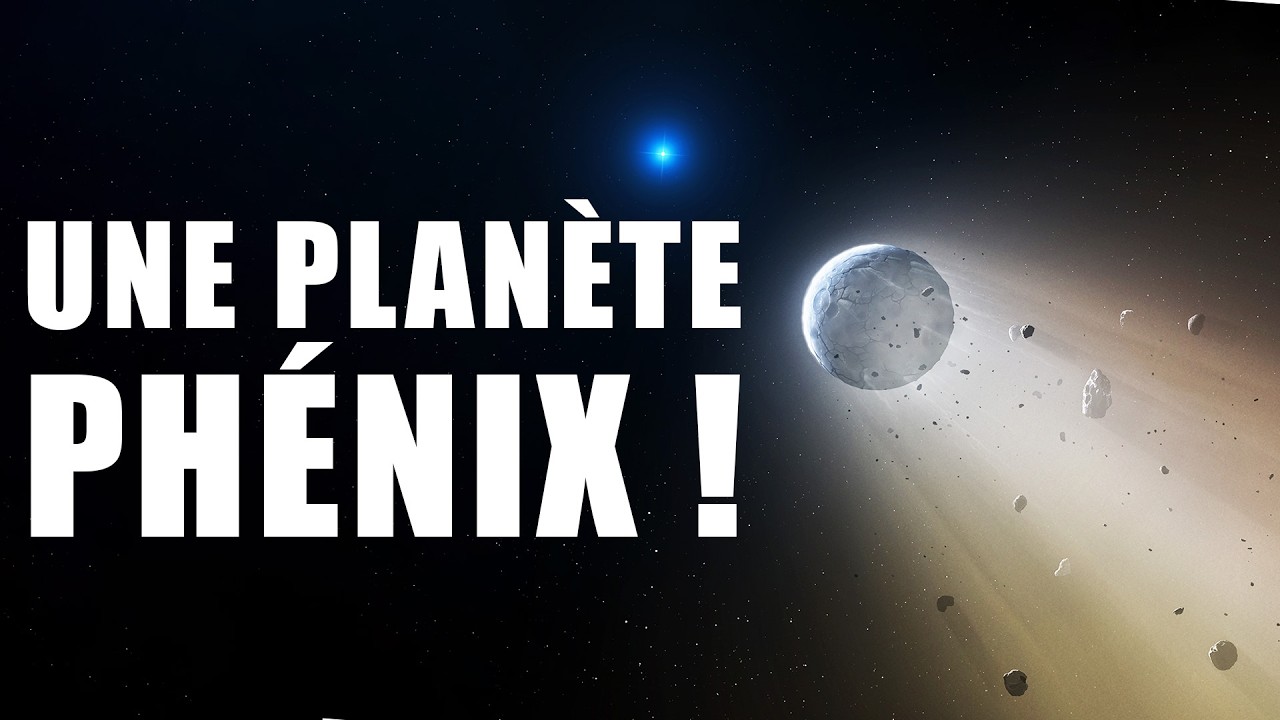
Incroyable, une planète naît des cendres de son étoile ! DNDE
Incredible, a planet is born from the ashes of its star! DNDE
Keywords
Summary
154 words
Critical Evaluation
Value of the Information & Strength of the Argument
The video provides significant value by synthesizing multiple recent space developments into a coherent narrative. The planetary discovery is well-explained, with a clear chain of evidence: the unexplained spectral lines in Hubble data, the identification of niobium, and the TESS periodic signal. The argumentation is cautious, explicitly noting this scenario is ’to be confirmed’ and presenting it as a convergence of clues. The other segments are factually reported with appropriate context, such as the economic challenges facing commercial space stations. The discussion of HyPrSpace’s hybrid propulsion includes technical rationale, though it does not delve into all engineering complexities. Overall, the reasoning is sound and accessible, though the planet interpretation is inherently speculative at this stage.
Scientific Rigor, Source Quality, Title Accuracy
The video demonstrates strong scientific rigor by citing a peer-reviewed Nature paper, an official NASA press release, a technical abstract from the IAF, and a reputable space news outlet (La Chronique Spatiale). These sources are directly relevant to each claim. The title accurately reflects the most newsworthy story while the DNDE branding conveys the news summary format. The content stays faithful to the sources without exaggeration, and the presenter distinguishes between confirmed results and hypotheses. The inclusion of the sponsor segment is clearly separated from editorial content, and the sponsor (Saily) is not mentioned in the analysis per instructions.
229 words
Title / Content Match
The title highlights the most striking story (the second-generation planet) which is indeed the lead segment, while the DNDE acronym indicates a news format; fully appropriate.
Quality & Reliability
8/10
The video cites peer-reviewed research (Nature), official NASA releases, and recent industry announcements, providing high credibility. The reporting includes appropriate caveats about the planetary interpretation and distinguishes confirmed facts from hypotheses.
Key Moments
Markers derived by PSI from the transcript: the creator did not define chapters.
- Introduction to the planet discovery: Hubble observation of white dwarf HS 0509+0832 in 1999
- Presentation of the new analysis: identification of niobium and other heavy elements as evidence of a second-generation planet
- Explanation of the TESS periodic signal and the proposed planet's characteristics
- NASA's request for proposals for commercial space stations to succeed the ISS
- The Exploration Company's ONEIROS lunar lander and its planned desert tests in UAE
- HyPrSpace inaugurates La Boulangerie, its production plant for Baguette One and Obi One rockets
Cited Sources
- A possible second-generation planet around a white dwarf (Nature) — Peer-reviewed article reporting the chemical signatures and TESS observations supporting the planet's existence.
- NASA Seeks US Industry Plans for Commercial Space Stations — Official NASA press release announcing the final request for proposals for the post-ISS era.
- ONEIROS – The Exploration Company's Lunar Demonstrator (IAF paper) — Technical paper detailing the ONEIROS mission and its objectives.
- HyPrSpace ouvre sa Boulangerie (La Chronique Spatiale) — Article covering the inauguration of HyPrSpace's production facility and its milestone.
External References
Contribution & Novelties
The video effectively synthesizes recent space news, giving particular emphasis to the fascinating possibility of second-generation planets around white dwarfs. This concept is original in that it suggests planetary formation can occur after a star’s death, with a unique chemistry enriched in heavy elements. The video also contextualizes NASA’s transition to commercial space stations, a pivotal shift in low Earth orbit operations, and highlights European private initiatives in lunar landers and hybrid rocketry. Its contribution lies in making these cutting-edge developments accessible while preserving scientific nuance.
Pour aller plus loin :
- White dwarf — Essential background on the stellar remnant in question.
- TESS — The telescope that detected the periodic signal attributed to the candidate planet.
- Commercial Low Earth Orbit Destinations — NASA’s program for the post-ISS commercial stations.
- Hybrid rocket — Explains the propulsion architecture used by HyPrSpace.
139 words
Radar Profile
The radar profile shows a balanced video with strong scores in quantity and quality of information, reflecting the synthesis of multiple well-sourced stories. The technical level is moderate, suitable for a general audience while retaining depth. The overall fiability is high, consistent with the reliance on authoritative sources.