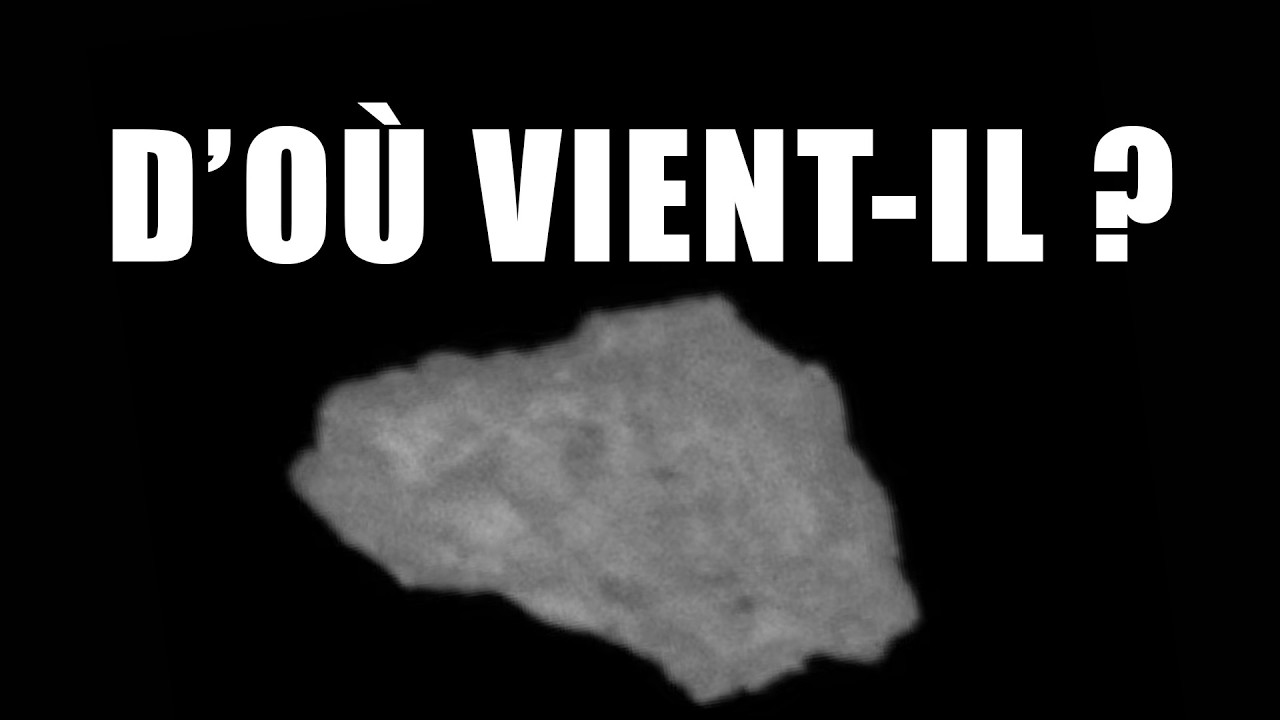
Ce caillou suit la Terre depuis 100 ans… et personne ne sait D’OÙ il vient !
COMA dossier
Title history
- Ce caillou suit la Terre depuis 100 ans… et personne ne sait D’OÙ il vient ! — observed on 20261105-1852 UTC (YouTube)
Keywords
Summary
172 words
Critical Evaluation
Value of the Information & Strength of the Argument
The video provides a well-structured narrative, clearly explaining the history of observations and the competing hypotheses. It presents scientific results with appropriate caveats, emphasizing that no conclusion is definitive yet. The presenter effectively uses analogies and diagrams to make complex orbital mechanics accessible. The argumentation is balanced, showing both the lunar fragment hypothesis and the main-belt asteroid alternative without endorsing either prematurely. The discussion of the upcoming sample return mission adds a forward-looking perspective and highlights why the debate matters.
Scientific Rigor, Source Quality, Title Accuracy
The video cites several peer-reviewed papers and credible news sources (arXiv, Nature Communications, University of Arizona, Sky & Telescope, SpaceNews), all listed in the description. It distinguishes between confirmed facts, such as the asteroid’s orbit and rotation, and speculative interpretations of spectral data. The title is engaging but accurately reflects the mystery surrounding Kamoʻoalewa’s origin. No promotional content is present; the video is a straightforward science communication piece.
163 words
Title / Content Match
The title accurately reflects the content: Kamoʻoalewa has been a quasi-companion for nearly a century, and its origin remains debated.
Quality & Reliability
8/10
The video relies on recent peer-reviewed studies and mission reports, all referenced in the description. The presenter clearly distinguishes established facts from hypotheses and presents competing theories without bias.
Key Moments
Markers derived by PSI from the transcript: the creator did not define chapters.
- Introduction to Kamoʻoalewa and its mysterious nature
- Explanation of quasi-satellite orbits and Earth's orbital companions
- Discovery in 2016 and initial classification as a geocentric object
- 2021 spectroscopic analysis suggesting lunar surface composition
- Hypothesis linking Kamoʻoalewa to the Giordano Bruno crater ejecta
- 2026 conflicting studies and the role of JWST observations
- Introduction of the Tianwen-2 mission and its sampling methods
Cited Sources
- arXiv:2111.06372 - Spectroscopic identification of lunar origin for near-Earth asteroid Kamoʻoalewa — Original 2021 study suggesting a lunar origin based on spectral match with the Moon.
- The Astrophysical Journal Letters - 10.3847/2041-8213/aea6b6 — 2024 paper on impact simulations linking Kamoʻoalewa to the Giordano Bruno crater.
- University of Arizona News - Near-Earth asteroid was blasted from a crater on the Moon, study finds — Press release summarizing the 2024 crater formation hypothesis.
- Sky & Telescope - Tianwen-2 Arrives at Quasi-Moon Kamoʻoalewa, Returns Images — News coverage of the Tianwen-2 mission's arrival and the first images.
- SpaceNews - Tianwen-2 arrives at asteroid Kamoʻoalewa, first image revealed — Space industry news report on the mission's status.
- Nature Communications - 10.1038/s41467-026-73284-w — 2026 article presenting alternative spectral interpretations, possibly the LL-chondrite hypothesis.
Concurring Sources
- arXiv:2111.06372 — Supports the lunar origin hypothesis.
- University of Arizona News article — Corroborates the Giordano Bruno crater link.
- Sky & Telescope and SpaceNews reports — Confirm the mission status and observations.
Contribution & Novelties
The video synthesizes the latest developments up to 2026, including the arrival of Tianwen-2 and the recent contradictory spectral analyses. It offers a clear, up-to-date account of the ongoing scientific investigation into Kamoʻoalewa’s origin, making it valuable for viewers seeking a concise but detailed overview.
Pour aller plus loin :
- Kamoʻoalewa — Provides general facts and orbital parameters.
- Quasi-satellite — Explains the concept of quasi-satellites relevant to Earth’s companions.
- Tianwen-2 — Details on the Chinese sample-return mission.
- Giordano Bruno (crater) — Description of the proposed lunar source crater.
88 words
Radar Profile
The radar shows a balanced profile, with high scores in information quality and reliability, moderate technical level, and slightly lower quantitative breadth, reflecting its concise duration and focus on a specific topic.