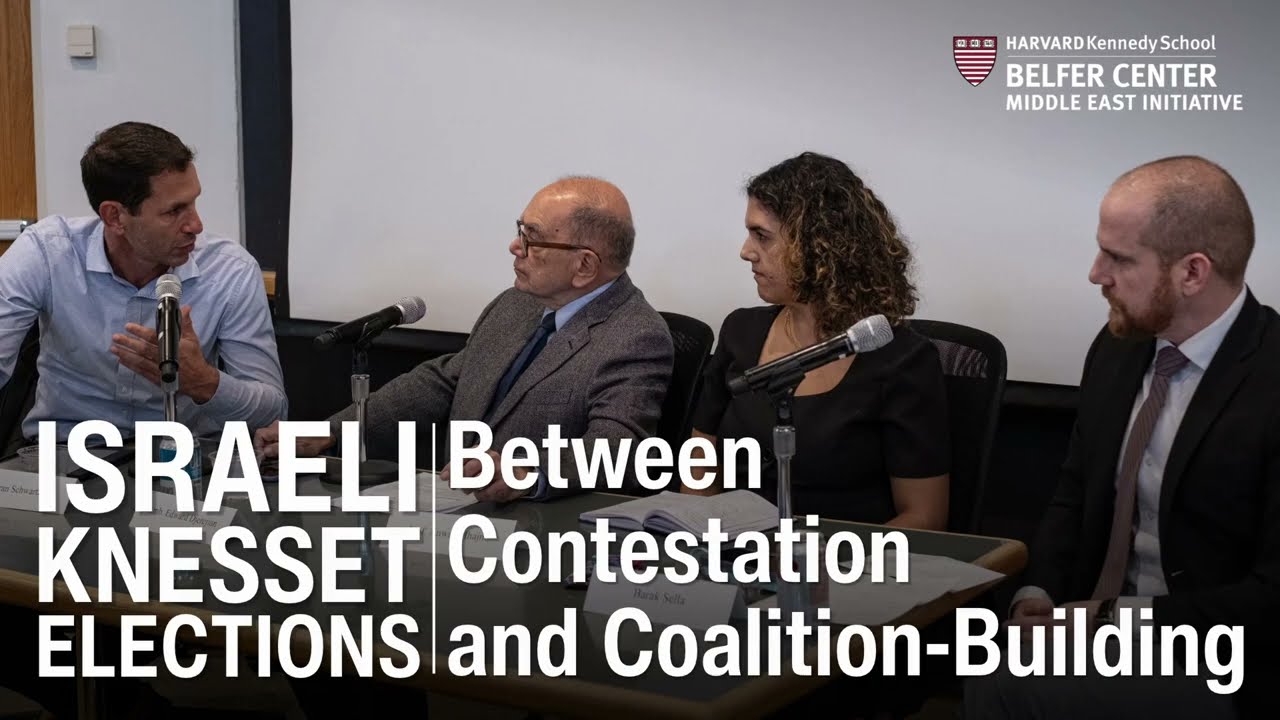
2026 Israeli Knesset Elections: Between Contestation and Coalition-Building
Keywords
Summary
200 words
Critical Evaluation
Value of the Information & Strength of the Argument
The value of the information lies in its expert, multi-perspective analysis. The panelists bring complementary viewpoints: Schwartz, a pro-democracy activist and former CEO of Democracy Headquarters, offers insights from inside the protest movement; Sella provides a demographic and religious identity framework; Mhajne adds the perspective of the Arab/Palestinian minority in Israel, emphasizing surveillance, violence, and discrimination. Their arguments are supported by references to recent polls (e.g., IDI), demographic data, and concrete policy changes such as home demolitions and the draft bill. The discussion is well-structured, moving from broad questions to specific coalition mechanics, and incorporates audience Q&A. However, some positions are explicitly value-driven (e.g., Schwartz’s criticism of Netanyahu), which, while transparent, slightly reduces objectivity. Nevertheless, the panel’s collective expertise and the depth of contextual analysis make the information highly valuable.
Scientific Rigor, Source Quality, Title Accuracy
The rigor is high, as the panel relies on up-to-date polling, demographic statistics, and concrete examples. The sources explicitly mentioned include the Israel Democracy Institute (IDI) and organizations like FakeReporter and the Israel Internet Society, though these are referenced without formal citations. The video’s own description links to the Belfer Center event page and newsletter, providing a direct avenue for verifying the event’s legitimacy. The title is an accurate descriptor of the content: it focuses on both the contestation within Israeli society and the coalition-building process, which is central to the discussion. There is no evidence of misinformation or unsubstantiated claims; the panelists qualify their statements and acknowledge uncertainties. Overall, the source quality and argumentation adhere to academic standards.
264 words
Title / Content Match
The title accurately captures the two central themes of the discussion: the contentious nature of the election and the coalition-building that will follow. The panel explores both contestation over Netanyahu's legacy and the practical strategies of forming a government.
Quality & Reliability
8/10
The panel comprises credible academics and former officials with direct expertise in Israeli politics, coalition dynamics, and security. Their analysis is nuanced, based on current polling and events, and avoids sensationalism. The discussion is balanced but not purely objective, as some panelists express clear political preferences, yet this is transparent and grounded in demonstrated expertise.
Chapters
- Introductions
- How Consequential Are These Elections?
- Are the Elections About October 7th or Something Else?
- How Do Israelis Feel About Security and Foreign Policy?
- Is There Hope for Peace and Regional Integration?
- What is the Role of the United States in the Election?
- Q&A: Eisenkot's Coalition Options
- Q&A: October 7th and Netanyahu's Legacy
- Q&A: Growing Far-Right Movements
- Q&A: Religion & Identity Politics
- Q&A: Israel's Global Standing
- Q&A: Possibility of a Eisenkot-Netanyahu Coalition
- Q&A: Post-Netanyahu Israel
Cited Sources
- 2026 Israeli Knesset Elections: Between Contestation and Coalition-Building (Event Page) — Official event page with further details about the panel and speakers.
- Middle East Initiative Newsletter Subscription — Mentioned for viewers to stay updated on MEI research and events.
Contribution & Novelties
The panel provides a real-time, expert analysis of the 2026 Israeli elections, capturing the distinct narratives of different societal groups and the strategic challenges of coalition-building. It uniquely highlights the role of Arab parties in the coalition equation and the demographic and religious shifts reshaping Israeli politics. The discussion goes beyond surface-level security concerns to explore deeper issues of social contract, identity, and minority rights.
Pour aller plus loin :
- Coalition government in Israel — Explains the proportional representation and coalition dynamics crucial to understanding the Knesset.
- October 7 attacks — Background on the event that profoundly influences the election’s discourse.
- Israel Democracy Institute — The source of the poll cited in the discussion, providing empirical data on voter attitudes.
- Benny Gantz and Gadi Eisenkot — Though specific to individuals, this context helps understand opposition figures.
136 words
Radar Profile
The radar profile shows a well-rounded panel: high on information quality and reliability, slightly lower on technical complexity (since it is accessible to a general audience) and moderate on novelty, as the themes are current but familiar to followers of Israeli politics. The strength lies in the balanced expert perspectives.