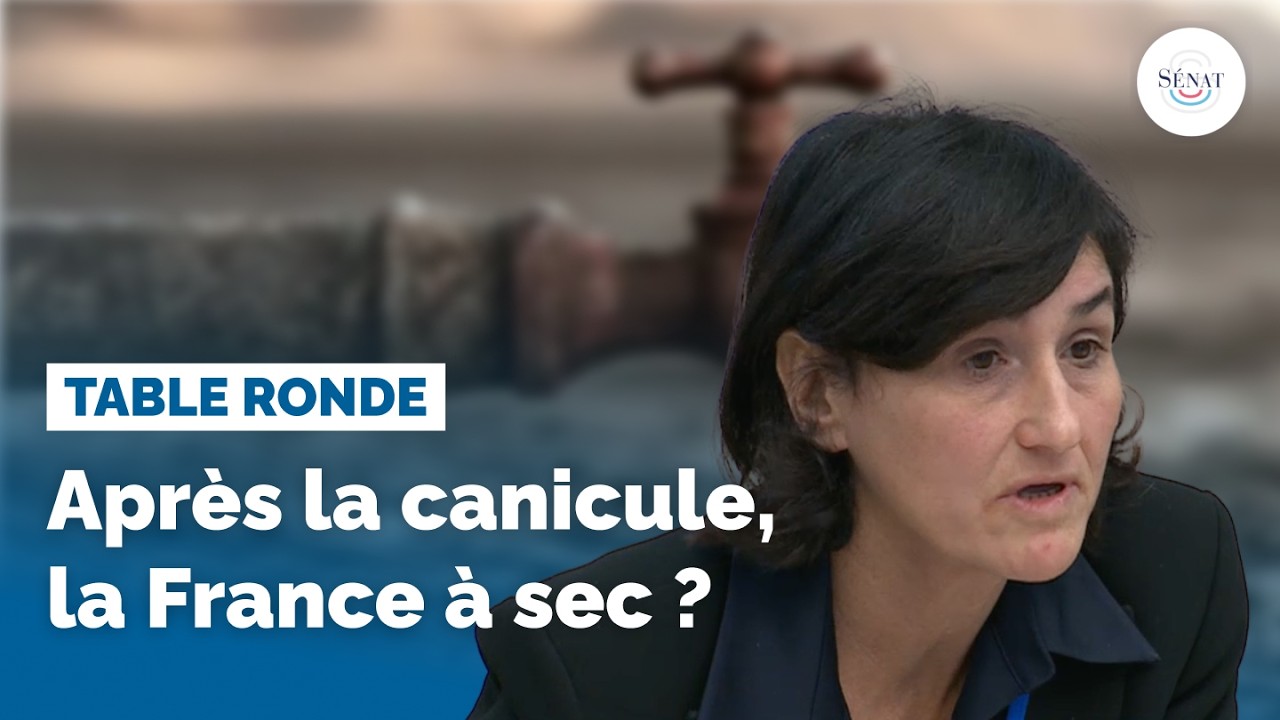
Après la canicule, la France à sec ?
After the heatwave, is France dry?
Keywords
Summary
174 words
Critical Evaluation
Value of the Information & Strength of the Argument
The information provided is of high value: it combines robust scientific data (IPCC, BRGM observatories, Météo-France) with concrete field feedback from local authorities. Each expert offers a clear, well-structured argument, supported by quantitative data. The presentation is rigorous, with a clear distinction between observed facts, model projections and their uncertainties. The discussion is balanced, recognising both the need to anticipate and the technical limits of forecasting. The argumentation is coherent and underlines an urgent need for action, while remaining scientifically cautious.
Scientific Rigor, Source Quality, Title Accuracy
The scientific rigour is exemplary: references to IPCC reports, modelling projects (Explore 2), and data from national agencies are cited. The speakers are recognised experts in their fields. The title accurately reflects the content. The discussion between senators and experts enriches the analysis without compromising its accuracy. No advertising or promotional content appears, only the institutional context of the Senate.
156 words
Title / Content Match
The title perfectly matches the content: a round table questioning the state of water resources after the summer heatwave, exactly as announced.
Quality & Reliability
9/10
Interventions of high-profile scientists (climatologist from CNRM, water director of BRGM, representative of Amorce) based on institutional data (GIEC, Météo-France, BRGM, Explore 2). The speech is precise and well-sourced, with a clear scientific consensus.
Key Moments
Markers derived by PSI from the transcript: the creator did not define chapters.
- Introduction by the Senate commission president, recalling the heatwave record and the context of the round table.
- Hervé Douville presents the types of droughts and the evolution of soil moisture according to IPCC projections.
- Ariane Blum details the state of groundwater level, with 66% of points below normal and a late recharge.
- Nicolas Garnier highlights consequences for local authorities, including supply interruptions affecting 100,000 inhabitants.
- Discussion on the Loire Forez situation and questions from senators about adaptation measures.
Cited Sources
- IPCC AR6 Working Group I report — Mentioned by Hervé Douville about the water cycle chapter and observed drying trends.
- Explore 2 project — Cited for hydrological projections of low-water flows in France.
- BRGM groundwater bulletins — Used by Ariane Blum to illustrate aquifer levels.
Contribution & Novelties
This round table provides an original, multi-scale synthesis of the water crisis in France after the 2026 heatwave, combining climatology, hydrogeology, and local territorial feedback. It highlights the unprecedented early onset of drought and the failure of the normal autumn recharge, data not widely accessible to the public. The discussion offers operational insights for public policy, emphasising sobriety and anticipatory governance.
Pour aller plus loin :
- Water cycle - Wikipedia — Fundamental concept explaining the interconnectedness of water reservoirs.
- Drought - Wikipedia — General overview of drought types and impacts.
- IPCC AR6 WG1 — Primary source for climate projections and observed changes.
- Explore 2 INRAE — Key French research project on future river flows.
114 words
Radar Profile
The radar profile shows very high scores in information quantity, quality, technical level, and reliability, reflecting a dense, well-sourced, and expert-led debate with no major weaknesses. The only slight relative weakness is the technical level, which remains high but assumes some scientific background.