IvS Seminar: Lara Delbroek (05/11/2026)
Title history
- IvS Seminar: Lara Delbroek (05/11/2026) — observed on 20261106-1037 UTC (YouTube)
Keywords
Summary
153 words
Critical Evaluation
Value of the Information & Strength of the Argument
The research addresses a critical limitation of traditional 1D models by providing a 3D framework for computing observables. The value lies in its potential to improve the interpretation of spectral line broadening, macroturbulence, and stellar rotation. The argumentation is logical and methodical, supported by simulation results and comparisons with observations. The speaker clearly explains the rationale for each step and discusses limitations, such as the inability to constrain V sin I and V macro simultaneously. The preliminary results, including the variability of line profiles between snapshot and mixed sphere models, are well presented. Overall, the argumentation is solid, though the work is recognized as incomplete.
Scientific Rigor, Source Quality, Title Accuracy
The scientific rigor is high: the talk uses established equations (radiative transfer, conservation of angular momentum) and well-known codes like Fastwind as a benchmark. However, no explicit citations to literature are provided, and the presentation relies on the group’s own simulations and standard methods. This is typical for seminar talks, but it limits the verifiability. The title is generic and does not convey the topic, but it is a seminar announcement and does not mislead. The content matches the expected scope of an astronomy seminar.
205 words
Title / Content Match
The title is generic and does not indicate the topic, but it is typical for a seminar announcement. It provides no misleading information, and the content is as expected from a seminar.
Quality & Reliability
7/10
The seminar presents ongoing research with a clear methodology and preliminary results. The speaker is a PhD student in the field, and the work is based on established simulation and radiative transfer techniques. However, no explicit citations to external publications are given, and some results are acknowledged as work in progress, which slightly reduces the reliability score.
Key Moments
Markers derived by PSI from the transcript: the creator did not define chapters.
- Introduction: motivation for 3D radiative transfer in massive star atmospheres.
- Explanation of the iron bump and its role in creating turbulent wind structures.
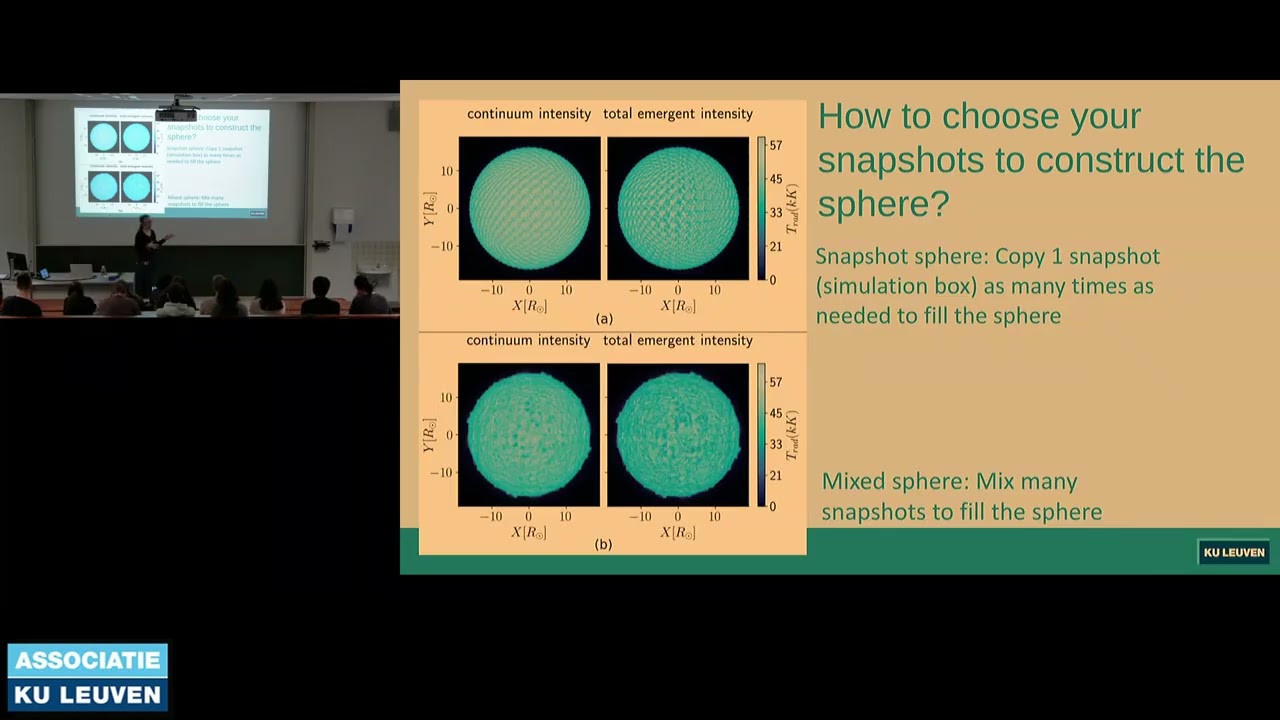
- Construction of spherical models by stacking snapshots: snapshot vs mixed sphere approaches.
- Calculation of source functions and opacities using LTE, approximate NLTE, and scattering approaches.
- Results on micro and macro turbulence from mock observations using 1D analysis tools.
- Implementation of scattering, line blocking, and blanketing with a multi-group method.
Contribution & Novelties
STARFRUIT provides a novel 3D radiative transfer pipeline that connects multidimensional RHD simulations to synthetic observables, incorporating scattering, approximate NLTE effects, and line blocking in a fully 3D framework. Its contribution lies in enabling direct comparison with observations and highlighting the limitations of traditional 1D analyses for massive stars.
Pour aller plus loin :
- Radiative transfer — General background on the physical principles used in the code.
- Stellar atmosphere — Context for the model atmospheres discussed.
- Massive star — Overview of the objects studied, including their structure and evolution.
- Stellar wind — Relevant to the wind-launching region and line-driven flows.
100 words
Radar Profile
The profile shows high technical level and good information quantity, with slightly lower reliability reflecting the preliminary nature of the work. The scores align with a complex technical seminar that is informative but not yet fully peer-reviewed.