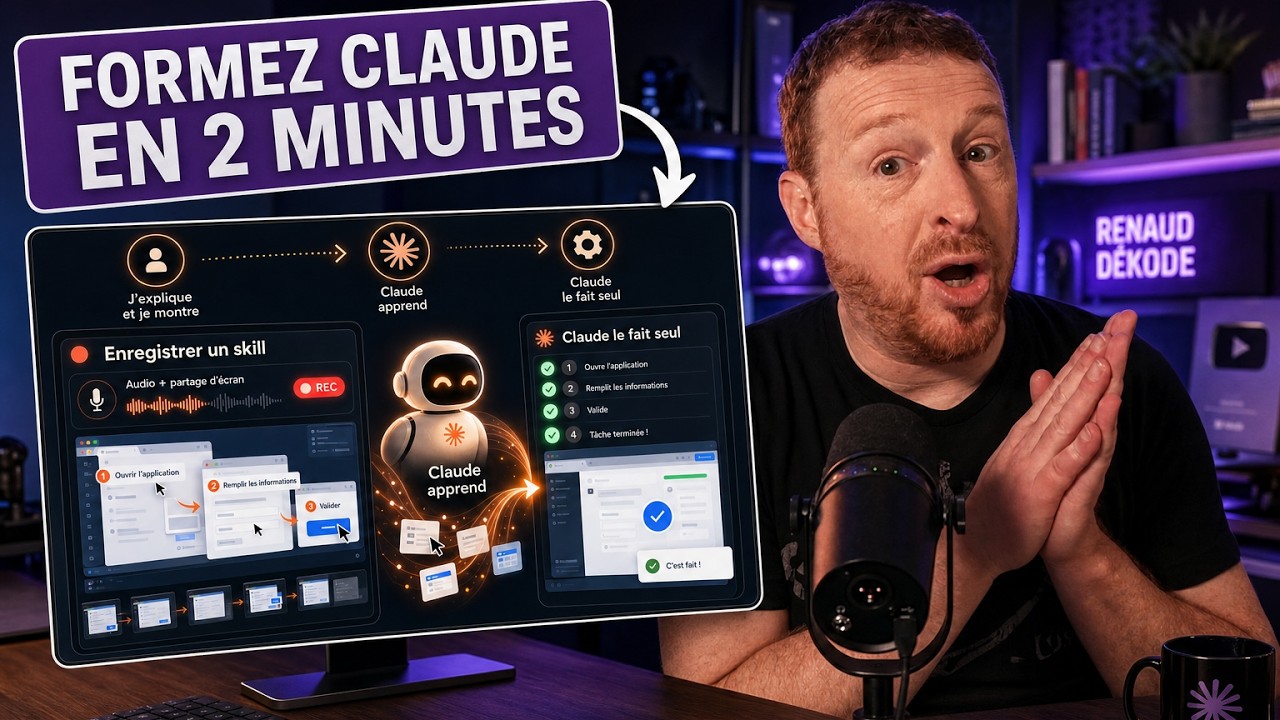
Claude apprend en vous regardant : formez le en 2 minutes !
Claude learns by watching you: train it in 2 minutes!
Keywords
Summary
169 words
Critical Evaluation
Value of the Information & Strength of the Argument
The value of this video lies in its practical, step-by-step demonstration of a feature that lowers the barrier to creating AI skills for non-programmers. The argumentation is coherent: the host clearly explains why recording a task is superior to manually writing a skill definition, and he supports his point by showing the entire process from recording to execution. He also anticipates potential pitfalls, such as Claude’s interpretation of screen elements and the importance of explaining the ‘why’ behind actions. The reasoning is solid for a tutorial, though it would benefit from more technical depth and references to official documentation.
Scientific Rigor, Source Quality, Title Accuracy
The video is methodical in its demonstration, but it does not cite any external scientific sources or technical references beyond the links in the description (which are community-facing). The title is fully accurate: the content indeed shows how to train Claude in about two minutes. However, the lack of external verification or discussion of limitations slightly reduces scientific rigor. The video is a practical guide rather than an analytical study, which is appropriate for its purpose.
190 words
Title / Content Match
The title accurately reflects the content: the video demonstrates how to teach Claude a task by showing it on screen, and the process is quick (around 2 minutes).
Quality & Reliability
7/10
The video provides a clear, practical demonstration of a novel feature, with thorough explanation of the process. However, it lacks external references or verification of the technical claims, and relies on a single live demonstration.
Key Moments
Markers derived by PSI from the transcript: the creator did not define chapters.
- Introduction to the feature and overview of the tutorial
- Accessing the 'Record a skill' feature in the Claude desktop app
- Starting the screen recording and explaining the task (YouTube comments analysis)
- Claude finishes recording and generates the skill; explanation of what Claude captured
- Running the newly created skill and observing Claude autonomously navigating YouTube Studio
Cited Sources
- Renaud Dékode website — Community website and resource hub for the channel
- Klub subscription — Paid membership offering additional tutorials and community support
Contribution & Novelties
The video introduces a practical method for non-programmers to create AI skills by demonstrating the task, rather than writing code. This is a significant innovation in user experience, as it reduces the learning curve and makes AI customization accessible. The demonstration is concrete and reproducible, though it lacks a discussion of potential limitations or edge cases. The technique is particularly useful for automating repetitive digital workflows.
Pour aller plus loin :
- Prompt engineering — Core concept behind instructing AI models effectively.
- Intelligent agent — Theoretical background on autonomous systems that act on behalf of users.
- Model Context Protocol — Official protocol for connecting AI models to external tools, relevant to Claude’s skill architecture.
113 words
Radar Profile
The profile is balanced, with slightly higher quality of information and reliability compared to quantity and technical depth. The video excels in practical usability but lacks theoretical grounding and multiple sources, resulting in a moderate overall score.