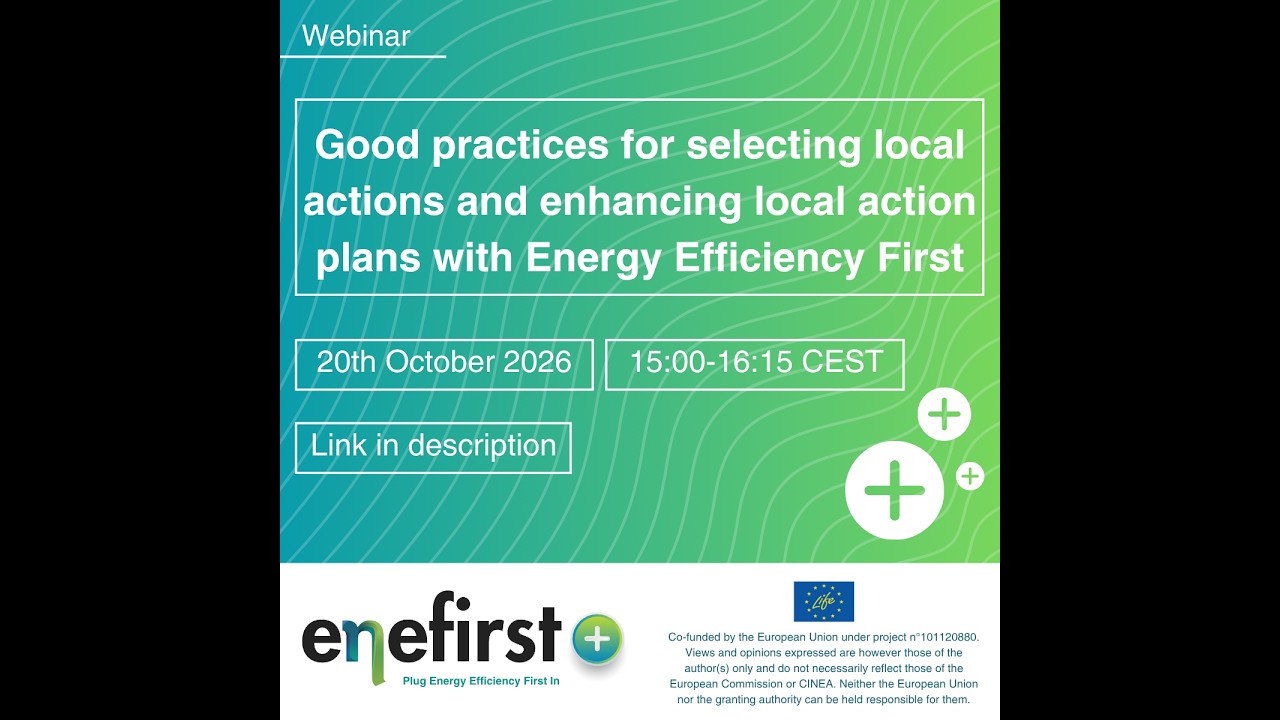
Good practices for selecting local actions & enhancing local action plans with EE1st (Enefirst Plus)
Keywords
Summary
157 words
Critical Evaluation
Value of the Information & Strength of the Argument
The video offers valuable practical insights from a real pilot case, emphasizing that implementing EE1st is not solely about cost-benefit analysis but also involves organizational and governance aspects. The argumentation is solid, based on the analysis of SECAPs, collaboration with municipalities, and references to JRC guidelines. The presenters clearly explain the methodology and provide actionable recommendations, making the content useful for local authorities and energy planners.
Scientific Rigor, Source Quality, Title Accuracy
The sources cited are credible, including the Enefirst Plus project, ENEA, and the EU LIFE Programme. The presentation references official guidelines from the JRC and the project’s own resources. The title accurately reflects the content, which discusses good practices for local actions and enhancing SECAPs with EE1st. The video is well-structured with clear timestamps and a professional presentation.
139 words
Title / Content Match
The title accurately describes the content, which focuses on good practices for local action plans using the EE1st principle.
Quality & Reliability
7/10
The video is based on the Enefirst Plus project funded by the EU LIFE Programme, with presentations from experienced researchers at ENEA and Fraunhofer ISI. It provides a detailed case study and references to official guidelines. However, it is a single pilot case and the video is not peer-reviewed.
Chapters
Cited Sources
- IEECP Official Website — Referenced as the main organization and resource hub.
- Enefirst Plus Project Page — Mentioned as the project providing the context and resources.
- IEECP Topics — Listed as a source for research and project details.
- Playlist of IEECP Videos — Linked as one of the topic playlists for further content.
- IEECP Newsletter Subscription — Provided for updates and further information.
Concurring Sources
- IEECP Project Page — Supports the project background and resources.
- Covenant of Mayors — Aligns with the SECAP framework discussed.
Contribution & Novelties
The video contributes by sharing a replicable methodology for assessing EE1st integration in SECAPs, based on the Italian pilot case, and introduces a new catalogue of energy efficiency solutions. It emphasizes organizational efficiency and data availability as key enablers. For further exploration:
- Energy Efficiency First (EU) — Central principle discussed in the video.
- Covenant of Mayors — The initiative that SECAPs follow.
- Cost-Benefit Analysis Guide — Related resource from the Enefirst Plus project.
73 words
Radar Profile
The profile shows a strong emphasis on technical level and information quality, with slightly lower scores for quantity and reliability, indicating a concise but expert-level presentation with credible sources.