FMSZ 2026 Annual Congress Presentation by Mr Lyman Khumbula
Title history
- FMSZ 2026 Annual Congress Presentation by Mr Lyman Khumbula — observed on 20261026-0952 UTC (YouTube)
Keywords
Summary
165 words
Critical Evaluation
Value of the Information & Strength of the Argument
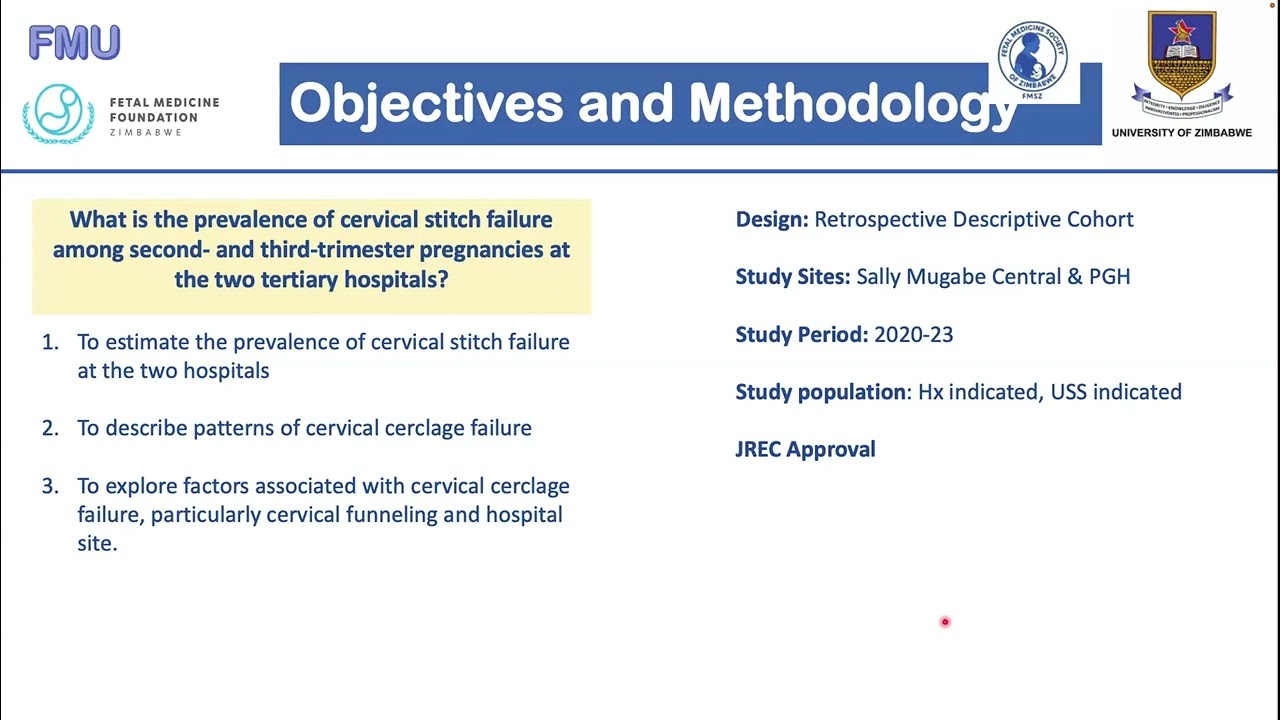
The presentation provides useful preliminary data on cervical stitch failure in a low-resource setting, a topic with limited literature. The argumentation is methodical, describing the ultrasound protocol, study design, and outcomes. The distinction between clinical failure (pregnancy loss before 28 weeks) and ultrasound-detected failure is clearly explained. The speaker appropriately highlights the association with funneling as an association, not causation, due to the small sample size. The value lies in its focus on a specific clinical scenario and its potential to inform practice in Zimbabwe, though the lack of delivery outcomes limits the clinical significance.
Scientific Rigor, Source Quality, Title Accuracy
The study is a retrospective chart review, a recognized though lower-tier study design. The methodology is described with enough detail for replication, including the ultrasound criteria and inclusion criteria. The sources are limited to the presenter’s own work; no external references are cited. The title accurately reflects the content. The study’s rigor is moderate: the sample size is small, and the exclusion of many records may introduce bias. The lack of a peer-review process and absence of detailed statistical analysis in the presentation also reduce its overall rigor.
198 words
Title / Content Match
The title accurately describes the content: a presentation at an annual congress on the prevalence of cervical stitch failure in two tertiary hospitals in Zimbabwe.
Quality & Reliability
6/10
The presentation is a retrospective descriptive study with clear methodology and a defined population. However, the sample size is small (84 out of 2200 eligible), missing records, and no delivery outcomes. The speaker acknowledges limitations. The study appears plausible but not peer-reviewed.
Key Moments
Markers derived by PSI from the transcript: the creator did not define chapters.
- Introduction to the study on cervical stitch failure prevalence.
- Description of the ultrasound protocol for cervical assessment.
- Study objectives and definitions of stitch failure.
- Study design and inclusion criteria, retrospective cohort at two hospitals.
- Results: prevalence and hospital distribution.
- Demographics and gestational age at detection of failure.
- Association with funneling and interpretation.
- Limitations and conclusion.
Contribution & Novelties
This presentation offers local data on cervical cerclage failure in Zimbabwe, a setting where such data are scarce. The study highlights the utility of ultrasound in detecting stitch failure and identifies funneling as a potential risk marker. The novelty is in the specific population and the use of ultrasound criteria rather than clinical loss alone.
Pour aller plus loin :
- Cervical cerclage — Overview of the procedure and indications.
- Transvaginal ultrasound — Technique used for cervical assessment.
- Preterm birth prevention — See World Health Organization on preterm birth for context.
90 words
Radar Profile
The radar profile shows moderate scores across quantity, quality, technical level, and reliability, indicating a balanced but not exceptional presentation. The study is technically sound but limited by sample size and retrospective design.