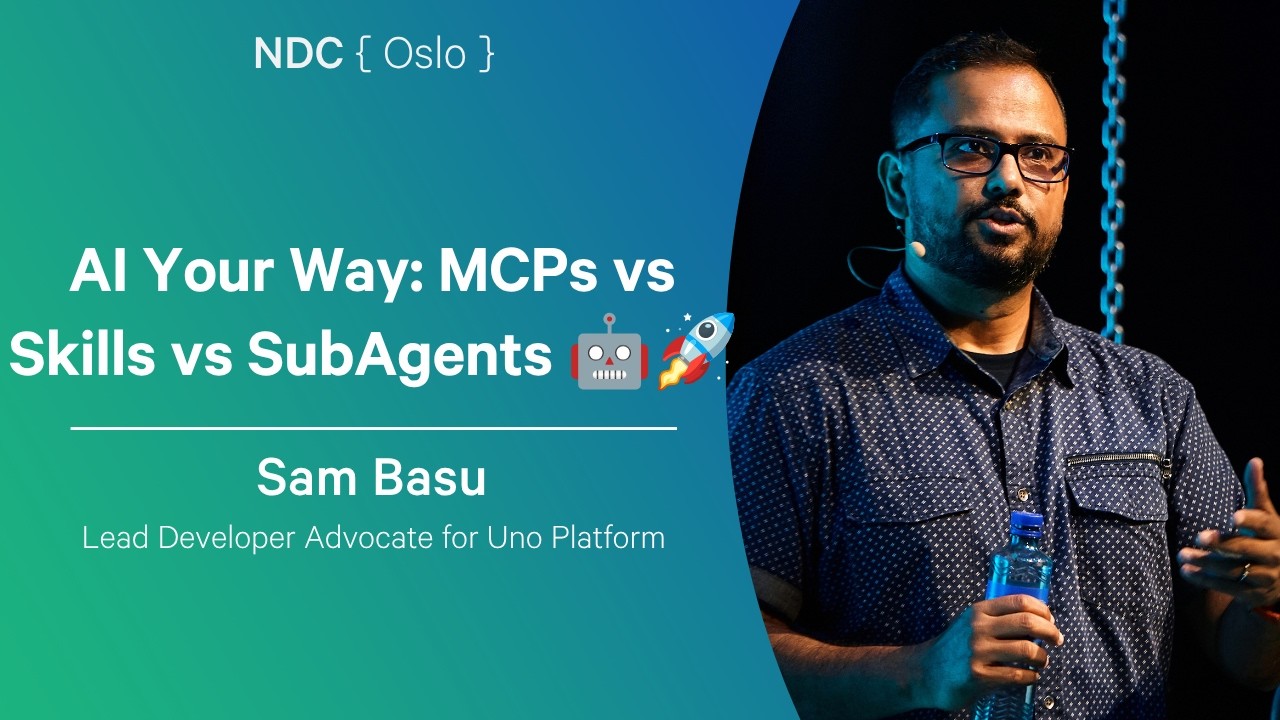
AI Your Way: MCPs vs Skills vs SubAgents 🤖🚀 - Sam Basu - NDC Oslo 2026
Title history
- AI Your Way: MCPs vs Skills vs SubAgents 🤖🚀 - Sam Basu - NDC Oslo 2026 — observed on 20261028-0955 UTC (YouTube)
Keywords
Summary
142 words
Critical Evaluation
Value of the Information & Strength of the Argument
The talk provides valuable practical insights for developers, with clear explanations and a memorable restaurant analogy. The speaker makes a strong case for using a combination of MCP, skills, and subagents to enhance developer productivity. The argumentation is based on real-world examples and personal experience, though not heavily supported by empirical data. The emphasis on guardrails and context is well-argued, and the step-by-step demonstrations strengthen the credibility of the recommendations.
Scientific Rigor, Source Quality, Title Accuracy
The talk relies on the speaker’s professional experience and industry trends. It references the Model Context Protocol and its official SDKs, but does not cite specific research papers or detailed official documentation. The presentation is of moderate rigor, typical for a practitioner conference talk. The title is a good match: it clearly announces the comparison of three key concepts, which is exactly what the talk delivers. No formal sources are cited beyond the MCP website and conference links.
163 words
Title / Content Match
The title accurately reflects the content, as the talk directly compares and explains MCP, skills, and subagents.
Quality & Reliability
7/10
The talk provides practical, up-to-date information about MCP, skills, and subagents from an experienced developer advocate. The examples are concrete and the speaker demonstrates real usage. However, the content is based on the speaker's personal experience and industry trends rather than peer-reviewed research, and no formal sources are cited.
Key Moments
Markers derived by PSI from the transcript: the creator did not define chapters.
- Introduction and apologies; setting the stage for the talk.
- Overview of MCP, skills, subagents, and the importance of context.
- Restaurant analogy explaining roles of agents, tools, skills, and subagents.
- Demonstration of instructions file and skills in VS Code, showing how to configure agents.
- Building and using an MCP server with .NET, including code examples.
- Discussion of context window, cost, and best practices for using multiple agents.
Cited Sources
- NDC Conferences — Conference organization that hosted the talk.
- NDC Oslo — Official event site where the talk was recorded.
- Model Context Protocol — Official documentation and resources for the MCP standard mentioned in the talk.
External References
Contribution & Novelties
The talk provides a clear comparative framework for understanding MCP, skills, and subagents, with practical .NET examples and a memorable analogy. It underscores the importance of contextual engineering in AI agent workflows and offers actionable advice for developers. The original contribution lies in its synthesis of these concepts and its focus on developer-oriented guardrails.
Pour aller plus loin :
- Model Context Protocol — Official MCP documentation, essential for understanding the protocol details.
- Adding custom instructions for GitHub Copilot — Documentation on how to create instruction files, a core concept in the talk.
- Retrieval-Augmented Generation — Wikipedia article on RAG, a technique mentioned as a way to bring external context to AI agents.
112 words
Radar Profile
The profile shows high information quantity and moderate quality/reliability, indicating a broad but not deeply rigorous talk. The technical level is adequate for a developer audience, with a balanced emphasis on practical application.