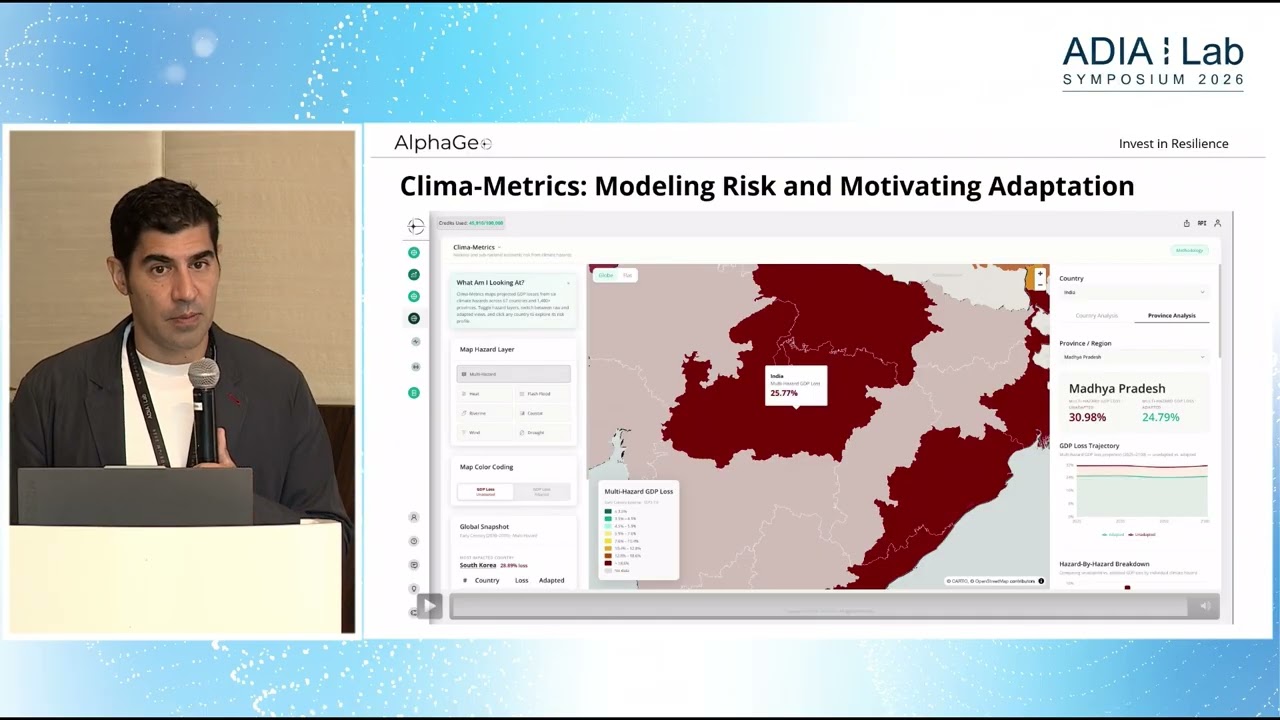
Scaling Resilience Through the Deployment of Climate Adaptation Solutions | Parag Khanna
Title history
- Scaling Resilience Through the Deployment of Climate Adaptation Solutions | Parag Khanna — observed on 20261105-1151 UTC (YouTube)
Keywords
Summary
167 words
Critical Evaluation
Value of the Information & Strength of the Argument
The presentation offers a fresh and actionable perspective by reframing adaptation as a measurable, place-based investment opportunity rather than an abstract global goal. The introduction of the ‘adaptation dividend’—the quantified benefit of existing adaptive infrastructure—provides a concrete metric that could help price resilience bonds and guide capital allocation. Khanna’s argument is logically structured: he identifies deficiencies in previous approaches (e.g., the IMF’s limited coverage) and demonstrates how his tool fills them. He supports claims with illustrative statistics (12,000 cities, 9.5 billion people, 1% urbanization per year) and real-world examples (Singapore, UAE). However, the argumentation sometimes relies on his own company’s authority and lacks external validation; the Q&A hints at potential critiques but does not deeply explore them. Overall, the reasoning is compelling for a professional audience but would benefit from peer-reviewed backing.
Scientific Rigor, Source Quality, Title Accuracy
Khanna cites only a few external sources: the IMF (for national-level GDP loss), Bloomberg (for a sectoral adaptation allocation index), and specific data like the number of data centers. These are mentioned without URLs or detailed citations, weakening direct verification. He also references his own firm’s public studies, but these are not linked in the description. The single provided link (to the symposium) is general conference information, not a substantive science source. The title accurately matches the content, as the talk indeed focuses on scaling adaptation solutions. However, the lack of rigorous sourcing and the proprietary nature of the presented data lower the overall scientific reliability.
253 words
Title / Content Match
The title accurately reflects the content, which focuses on scaling adaptation solutions and resilience through coordinated deployment, capital, and geospatial data.
Quality & Reliability
6/10
The talk presents a clear conceptual framework and specific data tools, but relies heavily on the speaker's own company's products without peer-reviewed references. Claims about the IMF dataset and Bloomberg indices are anecdotal, and the lack of detailed citations reduces verifiability.
Key Moments
Markers derived by PSI from the transcript: the creator did not define chapters.
- Introduction by moderator Yusuf; Parag Khanna welcomed as ADIA Lab visiting fellow.
- Khanna introduces the resilience formula: resilience = risk - adaptation, and discusses adaptation as a local private good.
- Presentation of ClimMetrics: a free and open-source tool for subnational climate risk and adaptation analysis.
- Discussion of urban focus: 12,000 cities, migration trends, and ranking cities by adaptation capacity.
- Analysis of data center siting: many are in climate-risk zones; need for adaptation-aware site selection.
- Singapore as a role model for adaptation investment; example of comprehensive measures from desalination to flood control.
- Concluding remarks on earth system science and the need to integrate climate adaptation into all policy objectives.
- Q&A: spillovers of adaptation technology and catastrophe bond risk premiums on data centers.
Cited Sources
- ADIA Lab Symposium 2026 — Conference website for the symposium where this talk was presented; contains general event information and may include program details.
Concurring Sources
- IMF Work on Climate Change — Khanna references IMF data on GDP loss from climate hazards; this institutional source aligns with his claim about existing national-level assessments.
Dissenting Sources
- IPCC Reports — Khanna suggests IPCC is not focused on adaptation methodologies at the granular level; IPCC's synthesis reports may have more comprehensive adaptation guidance, though they are not directly contradictory.
Contribution & Novelties
The presentation introduces a novel framework for quantifying adaptation capacity and integrating it into financial decision-making. The ‘adaptation dividend’ concept and the ClimMetrics tool provide a granular, subnational view that addresses the three gaps of data, capital, and coordination. By making the tool open-source, Khanna offers a practical pathway for cities and investors to evaluate resilience investments. The emphasis on local private goods challenges the dominant global climate finance narrative.
Pour aller plus loin :
- Climate adaptation — Overview of adaptation measures and policies; relevant to the core topic.
- Climate finance — Discusses the funding mechanisms and challenges for adaptation and mitigation.
- Geospatial analysis — Foundational methodology for the geospatial data science approach presented.
- Sovereign wealth funds — Example of national funds investing in adaptation (no URL certain; Khanna mentions UAE).
- Green bonds — Financial instruments for adaptation (no URL certain).
141 words
Radar Profile
The scores indicate a talk with moderate to good information content and technique, but lower on rigorous sourcing and expert verification. The strength lies in the novelty of the framework and practical tools, while the weakness is the reliance on proprietary data and lack of academic citations. The overall profile suggests a high-value, professional presentation rather than a peer-reviewed scientific contribution.