Accelerating Research with AI Agents: Lessons from OpenAI | Stefano Fabbri | ADIA Lab Symposium 2026
Title history
- Accelerating Research with AI Agents: Lessons from OpenAI | Stefano Fabbri | ADIA Lab Symposium 2026 — observed on 20261104-0952 UTC (YouTube)
Keywords
Summary
186 words
Critical Evaluation
Value of the Information & Strength of the Argument
The talk provides valuable firsthand insights into OpenAI’s internal AI agent usage, with quantitative data on token consumption, automation rates, and long-running experiments. The examples of the Navier-Stokes proof and GPU kernel optimization illustrate the potential of AI agents in complex research tasks. The argumentation is coherent, moving from general trends to specific case studies, and highlights both capabilities and limitations (e.g., the high cost of large-scale experiments). The emphasis on practical applications like paper replication and kernel optimization adds concrete value for financial researchers. However, some claims lack external verification, and the presentation has a promotional undertone.
Scientific Rigor, Source Quality, Title Accuracy
The talk draws on OpenAI’s internal data and experiences, but no external scientific papers or citations are provided other than the symposium link. The speaker acknowledges that some data is available online but does not give specific references. The title accurately represents the content, and the presentation is logically structured. No comments were provided for analysis, so no public sentiment can be assessed.
176 words
Title / Content Match
The title accurately reflects the content, focusing on lessons from OpenAI's experience in accelerating research with AI agents.
Quality & Reliability
7/10
The talk presents concrete internal data from OpenAI on AI agent usage, including token consumption and task automation statistics, alongside specific examples like Navier-Stokes proof and GPU kernel optimization. However, these are unverified claims from an OpenAI employee, and the presentation has a promotional tone, limiting full independent verification.
Key Moments
Markers derived by PSI from the transcript: the creator did not define chapters.
- Introduction and overview of the talk topics.
- Statistics on token consumption and agent usage at OpenAI.
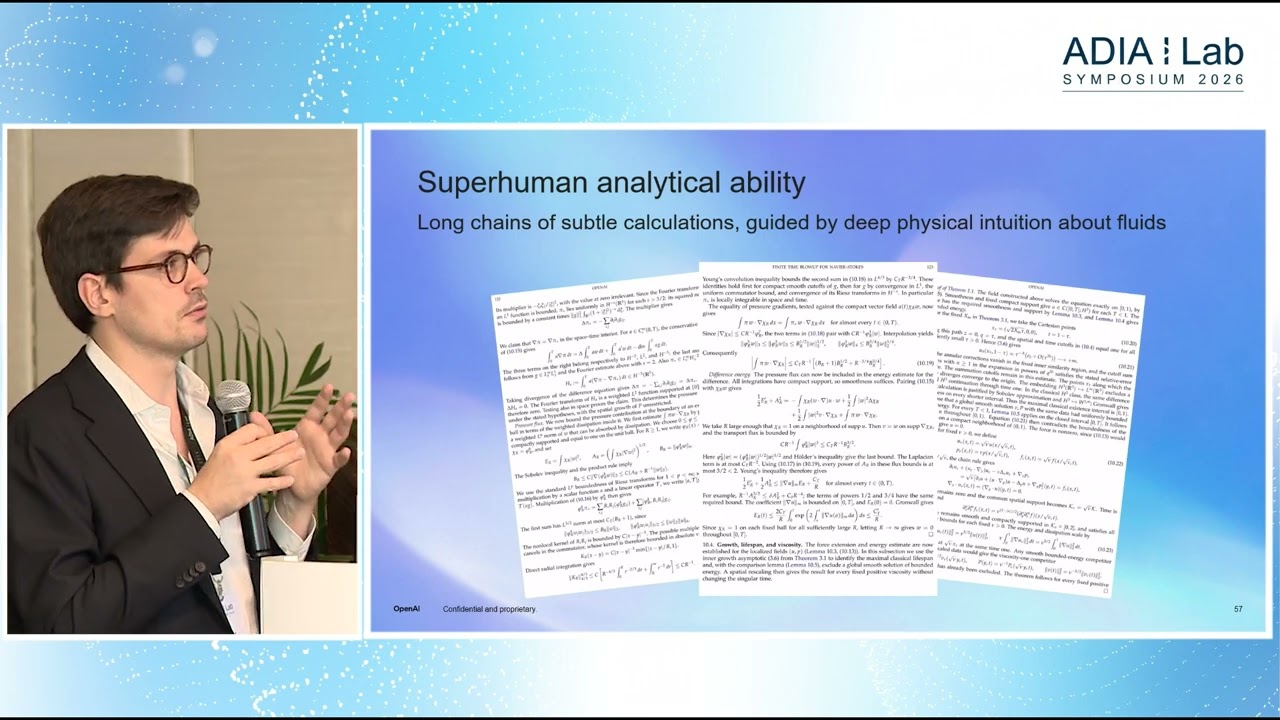
- Discussion of mathematical capabilities evolution, including Navier-Stokes proof.
- Explanation of the 10,000-agent system and messaging orchestration.
- Example of replicating an academic paper using AI agents.
- GPU kernel optimization example and its significance for finance.
- Conclusion and key takeaways.
Cited Sources
- ADIA Lab Symposium 2026 — Official symposium page where the talk was presented.
Concurring Sources
- ADIA Lab Symposium 2026 — The official event page, consistent with the talk's context.
Contribution & Novelties
The talk offers a rare inside look at OpenAI’s use of AI agents in research, with specific metrics and case studies. It contributes to understanding how multi-agent systems can be coordinated for scientific discovery and highlights the cost dynamics of such experiments. The examples of paper replication and GPU optimization provide actionable insights for quantitative finance.
Pour aller plus loin :
- OpenAI Codex — Official tool mentioned for running agentic workflows; the harness is open source.
- Navier–Stokes existence and smoothness — The problem solved by OpenAI’s internal model, a Millennium Prize problem.
- Large language models for mathematics — OpenAI’s research on mathematical reasoning, though not directly cited, relevant to the capabilities discussed.
- Multi-agent reinforcement learning — Background on multi-agent systems, though the talk focuses on message-passing rather than RL.
129 words
Radar Profile
The radar shows high scores for quantity, quality, and technical depth, indicating a dense and specialized presentation. Reliability is slightly lower due to reliance on undocumented internal data, but overall the profile suggests a substantive expert talk.