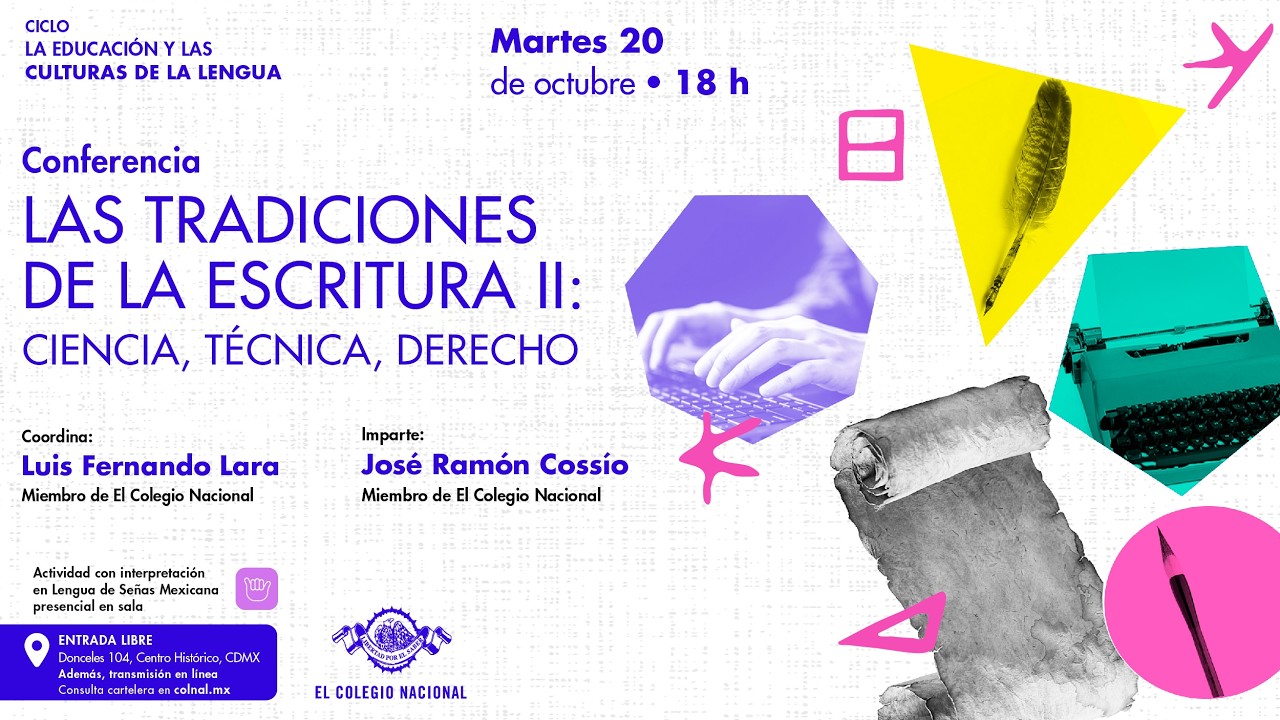
Las tradiciones de la escritura II: ciencia, técnica, derecho
Writing Traditions II: Science, Technique, Law
Keywords
Summary
198 words
Critical Evaluation
Value of the Information & Strength of the Argument
The lecture provides a rich historical account of how Spanish scientific and legal terminology evolved, citing concrete examples from Alfonso X, the introduction of terms like ‘astrolabio’, and the influence of French and English. The argumentation is coherent, moving from general principles to specific cases. The speaker makes a strong case for the importance of understanding etymological roots to foster creativity and international communication. However, some generalizations about the opacity of certain terms are subjective, and the causal link between term transparency and scientific creativity is debatable. The legal examples effectively illustrate the need for univocal definitions in law.
Scientific Rigor, Source Quality, Title Accuracy
The speaker draws on well-established historical sources, such as the works of Alfonso X and the dictionary of Terreros y Pando, and cites the books of Beuchot and López García. The content is well-researched, but it is presented as an expert opinion rather than a peer-reviewed study. The title accurately reflects the content, which indeed covers the writing traditions in science, technique, and law. No significant discrepancy is observed between the title and the actual content.
190 words
Title / Content Match
The title precisely matches the content, which covers the writing traditions in science and law, exploring terminology and vocabulary development.
Quality & Reliability
8/10
The lecture is delivered by a member of El Colegio Nacional with deep expertise in linguistics, citing historical sources and examples. However, it is an opinionated presentation without formal peer review, and some claims are presented as assertions.
Key Moments
Markers derived by PSI from the transcript: the creator did not define chapters.
- Introduction and context of the lecture series, thanking the audience and introducing José Ramón Cossío.
- Discussion of Alfonso X the Wise and his role in normalizing Spanish orthography and creating scientific and legal vocabulary.
- Examples of scientific terms derived from Greek and Latin, contrasting transparent terms like 'planeta' with opaque neologisms such as 'quark'.
- Translation issues in scientific terminology, notably Heisenberg's 'Unschärferelation' becoming 'uncertainty' instead of 'indetermination'.
- Legal terminology and the need for precise definitions, illustrated by examples like traffic regulations and customs classification of a harpsichord.
Cited Sources
- Historia mínima de la lengua española — Referenced by the speaker to illustrate the evolution of Spanish writing traditions.
- Sor Juana, una filósofa barroca — Mentioned in relation to Sor Juana's intellectual correspondence.
- Cómo surgió el español: Introducción a la sintaxis histórica del español antiguo — Cited as an example of a study on the historical syntax of Spanish.
- Diccionario castellano con las voces de ciencias y artes — Mentioned as a work by Esteban de Terreros y Pando.
Contribution & Novelties
The lecture offers a unique perspective on the parallel between scientific and legal terminological development, emphasizing the role of cultural tradition and the perils of opaque neologisms. It provides a systematic comparison of how sciences and law both require univocity but differ in their reliance on societal language. The historical depth, from Alfonso X to modern English influence, enriches the understanding of Spanish vocabulary formation.
Pour aller plus loin :
- Alfonso X of Castile — Key figure in establishing Spanish as a language of knowledge.
- Quark — Example of an arbitrary scientific term discussed in the lecture.
- Homochirality — Recent scientific term referenced in the context of the 2026 Nobel Prize in Chemistry.
- Uncertainty principle — The translation issue of Heisenberg’s principle analyzed in the talk.
126 words
Radar Profile
The profile indicates high information quantity and quality, with strong technical depth and overall reliability, consistent with an expert lecture.