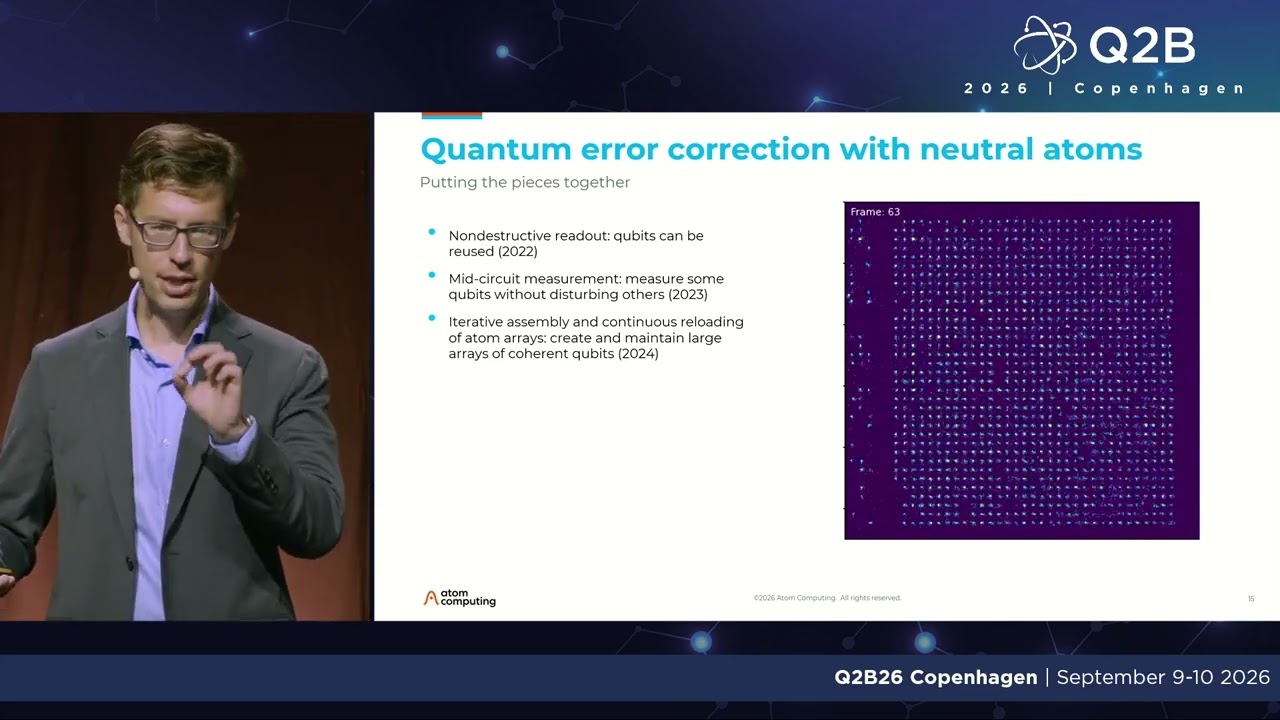
Q2B26 Copenhagen | Jonathan King, Chief Scientist and Co-Founder, Atom Computing
Keywords
Summary
146 words
Critical Evaluation
Value of the Information & Strength of the Argument
The talk provides substantial technical value by detailing the engineering milestones required for fault-tolerant quantum computing with neutral atoms. The argumentation is coherent, starting from the definition of utility scale and systematically connecting each engineering step to the end goal. King supports his claims with specific demonstrations, such as the autonomous array filling and the toric code error correction results, and contrasts their approach with alternatives like superconducting or trapped ion systems. He acknowledges the need for continued scaling and error rate reduction, which adds credibility. However, the commercial context and lack of independent review in this talk slightly weaken the objectivity, though the technical details and publication references suggest solid grounding.
Scientific Rigor, Source Quality, Title Accuracy
The talk references the DARPA quantum benchmarking program and mentions published works but does not provide explicit citations within the video. The only external source from the description is the Q2B conference website, which is not a primary source. The title matches the content precisely, as it is a conference talk by the chief scientist. The overall scientific rigor is good for an industry presentation, but the reliance on self-reported results without real-time scrutiny limits its status. No comments were provided, so public reception cannot be assessed.
214 words
Title / Content Match
The title accurately describes the video: it is a Q2B26 Copenhagen talk by Jonathan King, Chief Scientist and Co-Founder of Atom Computing, discussing the company's path to utility-scale quantum computing.
Quality & Reliability
7/10
The talk is delivered by the chief scientist of Atom Computing and presents technical results with supporting plots and references. It is not peer-reviewed in this format and contains a commercial perspective, but the content appears credible and aligns with published literature.
Key Moments
Markers derived by PSI from the transcript: the creator did not define chapters.
- Introduction: Atom Computing background, mission, and locations.
- Explanation of neutral atom qubits and their scalability and flexibility.
- Definition of utility scale and required specifications (logical qubits, error rates, runtime).
- Engineering journey: non-destructive readout and autonomous array filling.
- Quantum error correction demonstration with toric code, including results.
- Copenhagen presence and Q North partnership with Microsoft.
Cited Sources
- Q2B Conference Site — The talk was part of the Q2B26 Copenhagen conference.
Contribution & Novelties
The talk presents Atom Computing’s original contributions to neutral atom quantum computing, including the first complete demonstration of quantum error correction on a neutral atom platform using a toric code. It highlights non-destructive mid-circuit readout and autonomous atom replacement, which are critical for sustained computations. The reconfigurable connectivity of atoms enables codes like the toric code that go beyond planar layout constraints.
Pour aller plus loin :
- Quantum error correction — Overview of the principles and codes used to protect quantum information.
- Toric code — Topological error correcting code that requires non-planar connectivity, central to the talk’s demonstration.
- Surface code — The most common QEC code, restricted to planar lattices, contrasting with the toric code’s advantages.
116 words
Radar Profile
The radar profile shows high technical depth and substantial information quantity, with slightly lower marks for source robustness and overall reliability due to the commercial and non-reviewed nature of the talk. The balance reflects a technically strong but inherently promotional presentation.