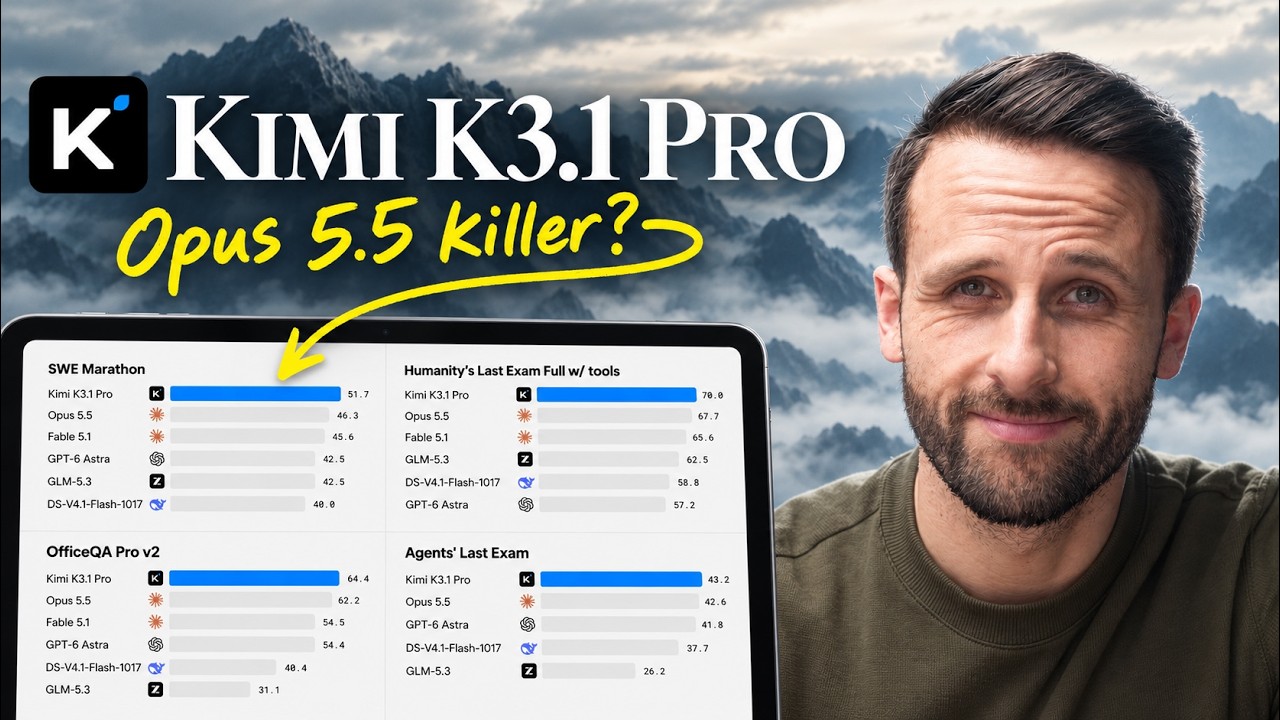
Kimi K3.1: No Hype Full Review & Testing (Best Open Weight Model?)
Title history
- Kimi K3.1: No Hype Full Review & Testing (Best Open Weight Model?) — observed on 20261027-0724 UTC (YouTube)
Keywords
Summary
176 words
Critical Evaluation
Value of the Information & Strength of the Argument
The video provides substantial value by offering hands-on, comparative testing of an emerging open-weight model against established frontiers. The blind ranking methodology reduces bias, and cost/token data are valuable for practical users. The argumentation is persuasive, acknowledging limitations such as single-test variance and benchmark skepticism. The creator’s experience with routing to open-weight models adds practical credibility. However, the conclusions are appropriately cautious, emphasizing that benchmarks and tests are indicative but not definitive.
Scientific Rigor, Source Quality, Title Accuracy
The video references the creator’s own blog post (aiformortals.co/blog/kimi-k3-1-pro-review) containing prompts and results, which serves as a primary source. It also cites the Kimi K3.1 announcement and benchmarks, though without direct links to Moonshot’s official site. The description includes links to the sponsoring product (Cline) and to the blog. The title is fully aligned with the content: a comprehensive review with testing. No external sources are cited beyond the blog and sponsor, but the testing is documented transparently. Comments were not analyzed as none were provided.
173 words
Title / Content Match
The title accurately reflects the video's content: a comprehensive, no-hype review with multiple tests and benchmark analysis, while questioning whether Kimi K3.1 is the best open-weight model without definitive conclusions.
Quality & Reliability
7/10
The video provides a transparent, hands-on evaluation of Kimi K3.1 across multiple practical tasks, with costs and timing, alongside benchmark discussions. However, the testing is based on single runs with subjective scoring, and the presence of sponsorship (Cline) is disclosed but may still introduce bias. Overall, the methodology is reasonable but not exhaustive.
Chapters
Cited Sources
- Cline Desktop — Sponsor's product, an open-source agent harness.
- ClinePass (with 50% off) — Subscription service for open-weight models.
- Blog post with all builds and cost tables — Detailed prompts, results, and cost breakdowns for the tests.
- AI for Mortals Newsletter — Sign-up for weekly AI-related content.
Contribution & Novelties
The video contributes original, hands-on comparative testing of Kimi K3.1 in applied tasks (game development, web design, video), going beyond synthetic benchmarks. It offers transparent cost and token metrics, which are rarely detailed in official announcements. The blind ranking methodology adds rigor. The creator’s perspective as a practical user who routes between models provides useful insight for similar workflows.
Pour aller plus loin :
- Open-source artificial intelligence — Context on open-weight models and their ecosystem.
- Large language model — Background on the architecture and capabilities of models like Kimi.
- Intelligent agent — Relevant to the agentic coding and task automation aspects discussed.
102 words
Radar Profile
The radar profile shows moderate to high scores on information quantity and practical testing, with slightly lower technical depth and reliability due to single-run evaluations and sponsored content. Overall, it reflects a well-rounded but not fully rigorous review.