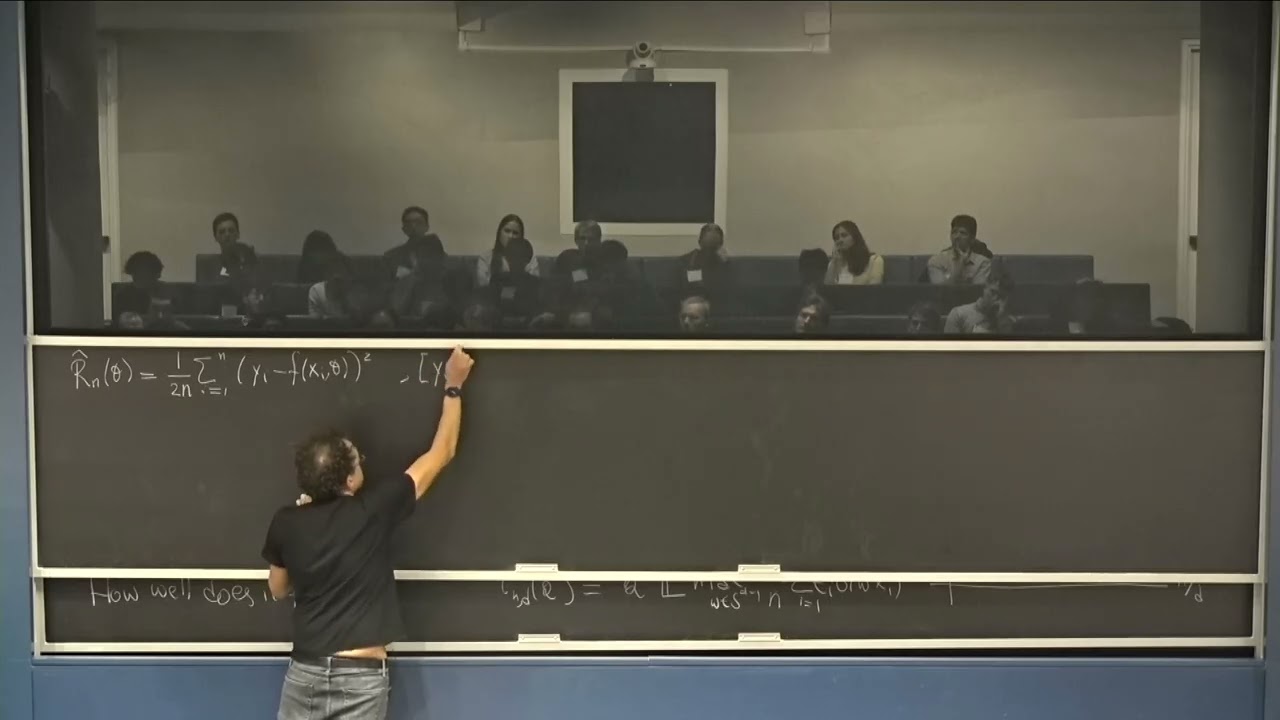
Andrea Montanari: The Phase Diagram of 2-Layer Neural Networks (September 24, 2026)
Title history
- Andrea Montanari: The Phase Diagram of 2-Layer Neural Networks (September 24, 2026) — observed on 20261106-1952 UTC (YouTube)
Keywords
Summary
147 words
Critical Evaluation
Value of the Information & Strength of the Argument
The value of the information is exceptionally high, providing novel rigorous characterizations of training behavior in two-layer networks, a fundamental model. The argumentation is rigorous, clearly stating assumptions and limitations. The speaker builds from classical results to original contributions, with a systematic comparison of algorithmic and information-theoretic limits. He also acknowledges gaps and open questions, enhancing credibility. The discussion of duality between mean and max is particularly insightful, though only proven for m=1, indicating a deep yet partially conjectural framework.
Scientific Rigor, Source Quality, Title Accuracy
The talk is scientifically rigorous, citing named theorems and papers (Bartlett 1996, Bubeck et al., Diaconis and Freedman, recent work by Wang et al.). The sources are appropriate and contemporary. The title accurately describes the content; the talk genuinely focuses on the phase diagram and its characterization. The description provides a reasonable overview, though the event link is the only source available in the description. No public comments were provided for analysis.
167 words
Title / Content Match
The title accurately reflects the content, which centers on a phase diagram for two-layer neural networks, combining rigorous bounds and heuristic results.
Quality & Reliability
9/10
The talk presents rigorous theorems and proofs, from a leading researcher, with high technical depth and clear reasoning. Claims are supported by named results (Bartlett, Bubeck et al.) and original contributions.
Key Moments
Markers derived by PSI from the transcript: the creator did not define chapters.
- Introduction to two-layer neural network setting and questions
- Bartlett's theorem on Rademacher complexity and its implications
- Definition of phase diagram and interpolation region
- Variational formula using stochastic processes for optimal training error
- Connection to projection pursuit and Gaussian projections
- Discussion of replica formula, duality, and open questions
- Behavior of SGD with evolving second layer and complexity growth
Cited Sources
- Simons Collaboration on the Physics of Learning and Neural Computation Annual Meeting 2026 — Event page for the talk, containing context and related information
Contribution & Novelties
The talk provides a major contribution by giving a precise variational characterization of the training error in two-layer networks, bridging algorithmic and statistical limits. It offers a phase diagram that unifies earlier results and highlights the role of the second-layer norm. The duality between the replica and algorithmic averages is a novel insight, albeit proved only for m=1. The empirical match with SGD is an important observation.
Pour aller plus loin :
- Rademacher complexity — A measure of function class capacity used in the talk to bound generalization and noise fitting.
- Projection pursuit — A statistical technique related to the distribution of low-dimensional projections, central to the theorem’s proof.
- Replica method — A heuristic from statistical physics employed to compute the information-theoretic limit, with rigorous justifications in limited cases.
129 words
Radar Profile
The radar profile shows extremely high scores across all dimensions, with technical level and reliability being the strongest. The quantity and quality of information are also near-maximal, reflecting a dense and accurate presentation.