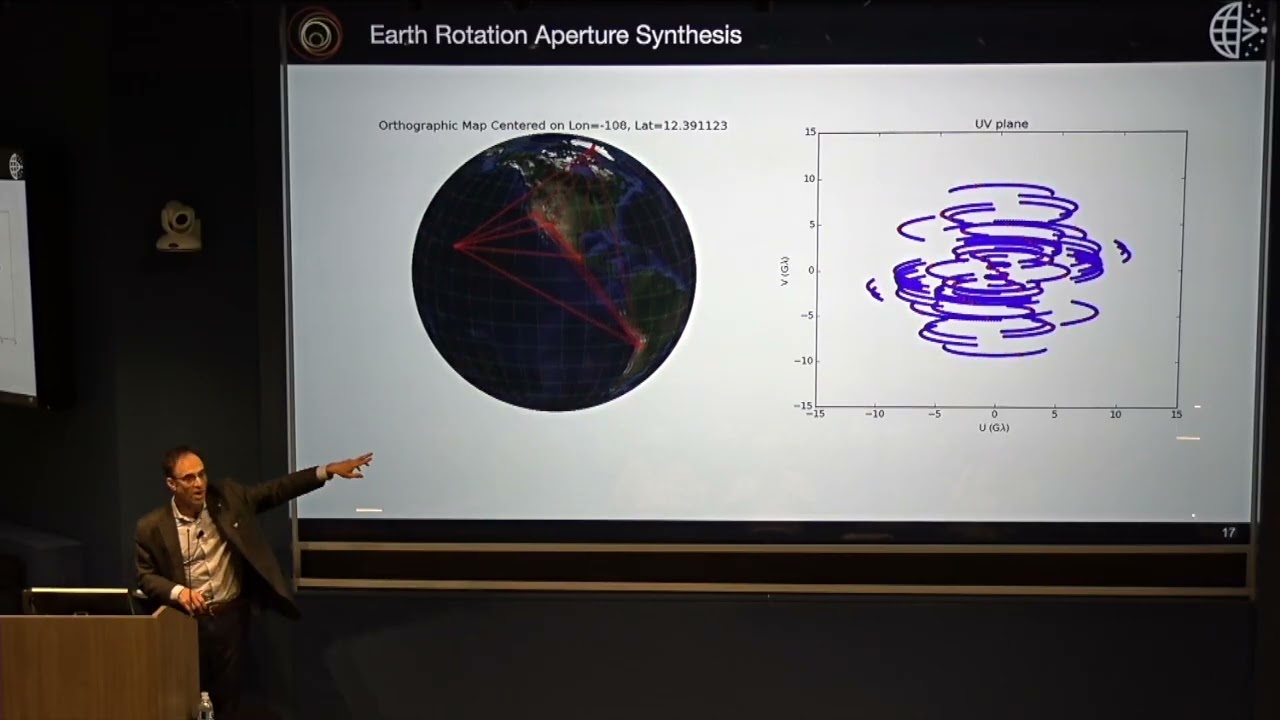
Sheperd Doeleman: Taking Pictures and Making Movies of Supermassive Black Holes (October 14, 2026)
Title history
- Sheperd Doeleman: Taking Pictures and Making Movies of Supermassive Black Holes (October 14, 2026) — observed on 20261026-2138 UTC (YouTube)
Keywords
Summary
167 words
Critical Evaluation
Value of the Information & Strength of the Argument
The lecture offers exceptional value by presenting cutting-edge astrophysical results in a highly accessible yet technically rich manner. Doeleman builds a compelling narrative that traces the theoretical foundations from 1921 through modern simulations, clearly explaining how each step motivates the technical choices for the EHT. His argumentation is robust: he emphasizes the role of independent imaging teams to eliminate confirmation bias, describes the use of calibration sources, and shows how the observed crescent shape aligns with relativistic Doppler beaming. The evidence for the black hole mass from both the shadow size and stellar dynamics is presented cohesively. The talk also honestly acknowledges uncertainties (e.g., 17% consistency with GR) and explains the need for larger and more sensitive arrays. The logical progression from historical context to technological constraints to observational results is seamless, making the case for the EHT’s achievements convincing and well-founded.
Scientific Rigor, Source Quality, Title Accuracy
The scientific rigor is exemplary: the presenter is the principal investigator of the EHT, and the results discussed have been peer-reviewed and published in top journals. He mentions specific tests, such as using two independent methods to measure the shadow diameter, and stresses the importance of four teams working in isolation to prevent human bias. The reliance on calibrated sources and the careful treatment of missing data with light regularizers demonstrate methodological transparency. The title accurately describes the content—both the past success in imaging black holes and the forthcoming goal of producing movies with the ngEHT. The lecture cites foundational works (e.g., van Laue’s photon orbit, Luminet’s simulations, Nobel Prize–winning Galactic center measurements) and references the actual data and algorithms used. While the talk does not provide formal citations, the presenter’s authority and the institutional support from the Simons Foundation reinforce high reliability.
300 words
Title / Content Match
The title accurately reflects the content: the speaker discusses taking images and making movies of supermassive black holes with the EHT.
Quality & Reliability
9/10
High-quality scientific lecture by a leading expert, presenting verified results from the Event Horizon Telescope collaboration, with clear methodology and peer-reviewed outcomes.
Key Moments
Markers derived by PSI from the transcript: the creator did not define chapters.
- Presentation of the first M87 black hole image and its global coverage
- Historical predictions: van Laue's photon orbit and Luminet's early simulations
- Why millimeter wavelengths are necessary to observe the event horizon
- Sensitivity challenges and adoption of commercial hard drives and FPGA-based systems
- First detection of Sgr A* and M87 via interferometry, leading to the EHT project
- Final results: shadow size, mass measurement, and validation by four independent teams
Cited Sources
- Taking Pictures and Making Movies of Supermassive Black Holes — Simons Foundation event page — Official event announcement and description of the Presidential Lecture by Shep Doeleman
Contribution & Novelties
The lecture provides a first-hand account of the EHT’s revolutionary achievements, including the first direct image of a black hole’s shadow and the transition from static imaging to time-resolved movies. It explains how the collaboration overcame unprecedented technical hurdles—such as coordinating global telescopes and maintaining atomic-clock timing—and validates the findings through multi-team independent analysis. The future ngEHT project is outlined as a means to obtain full-color movies that will probe black hole dynamics, jet formation, and general relativity in extreme regimes.
Pour aller plus loin :
- Event Horizon Telescope — Overview of the international collaboration and its key results.
- General relativity — Theoretical framework used to predict the black hole shadow and test gravity.
- Very-long-baseline interferometry — The technique that allows Earth-sized virtual telescopes.
- M87* — The supermassive black hole imaged in 2019.
133 words
Radar Profile
The radar profile shows a consistently high level across all dimensions, with no significant weakness. The scores reflect a lecture that is both information-dense and highly reliable, with a technical depth appropriate for a scientific audience.