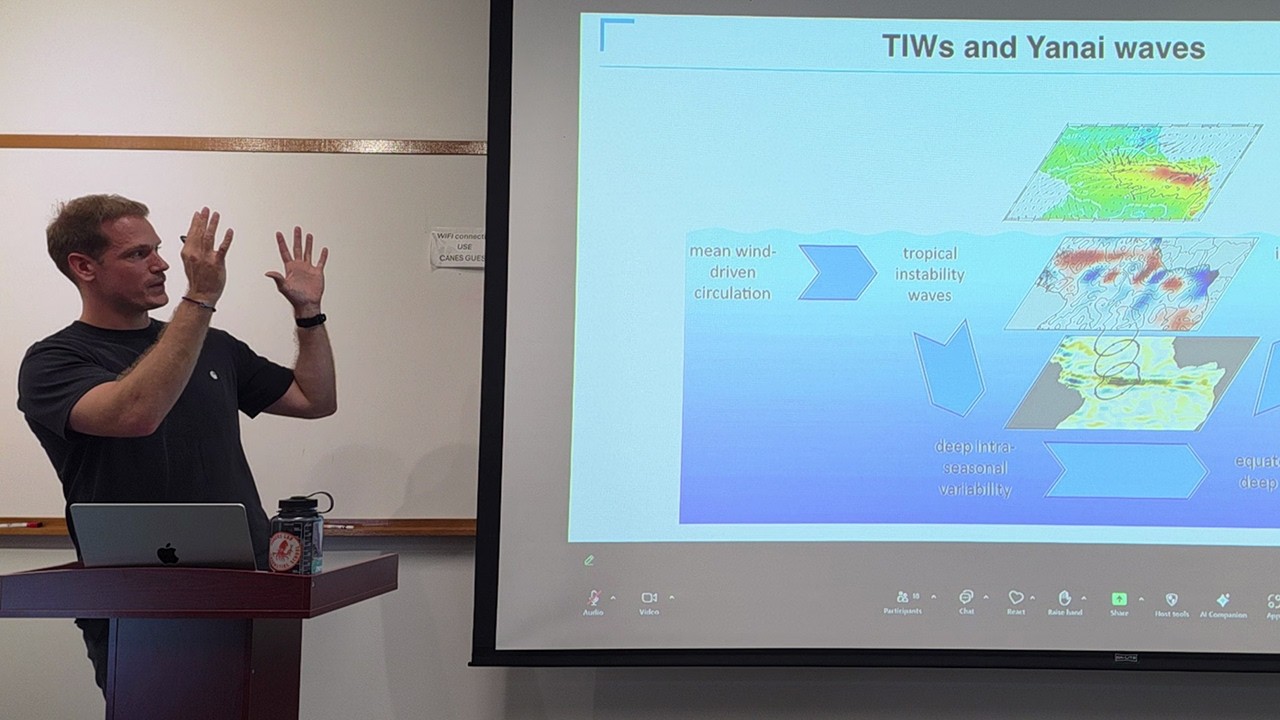
Philip Tuchen, Rosenstiel: Observing Tropical Instability Waves
Title history
- Philip Tuchen, Rosenstiel: Observing Tropical Instability Waves — observed on 20261105-0921 UTC (YouTube)
Keywords
Summary
219 words
Critical Evaluation
Value of the Information & Strength of the Argument
The value of this presentation lies in its synthesis of long-term observational records and its integration of physical, biogeochemical, and climatic impacts. Tuchen builds a compelling argument for the significance of TIWs by demonstrating their widespread effects on heat budgets, atmospheric circulation, and marine ecosystems. He supports his claims with a unique 20-year mooring time series, which represents a substantial contribution to oceanographic monitoring. The argumentation is logically structured, moving from generation mechanisms to observed variability and then to unresolved frontal-scale questions. He acknowledges uncertainties, such as the performance of reanalysis products and the incomplete understanding of small-scale turbulence, showing a balanced approach. The discussion of asymmetry in wave phases, attributed to the equatorial roll, is well supported by composite analyses. Overall, the scientific argumentation is rigorous and persuasive, though the presentation is dense and primarily aimed at an expert audience.
Scientific Rigor, Source Quality, Title Accuracy
The scientific rigor is high: Tuchen cites multiple foundational papers (e.g., Dhing, Philander, Cox, and recent modeling studies) and presents original data from well-maintained moorings. He clearly distinguishes between established knowledge and open questions, and he notes the limitations of satellite and reanalysis products. The reliance on a 20-year in-situ velocity record adds credibility, as such data are rare and essential for capturing intraseasonal waves. The title accurately reflects the content, which covers both multidecadal trends and frontal-scale variability. However, the presentation does not include direct citations with URLs, and the viewer must refer to the described literature separately. The seminar is not peer-reviewed itself, but it summarizes peer-reviewed work. Overall, the source quality is excellent, and the title faithfully represents the scope of the talk.
282 words
Title / Content Match
The title correctly describes the content: a seminar on observing tropical instability waves in the Atlantic Ocean, covering multidecadal trends and frontal scale variability.
Quality & Reliability
8/10
Presentation by a domain expert, based on original time series data and multiple peer-reviewed references. Some claims are tentative and ongoing research, but overall scientifically sound.
Key Moments
Markers derived by PSI from the transcript: the creator did not define chapters.
- Introduction to the equatorial Atlantic cold tongue and its climate impacts
- History of Tropical Instability Waves observations and theoretical understanding
- Generation mechanisms: barotropic and baroclinic instability, shear between currents
- Observing systems: PIRATA buoys and long-term subsurface mooring at 23°W
- Compilation of 20-year velocity time series and comparison with reanalysis products
- Definition of TIW activity index and presentation of seasonal cycle and interannual variability
- Link to Atlantic Niña events (e.g., 2021) and their suppressing effect on TIW activity
- Multidecadal trends and long-term changes in TIW activity
- Frontal-scale processes, unresolved questions, and future observational campaigns (WAVES cruises)
Cited Sources
- Dhing et al. (Nature) - First observations of meanders and long waves in the equatorial Atlantic — Cited as the earliest documented observations of TIWs, based on the GATE experiment.
- Philander et al. - Modeling of barotropic instability as generation mechanism — Mentioned in the history of TIW research.
- Cox et al. - Modeling of instabilities — Cited as proposing baroclinic instability as a lesser source.
- Hansen and Nepal - Papers on equal importance of barotropic and baroclinic instability — Discussed in the context of generation mechanism debate.
- Weisspec and Wine Gardner - Later observations with new current meter arrays — Provided improved phase speed measurements.
- Shukman - High-resolution simulations of temporal variability — Cited for high-resolution modeling of conversion terms.
Contribution & Novelties
The main original contribution is the construction and analysis of a unique 20+ year velocity time series from moored instruments at 23°W in the equatorial Atlantic, which enables the detection of multidecadal trends in TIW activity that were previously inaccessible. The presentation also provides a comprehensive synthesis of physical and biogeochemical impacts, and highlights the asymmetric phase structure of TIWs influenced by the equatorial roll. The discussion of ongoing WAVES field campaigns adds a forward-looking perspective on observational strategies.
Pour aller plus loin :
- Tropical instability waves — Overview and general mechanisms behind these waves.
- Atlantic Niña — Climate phenomenon related to interannual variability in the equatorial Atlantic.
- PIRATA — Observation network referenced in the seminar for mooring data.
119 words
Radar Profile
The profile shows high technical level and strong scientific rigor, with moderate but sufficient information quantity. The balance between qualitative and quantitative aspects is appropriate, and the presentation scores well on reliability due to the use of long-term in-situ data and peer-reviewed literature. The weaker point is the breadth of topics covered, which remains focused but may limit comparability across disciplines.