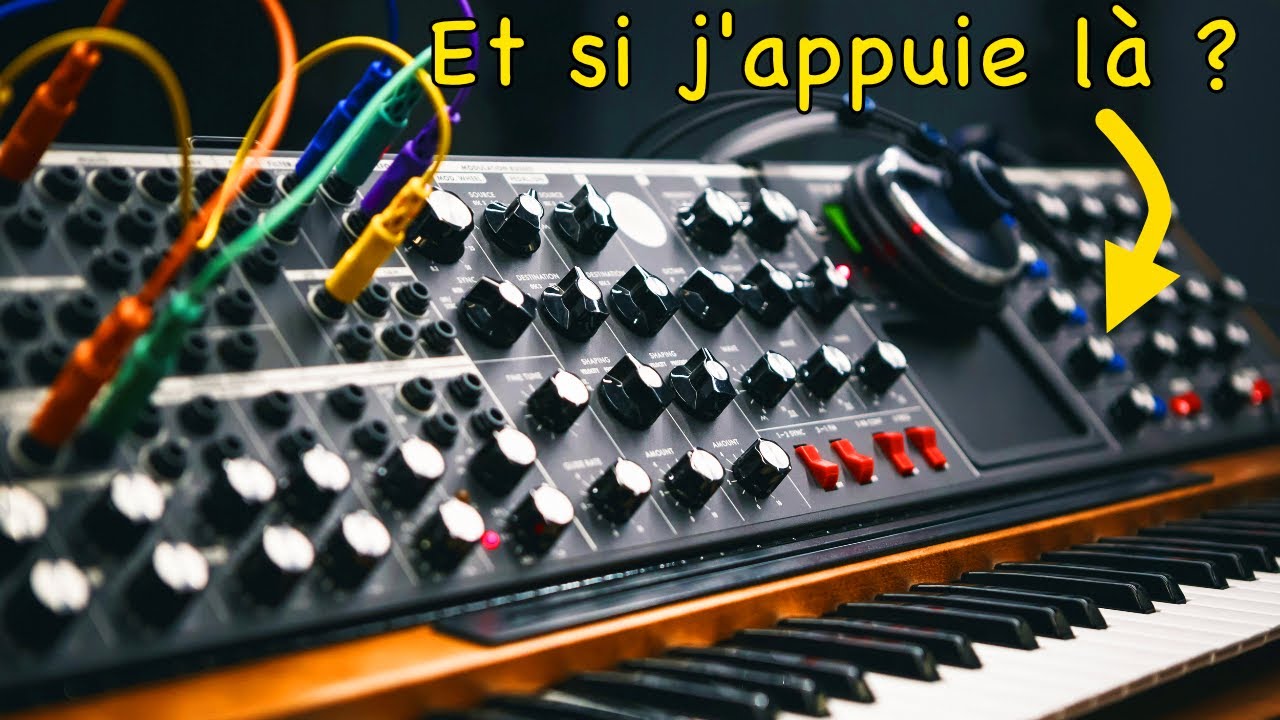
LE SYNTHÉTISEUR, ou comment l'électronique a changé la musique (ft. Scherzando)
THE SYNTHESIZER, or how electronics changed music (ft. Scherzando)
Title history
- LE SYNTHÉTISEUR, ou comment l'électronique a changé la musique (ft. Scherzando) — observed on 20261019-0417 UTC (PSI archive)
Keywords
Summary
198 words
Critical Evaluation
Value of the Information & Strength of the Argument
The video delivers substantial value by combining rigorous scientific explanations of how synthesizers work with a rich historical narrative. The argumentation is solid: each technical concept is clearly explained with visual aids and practical demonstrations, making advanced topics accessible. The collaboration with Scherzando adds depth to the cultural and historical dimensions, ensuring no aspect is treated superficially.
Scientific Rigor, Source Quality, Title Accuracy
The scientific rigor is high, with accurate representations of sound physics, Fourier analysis, and electronic circuits. The video cites no external printed sources but relies on established knowledge and demonstrates principles using open-source tools. The title accurately matches content, and the extra references in the description (books, support links) are relevant. No contradictions or unsupported claims were detected.
130 words
Title / Content Match
The title accurately reflects the video's dual focus: explaining the electronic principles of synthesizers and their historical impact on music.
Quality & Reliability
9/10
High-quality science communication with clear explanations, historical context, and technical demonstrations. The content is consistent with established physics and engineering principles.
Key Moments
Markers derived by PSI from the transcript: the creator did not define chapters.
- Introduction to sound as pressure waves and the two traditional ways to produce it.
- History of the theremin, its inventor Léon Theremin, and the instrument's role in early electronic music.
- Electronic principles of the theremin: oscillators, capacitance, and how hand movements control pitch and volume.
- The ondes Martenot, a keyboard-based electronic instrument, and its use in classical compositions like Messiaen's Turangalîla-Symphonie.
- Introduction to oscillators and the four basic waveforms (sine, triangle, square, sawtooth) and their harmonic content.
- Explanation of additive vs. subtractive synthesis, with live demonstrations using VCV Rack.
- The role of Robert Moog and the first modular synthesizers, transitioning from vacuum tubes to transistors.
- Impact of Wendy Carlos's 'Switched-On Bach' and the adoption of synthesizers in popular music, including the Beatles and Emerson, Lake & Palmer.
Cited Sources
- ScienceEtonnante's books — References to the author's books on science topics.
- Support page — Link to support the channel, mentioned in the description.
- Grégoire Blanc's theremin channel — Provided as a resource for theremin performances and tutorials.
- ScienceEtonnante YouTube channel — The main channel, where viewers can subscribe.
Concurring Sources
- ScienceEtonnante blog — Mentioned in the description as containing additional clarifications, likely aligned with the video content.
Contribution & Novelties
The video’s originality lies in its seamless integration of physics, engineering, and music history, making complex technical concepts approachable for a general audience. It successfully explains the foundational principles of electronic music creation without oversimplifying, and the collaboration with Scherzando provides a rare cultural perspective. The hands-on demonstration with VCV Rack enhances comprehension.
Pour aller plus loin :
- Theremin - Wikipedia — Detailed history and technical operation of the instrument.
- Subtractive synthesis - Wikipedia — Theory and applications of this predominant synthesis method.
- Moog synthesizer - Wikipedia — Evolution and impact of the pioneering synthesizer.
- Fourier transform - Wikipedia — Mathematical foundation for understanding harmonic content of sound.
108 words
Radar Profile
The scores are high across all dimensions, with a slight dip in technical level (7) reflecting the accessibility aimed at a broad audience. The high values for information quantity and quality confirm a dense yet clear educational experience, and the reliability score underscores the trustworthiness of the presentation.
💬 Très positif. Sur les 30 commentaires analysés, tous expriment une forte appréciation, beaucoup demandent une deuxième partie et saluent la clarté et la richesse du contenu.