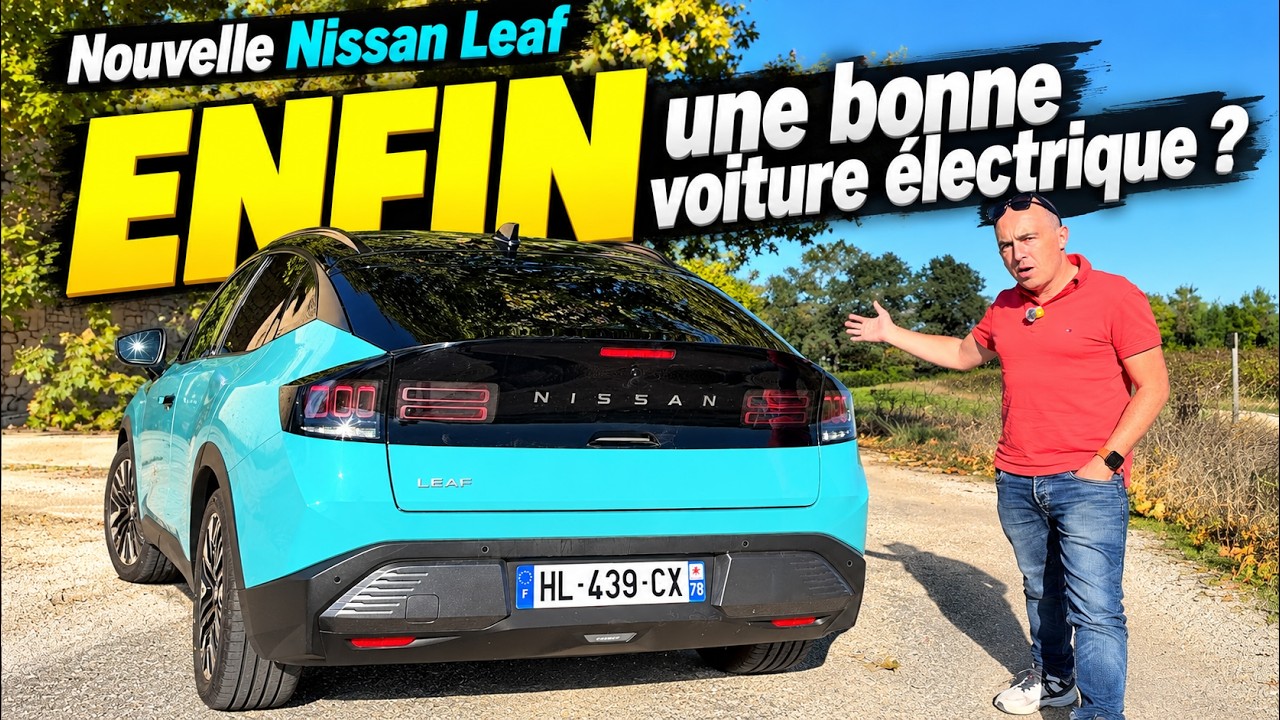
Essai Nissan Leaf 2026 : ENFIN une bonne voiture électrique ?
2026 Nissan Leaf Review: FINALLY a good electric car?
Title history
- Essai Nissan Leaf 2026 : ENFIN une bonne voiture électrique ? — observed on 20261110-0240 UTC (YouTube)
Keywords
Summary
181 words
Critical Evaluation
Value of the Information & Strength of the Argument
The video provides substantial value through real-world data collected over a long journey. Consumption figures, charging times, and range results are measured and presented with context, allowing viewers to assess the car’s practical capabilities. The argumentation is balanced: the presenter acknowledges both strengths (comfort, infotainment, design) and weaknesses (slow charging, ergonomics, lack of AWD). However, the conclusions rely on personal impressions and a single test, so they are not statistically robust. The comparison with competitors is qualitative, based on widely known specifications rather than direct back-to-back tests.
Scientific Rigor, Source Quality, Title Accuracy
The video does not cite academic or official sources, but it references real-world test results and links to the reviewer’s own article on Mac4Ever. The description also includes links to independent reviews of charging wallboxes, which are relevant peripheral products. The title aligns well with the content, which focuses on evaluating the Leaf’s overall quality. No user comments were provided for analysis. The absence of formal source citations reduces its scientific rigor, but for a consumer-oriented review, the transparency about methods and data collection is acceptable.
188 words
Title / Content Match
The title accurately reflects the content, which is a comprehensive test of the Nissan Leaf 2026, highlighting both strengths and weaknesses.
Quality & Reliability
7/10
The reviewer provides a hands-on test over 2000 km, including real-world range and charging measurements, but the assessment is subjective and lacks a formal methodology or third-party verification.
Chapters
Cited Sources
- Mac4Ever article on the Nissan Leaf 2026 test — The official article summarizing the test and including additional technical details.
- Test of the Beny charging wallbox — A review of a home charging wallbox, referenced as a complementary product in the video description.
- Test of the DazeBox Home charging wallbox — Another wallbox review, illustrating home charging solutions mentioned in the description.
External References
Contribution & Novelties
This video contributes original field data on the Nissan Leaf 2026, particularly real-world range and fast-charging performance over a 2000 km journey. It offers a user perspective on the car’s daily usability, including in-car technology like native Google Maps, and provides critical insights into ergonomic flaws that official reviews may overlook.
Pour aller plus loin :
- Nissan Leaf (Wikipedia) — Background on the Leaf model history and specifications.
- Worldwide harmonised Light vehicles Test Procedure (WLTP) — Explanation of the official range measurement standard used to state 622 km.
- Combined Charging System (CCS) — Overview of the fast-charging standard used on the Leaf and its limitations.
105 words
Radar Profile
The radar profile shows strong quantitative information and good data collection, but moderate scores in technical depth and reliability due to the lack of a formal methodology and external verification. The balance between information quantity and subjective assessment is typical for a well-crafted automotive review.