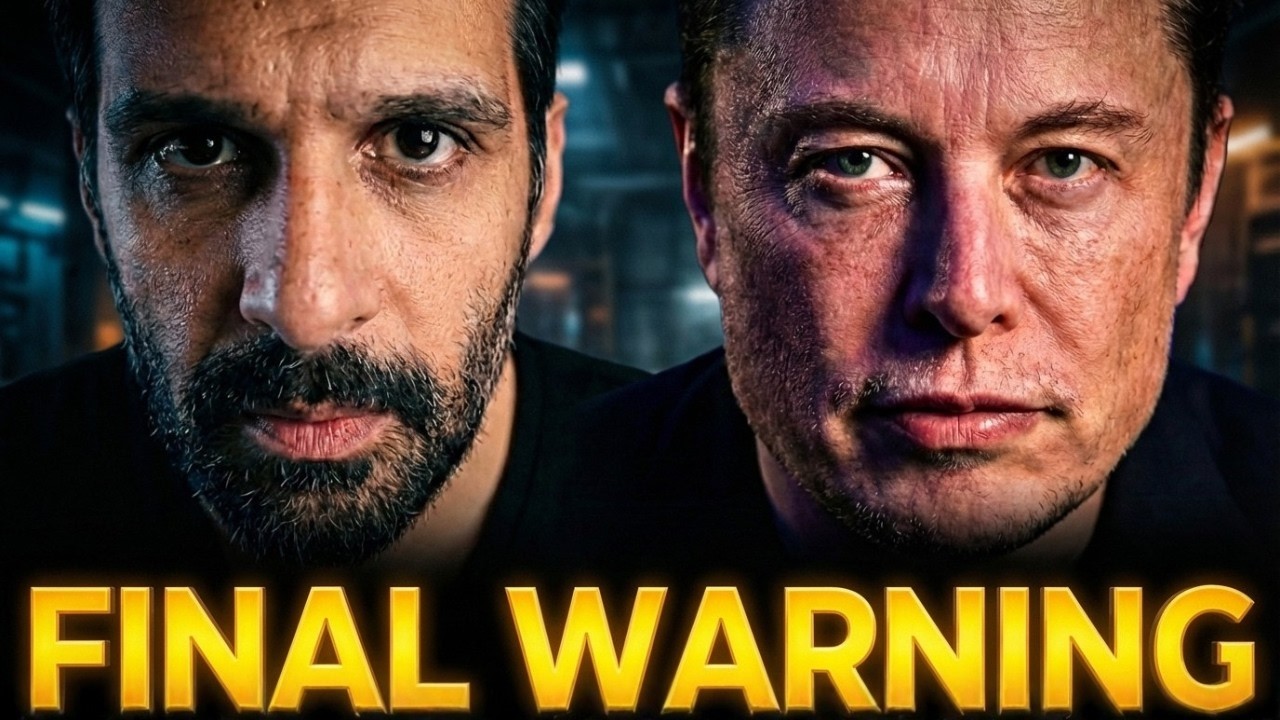
Tesla, SpaceX & xAI Are About to Make History
Title history
- Tesla, SpaceX & xAI Are About to Make History — observed on 20261110-0247 UTC (YouTube)
Keywords
Summary
161 words
Critical Evaluation
Value of the Information & Strength of the Argument
The video offers high value by synthesizing disparate developments into a coherent narrative that explains how Elon Musk’s companies interlock. The argumentation is logically structured, starting from first principles (energy-compute-AI flywheel) and building to specific examples. Farzad effectively uses the data moat concept, emphasizing unique data sources like X’s 600 million users and Tesla’s billions of driving miles. He also acknowledges counterarguments (‘where I could be wrong’), which strengthens credibility. The discussion of orbital data centers and the economics of Starship is compelling, though somewhat speculative. The strength lies in illustrating how the synergy creates exponential advantages that competitors cannot replicate.
Scientific Rigor, Source Quality, Title Accuracy
The video’s rigor is moderate; it references specific events and figures without external citations, relying on the author’s industry insight and public statements. Sources are limited to the description links (books and an exclusive article), but no direct quoting or hyperlinks during the video. The title matches the content perfectly. Comment analysis shows a generally positive reception, with some viewers asking for the author to speak instead of using an AI voice, indicating slight dissonance in presentation but not in substance.
197 words
Title / Content Match
The title accurately reflects the video's focus on the imminent historical significance of the combined actions of Tesla, SpaceX, and xAI, and the content delivers on that promise.
Quality & Reliability
6/10
The video presents a coherent and well-argued thesis about the convergence of Tesla, SpaceX, and xAI, supporting claims with specific events (e.g., SpaceX choosing Nvidia Vera Rubin) but relying heavily on interpretation and projections. Author discloses personal investments and past employment, adding credibility, yet many assertions are speculative and lack direct citations. Overall, the content is insightful but not rigorously evidenced.
Key Moments
Markers derived by PSI from the transcript: the creator did not define chapters.
- Introduction of the flywheel concept: AI, robotics, and energy as one revolution.
- Mention of SpaceX's exclusive partnership with Nvidia and the Vera Rubin compute for Starlink.
- Explanation of xAI as the brain, SpaceX as the vessel, and Tesla as the body.
- Discussion on Starship's heat shield and full reusability enabling orbital compute.
- Tesla's end-to-end neural network for driving and its application to Optimus.
- Cost comparison: Optimus at $20k-$30k vs a human worker's annual cost, highlighting the $40 trillion labor market.
- Elon Musk's plan for a 10,000-robot warehouse and the fleet learning effect.
- Terafab as the chip factory and the complete integrated system architecture.
- The idea of merging digital (Grok) and physical (Optimus) assistants, and the potential market mispricing.
Cited Sources
- Master Plan: What Elon Musk is Actually Building — Referenced as a book that provides deeper context on Musk's overarching strategy.
- Abundance or Collapse — Another book by the author that likely explores similar themes of innovation and future scenarios.
- Exclusive: Tesla, SpaceX and xAI are About to Make History — An article on the author's website that expands on the video's content.
External References
Contribution & Novelties
The video’s primary contribution is presenting the ‘one flywheel’ thesis, framing Tesla, SpaceX, and xAI as a single vertically integrated AI-robotics-energy system rather than separate entities. It uniquely ties together orbital data centers, neural network driving, humanoid robots, and manufacturing into a coherent narrative with actionable investment implications. The concept of a data moat multiplying across platforms is emphasized. For further exploration:
- Flywheel effect — The conceptual basis for the compounding cycle described.
- Space-based solar power — Relevant to the 24/7 solar energy in orbit claim.
- Data moat — Discusses how proprietary data creates competitive advantages, a core argument of the video.
102 words
Radar Profile
The radar shows a balanced profile with high information quantity (8) and technical depth (7), but lower global reliability (6) due to speculative elements. The argumentation is strong (quality 7), yet the lack of direct citations and reliance on projections pulls down trust. Overall, the video is informative and insightful for those following Musk's ventures, but should be consumed with awareness of its opinionated nature.
💬 Positive orientation, with viewers expressing enthusiasm for the integrated vision and the educational value, though several comments criticize the AI voiceover and request the creator to speak personally. Sur les 30 commentaires analysés, la plupart sont favorables et apprécient la synthèse claire, mais une poignée note que la voix AI altère l'engagement personnel.