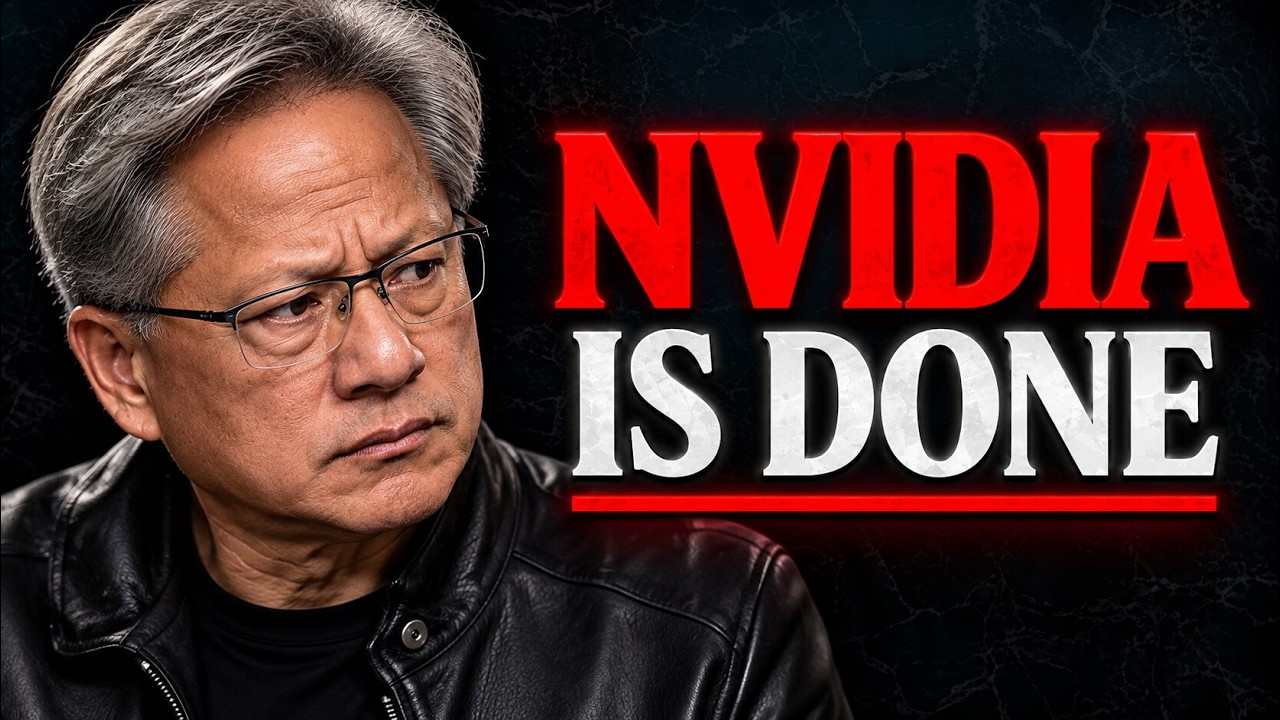
The (Overdue) Collapse of Nvidia's $900B Empire
Title history
- The (Overdue) Collapse of Nvidia's $900B Empire — observed on 20261031-2252 UTC (YouTube)
Keywords
Summary
101 words
Critical Evaluation
Value of the Information & Strength of the Argument
The video provides a compelling argument that Nvidia’s financial engineering has become a critical risk factor. It supports its claims with specific numbers, such as the $105 billion guarantee for OpenAI, Nvidia’s $500 billion off-balance-sheet promises, and the rise in CoreWeave’s bond yields. The argumentation is structured: it presents the problem, evidence, and then balances with counterpoints. However, it relies heavily on interpretations of events and quotes from analysts, and some connections are speculative.
Scientific Rigor, Source Quality, Title Accuracy
The video cites numerous research firms and financial institutions, including Gartner, Morgan Stanley, Goldman Sachs, and SemiAnalysis, but does not provide direct links or citations. It references filings and reports, but the lack of URLs makes verification difficult. The title ‘The (Overdue) Collapse of Nvidia’s $900B Empire’ is somewhat misleading as Nvidia is worth over $5 trillion at the time, and the video actually argues the collapse is not yet happening. The content is more balanced than the title suggests.
169 words
Title / Content Match
The title suggests an imminent collapse, but the video presents a balanced analysis acknowledging Nvidia's strength while highlighting risks. The title is somewhat sensational, though the content does discuss the potential collapse.
Quality & Reliability
7/10
The video relies on multiple reputable sources (Morgan Stanley, Gartner, SemiAnalysis) but also includes speculative statements and relies on quoted opinions. Financial figures are detailed but some claims lack direct references or URLs.
Key Moments
Markers derived by PSI from the transcript: the creator did not define chapters.
- Introduction: Nvidia's deal with Meta and Musk's warning about neo clouds.
- Nvidia's history and early struggles, including the '30 days from going out of business' phrase.
- Rise of AI and Nvidia's dominance, with revenue and market cap data.
- Introduction of financing guarantees and off-balance-sheet commitments.
- Detailed analysis of the OpenAI Ohio project and the $105 billion guarantee.
- Problems in the neo-cloud sector, including CoreWeave's debt and bond yields.
- Counterarguments: rental price increases, Nvidia's cash flow, and bullish analysts.
- Conclusion: three things to watch and the broader implications.
Cited Sources
- SemiAnalysis — Cited for analysis on limits of AI infrastructure, shifting from data center space to money.
- Morgan Stanley — Cited for cost estimates of Vera Rubin racks and data center power shortfall.
- Gartner — Cited for prediction that over 80% of neo cloud providers will cease independent operations by 2030, and infrastructure spending/revenue forecasts.
- Goldman Sachs — Cited for analysis on CoreWeave being likely in top quartile of neo clouds and capital constraints.
- OpenAI — Mentioned as the tenant in Ohio with a $105 billion guarantee from Nvidia.
- Meta — Mentioned for its stock sale and Nvidia's $3 billion investment to fund AI spending.
Concurring Sources
- Rich Piverotsky (Goldman Sachs strategist) — Quoted as saying demand for computing can grow exponentially but capital cannot finance it.
- John Lovelock (Gartner) — Quoted predicting takeovers and mergers of neo clouds, not bankruptcies, but with significant exposure.
- David Trainer (New Constructs) — Warned that if computing demand doesn't live up to expectations, there will be problems.
Dissenting Sources
- Andreessen Horowitz — Published data showing rental prices for Nvidia H200 and B200 chips up significantly, contradicting fears that chips wear out quickly.
- Gene Munster (Deepwater Asset Management) — Expects Nvidia to bring in around $700 billion revenue next year and argues its scale allows it to finance customers.
- Dan Ives (Wedbush Securities) — Called the CoreWeave fears 'way overdone' and expressed confidence in AI infrastructure spending.
Contribution & Novelties
The video highlights the underappreciated risk of Nvidia’s financial engineering, showing that its success has made it a lender and insurer to its own customers. It connects the dots between Nvidia’s off-balance-sheet guarantees, the credit crunch in neo clouds, and the potential systemic risk. This perspective is novel as most coverage focuses on Nvidia’s market dominance.
Pour aller plus loin :
- Credit default swap — Explains the insurance-like instrument mentioned in the video, used on CoreWeave’s debt.
- Tensor processing unit — Google’s custom chip that competes with Nvidia, a key alternative to GPUs.
- Data center — The physical facilities that house AI infrastructure, central to the financing issues discussed.
109 words
Radar Profile
The scores suggest a well-researched video with high information quantity but moderate technical depth and reliability. The balance between amount and quality of information indicates a comprehensive analysis, though reliance on speculative statements keeps the reliability score moderate.