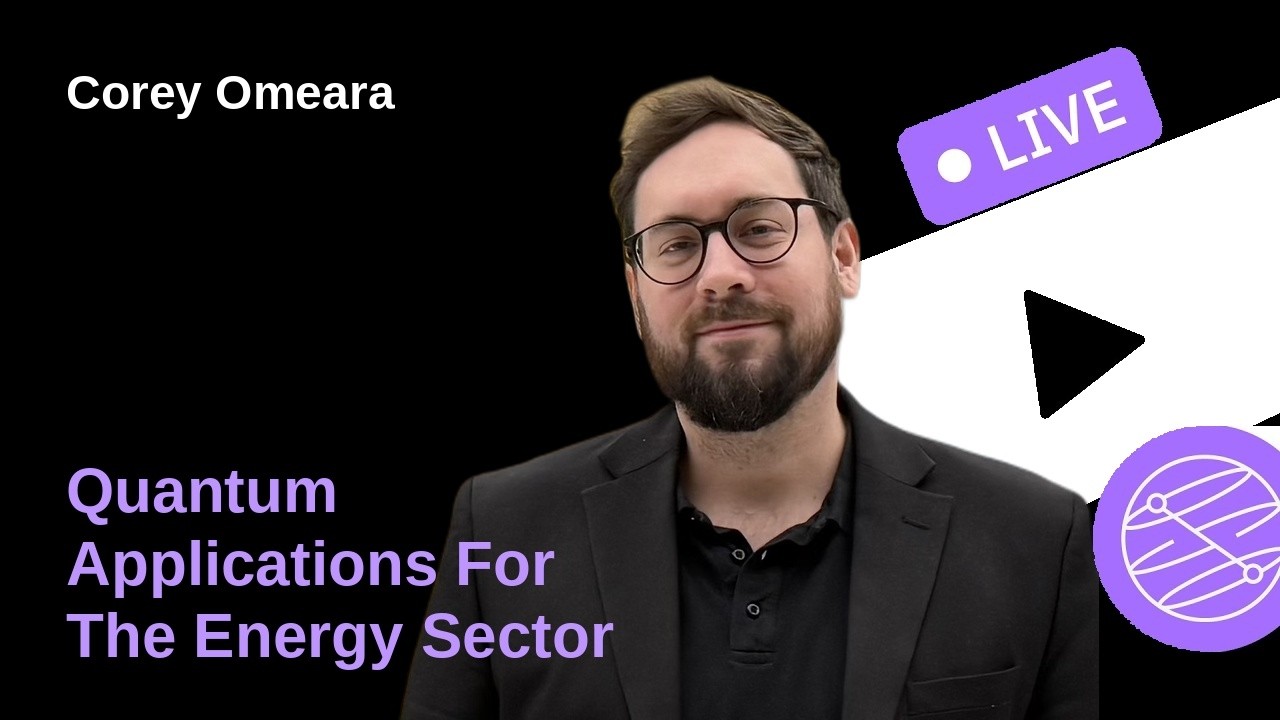
Dr. Corey Omeara | Seminar Series
Title history
- Dr. Corey Omeara | Seminar Series — observed on 20261101-0403 UTC (YouTube)
Keywords
Summary
184 words
Critical Evaluation
Value of the Information & Strength of the Argument
The talk provides a valuable insider perspective on how a major energy company approaches quantum computing, emphasizing practical business value over abstract speedups. The argumentation is strong: O’Meara clearly articulates the steps from identifying a problem, verifying its hardness, to running at scale on real hardware. He supports his claims with specific examples, such as the unit commitment problem where QAOA with Qiskit performance management achieves results comparable to classical solvers after one hour, and outperforms them in feasibility. The discussion of QOBLIB underscores the importance of standardized benchmarking. However, some statements are prospective (e.g., 2029 fault-tolerant expectations) and not all results are peer-reviewed yet, but the presentation of preliminary data is transparent. Overall, the value lies in bridging quantum computing theory with industrial energy applications.
Scientific Rigor, Source Quality, Title Accuracy
Dr. O’Meara demonstrates rigor by referencing published papers, patents, and collaborations with IBM Quantum. He mentions the QOBLIB paper in Nature Computational Science and provides links to his 2025 talk and a discussion on QOBLIB in the description. The use of real hardware results with specific qubit counts and error mitigation techniques adds credibility. The talk is well-structured and the title, while generic, does not mislead; the abstract and description accurately set expectations. No external contradictory sources are discussed, but the speaker acknowledges ongoing debate on quantum advantage and the need for rigorous validation. The public engagement (40 likes, 3,568 views) suggests interest, though no comments were provided for analysis.
251 words
Title / Content Match
The title 'Dr. Corey Omeara | Seminar Series' is generic and does not reflect the specific focus on quantum applications for energy, but it is consistent with the seminar format. The content aligns well with the abstract and description provided.
Quality & Reliability
7/10
The talk presents credible information from a leading industrial quantum computing team, with references to published work and real hardware results. However, it is a company perspective and some claims are forward-looking, lacking independent peer review for all statements.
Key Moments
Markers derived by PSI from the transcript: the creator did not define chapters.
- Introduction of Dr. Corey O'Meara and his background
- Overview of E.ON's business and complexity of energy grid
- Categories of quantum use cases: optimization and system modeling
- Journey from 7 qubit experiments to utility-scale 100+ qubit demonstrations
- Introduction of QOBLIB and its role in benchmarking optimization problems
- Detailed results on unit commitment problem using QAOA on IBM hardware
- Conclusion and future plans including 500+ qubit applications and fault-tolerant era
Cited Sources
- Dr. Corey O'Meara's 2025 QDC talk — Referenced as a prior talk by the speaker on quantum benchmarking
- Conversation with Dr. Christa Zoufal about QOBLIB — Mentioned as a discussion on the quantum optimization benchmarking library
Contribution & Novelties
The talk contributes an industrial perspective on practical quantum advantage, demonstrating that utility-scale quantum computing is being actively applied to real-world energy optimization problems. It highlights successful results on IBM hardware with 100+ qubits, particularly for the unit commitment problem and quantum machine learning, and introduces the use of QOBLIB for standardized benchmarking. The emphasis on starting from business needs and verifying problem hardness provides a valuable framework for other industries.
Pour aller plus loin :
- Quantum computing — Overview of quantum computing principles.
- Knapsack problem — The classical combinatorial optimization problem relevant to the unit commitment case.
- QAOA — Quantum approximate optimization algorithm used in the talk.
- Quantum annealing — Another approach to optimization mentioned in the background.
119 words
Radar Profile
The radar profile shows high scores in quantity and technical level, reflecting the detailed and specialized content, while quality and reliability are slightly lower due to the company perspective and forward-looking claims. The overall performance is solid for a professional seminar on applied quantum computing.