lecture 04 Solved Examples and Poynting vector
Title history
- lecture 04 Solved Examples and Poynting vector — observed on 20261030-1154 UTC (YouTube)
Keywords
Summary
142 words
Critical Evaluation
Value of the Information & Strength of the Argument
The value of the information is strong for a pedagogical setting: it bridges theoretical Maxwell equations with concrete engineering applications like resistance calculations and power transfer. The argumentation is methodical, deriving results from first principles and clearly explaining each algebraic step. The instructor anticipates common misconceptions (e.g., why the skin effect matters) and uses physical reasoning to justify approximations. However, the presentation is somewhat informal and lacks references to external authoritative sources, relying on the instructor’s expertise.
Scientific Rigor, Source Quality, Title Accuracy
Scientific rigor is acceptable: the derivation of the Poynting theorem follows standard textbook procedures, and the numerical examples are consistent with conventional formulas. No external sources are cited in the video; the only link in the description points to lecture notes (Google Drive). The title accurately matches the content: the lecture indeed presents solved examples and discusses the Poynting vector. No comments were provided to assess public reception.
160 words
Title / Content Match
The title accurately reflects the content: the video solves examples related to transmission lines and derives the Poynting vector and power expressions.
Quality & Reliability
7/10
The lecture provides a rigorous derivation of the Poynting theorem from Maxwell's equations and works through numerical examples. The reasoning is clear but relies on standard textbook material; no external citations are given beyond the lecture notes. The approach is pedagogical and consistent with established electromagnetic theory.
Key Moments
Markers derived by PSI from the transcript: the creator did not define chapters.
- Introduction: objectives of the lecture, review of previous concepts.
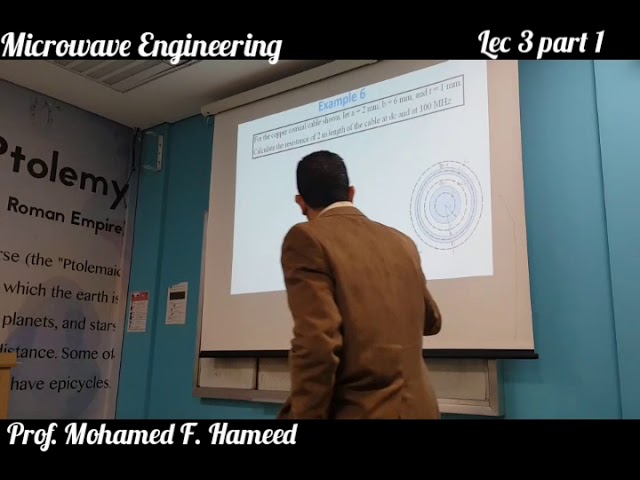
- Start of solved example: DC resistance of coaxial cable.
- Discussion of skin effect and AC resistance calculation.
- Comparison of AC and DC resistance at high frequency.
- Introduction of power flow and Poynting vector concept.
- Derivation of Poynting theorem from Maxwell's equations.
- Expression for average power in a lossy medium.
- Worked example: finding Poynting vector and average power for given fields.
Cited Sources
- Lecture notes (Google Drive) — The only link provided in the video description, likely containing supplementary notes for the lecture.
Contribution & Novelties
The video provides a step-by-step derivation of the Poynting theorem and applies it to concrete engineering problems, such as calculating resistance in coaxial cables with skin effect. It emphasizes the physical interpretation of each term in the power balance equation. The originality lies in the pedagogical approach, linking Maxwell’s equations to practical power transmission considerations.
Pour aller plus loin :
- Poynting vector — Wikipedia article detailing the definition and interpretation of the Poynting vector.
- Skin effect — Wikipedia article explaining the phenomenon of current concentration at high frequencies.
- Maxwell’s equations — Fundamental equations governing electromagnetism, foundational to the derivations in the lecture.
102 words
Radar Profile
The radar profile shows high scores in quantity of information and technical level, reflecting a dense, mathematically rigorous lecture. The quality and reliability scores are slightly lower, indicating that while the content is accurate, it relies on the instructor's presentation without external verification. Overall, the lecture is comprehensive for its target audience.