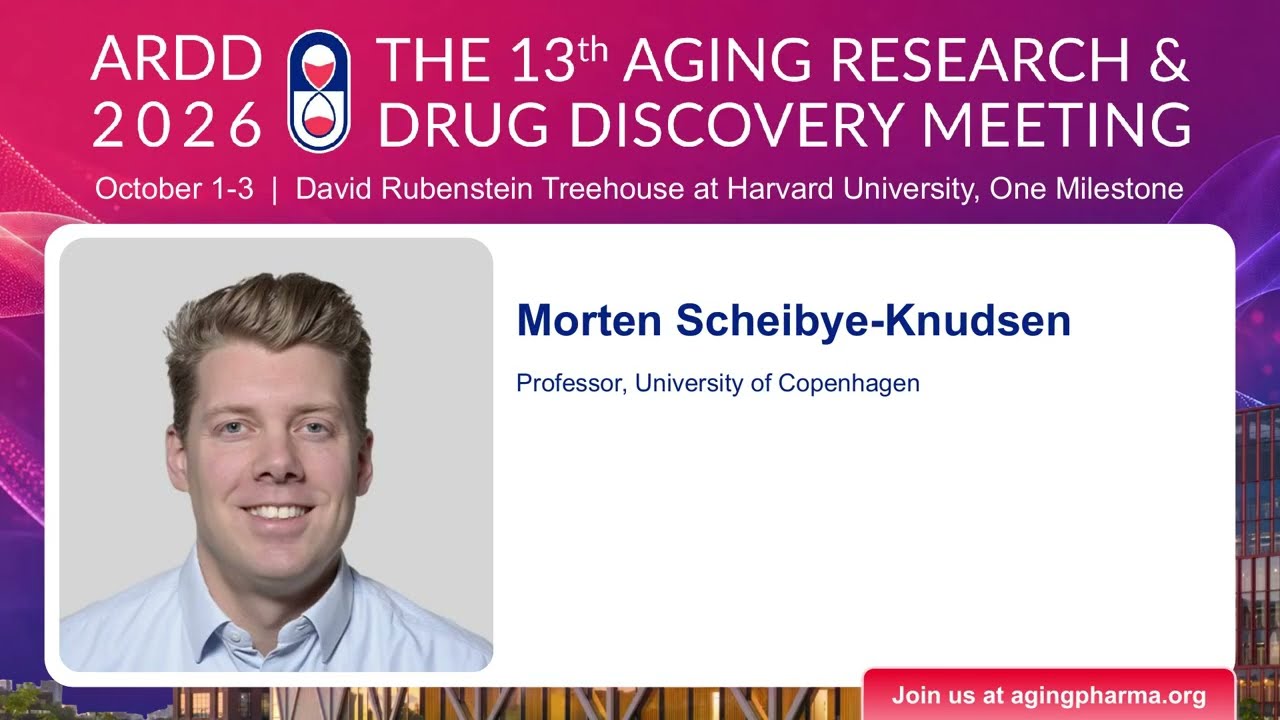
Morten Scheibye-Knudsen at ARDD2026: Quantifying and targeting aging phenotypes driven by DNA damage
Keywords
Summary
141 words
Critical Evaluation
Value of the Information & Strength of the Argument
The talk provides substantial value by presenting novel data from multiple angles: predictive biomarkers using facial photographs and cell morphology, a new perspective on mutation timing (embryonic origin), and a promising small molecule that targets the DNA damage response. The argumentation is logically structured: the speaker moves from observation (phenotypes) to mechanistic insight (DNA damage signaling) and finally to intervention (drug treatment). He connects his findings to broader aging concepts and existing literature, though some conclusions are based on unpublished data and are presented with appropriate caution. The rationale for focusing on DNA damage signaling rather than mutations is well-supported by evidence from DNA polymerase mutations not causing accelerated aging.
Scientific Rigor, Source Quality, Title Accuracy
The presentation maintains a high level of scientific rigor, citing collaborations with hospitals, spin-out companies, and unpublished work from the Verdin lab. The use of computational algorithms and single-cell RNA-seq for mutation inference is sophisticated, but the methodology for distinguishing inherited from somatic mutations is not fully detailed, leaving room for scrutiny. The speaker acknowledges the preliminary nature of some results and discusses potential confounders. The title is accurate and not exaggerated, reflecting the dual focus on quantifying and targeting aging phenotypes. The talk references prior work by David Sinclair and others, situating the research within the field. No external sources are directly cited beyond the ARDD conference context, but the speaker mentions published papers and ongoing projects.
243 words
Title / Content Match
The title accurately reflects the talk's content, which focuses on quantifying aging phenotypes via biomarkers and interventions targeting DNA damage pathways.
Quality & Reliability
8/10
Presents a blend of published and unpublished data, with robust computational and experimental methods. Claims are often preliminary but supported by clear reasoning and references to ongoing collaborations.
Key Moments
Markers derived by PSI from the transcript: the creator did not define chapters.
- Introduction to the lab's focus on phenotypes, including whole-organism and cellular levels.
- Facial photograph analysis predicts survival with better accuracy than blood tests.
- Computational detection of senescent cells from morphology; low senescent cell count correlates with higher cancer risk.
- Analysis of mutations in single-cell RNA-seq reveals most mutations occur during embryogenesis, not aging.
- The DNA damage response consumes NAD; NR supplementation improves outcomes in a COPD RCT.
- High-throughput screening identifies compounds that activate DNA damage signaling without causing damage; lead compound 'Drug F' reverses senescence.
- Drug F rescues motor function in fruit flies and reduces DNA damage foci in neurons.
- Six-month treatment with Drug F in 5XFAD Alzheimer's mice improves learning, motor function, and body weight; secondary model also shows benefits.
Cited Sources
- AgingPharma.org — Official website of the ARDD conference and Aging Research and Drug Discovery community.
- AgingPharma LinkedIn — LinkedIn page for updates on ARDD and related aging research events.
Contribution & Novelties
The talk introduces several novel findings: facial photographs as robust predictors of survival, a computational method to identify senescent cells from morphology and blood smears, evidence that most somatic mutations arise in embryogenesis rather than aging, and a small molecule that activates the DNA damage response without DNA damage, reversing senescence and improving Alzheimer’s disease phenotypes in mice. It also presents a pilot RCT on NR in COPD, showing potential for NAD+ precursors in inflammation.
Pour aller plus loin :
- DNA damage response — Central mechanism discussed; key to understanding the therapy’s target.
- Senescence — The cellular phenotype targeted by the drug and biomarker studies.
- Nicotinamide adenine dinucleotide — NAD+ and its precursors (NR, NMN) are crucial in aging and DNA repair.
122 words
Radar Profile
The radar shows high quantite_information and niveau_technique, indicating a dense, technical presentation. Qualite_information is high due to robust methods, but fiabilite_globale is slightly lower due to many unpublished results. The overall score balances these factors.