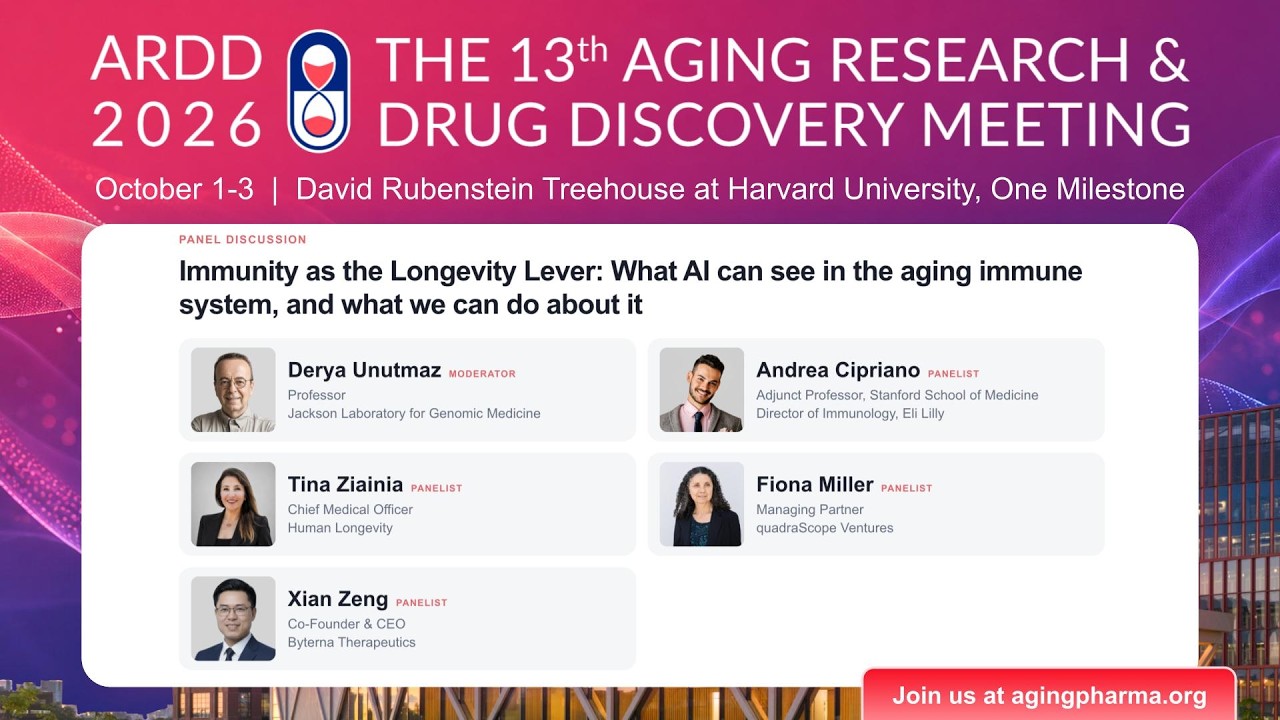
AI for Systems Immunology & Immune Aging Panel at ARDD2026
Title history
- AI for Systems Immunology & Immune Aging Panel at ARDD2026 — observed on 20261104-1436 UTC (YouTube)
Keywords
Summary
159 words
Critical Evaluation
Value of the Information & Strength of the Argument
The panel provides valuable cross-disciplinary perspectives on immune aging, combining investor viewpoints, clinical practice, and AI-driven drug development. The argumentation is solid, with experts grounding their claims in their own data and experience. For instance, Andrea Cipriano clearly explains the context-of-use problem for omic clocks, arguing that their training on chronological age limits their relevance for measuring therapeutic efficacy. This is a well-reasoned point supported by examples from his work. Similarly, Fiona Miller’s emphasis on team dynamics over science alone offers a pragmatic investment perspective. However, some statements remain anecdotal, such as Tina Ziainia’s mention of a patient with endometrial cancer, which illustrates the need for whole-person monitoring but lacks systematic evidence. The discussion acknowledges the lack of consensus on defining immune aging and the necessity for better biomarkers, which adds intellectual honesty. Overall, the arguments are coherent and advance the understanding of AI’s role in immune aging, though the informal format sometimes leads to oversimplifications.
Scientific Rigor, Source Quality, Title Accuracy
The scientific rigor is generally high, as the panelists are recognized experts. They reference specific initiatives, such as the Biomarker consortium, and discuss unpublished data from their companies. However, no formal citations are provided within the video, relying on the speaker’s authority. The title accurately captures the content—a focused panel on AI in systems immunology and immune aging. The adequacy between title and content is precise, with no detour. The description includes links to the ARDD website and LinkedIn, which serve as official sources for the organization. While the panel does not produce a peer-reviewed article, it offers timely insights into ongoing research directions and challenges. The ad hoc nature of a live panel reduces the reproducibility of claims, but it still provides a high-level view of current thinking in the field.
303 words
Title / Content Match
The title accurately reflects the content, which is a panel on AI applications in systems immunology and immune aging at the ARDD2026 conference.
Quality & Reliability
7/10
Panel of experts in immunology and aging, moderated by Derya Unutmaz, discussing recent findings and challenges. The discussion is based on expert experience and referenced data, though some statements are subjective.
Key Moments
Markers derived by PSI from the transcript: the creator did not define chapters.
- Introduction of panel and topic by Derya Unutmaz.
- Fiona Miller discusses investment perspective on immune aging.
- Tina Ziainia talks about female immune system and menopause.
- Andrea Cipriano critiques omic clocks and advocates functional readouts.
- Jamie (likely from XPRIZE) discusses distance-to-problem approach and need for large datasets.
- Xian Zeng explains AI challenges for in-vivo CAR T therapy.
- Final remarks and conclusion of the panel.
Cited Sources
- ARDD Official Website — Website of the conference and organization.
- ARDD LinkedIn — Official LinkedIn page for updates.
Concurring Sources
- ARDD Official Website — Conference source corroborating the event and its focus.
Contribution & Novelties
The panel offers a novel synthesis of immunology, AI, and investment perspectives, emphasizing that functional readouts (e.g., vaccine response, disease onset) are more reliable than molecular clocks for validating immune rejuvenation. It highlights the need for large-scale longitudinal datasets and AI integration to move beyond single-time-point snapshots. The discussion also brings attention to female-specific immune aging and the potential of in-vivo programmable therapies.
Pour aller plus loin :
- Inflammaging — Chronic low-grade inflammation as a hallmark of aging, central to the panel’s discussion on immune aging.
- Epigenetic clocks — The so-called ‘omic clocks’ mentioned, highlighting their limitations in measuring rejuvenation.
- Immunosenescence — Age-related decline in immune function, relevant to the panel’s definition of immune aging.
115 words
Radar Profile
The radar profile shows high scores for information quantity and quality, with moderate technical depth and reliability. The panel's breadth of topics leads to strong coverage, but the informal setting slightly reduces reliability due to lack of verifiable citations.