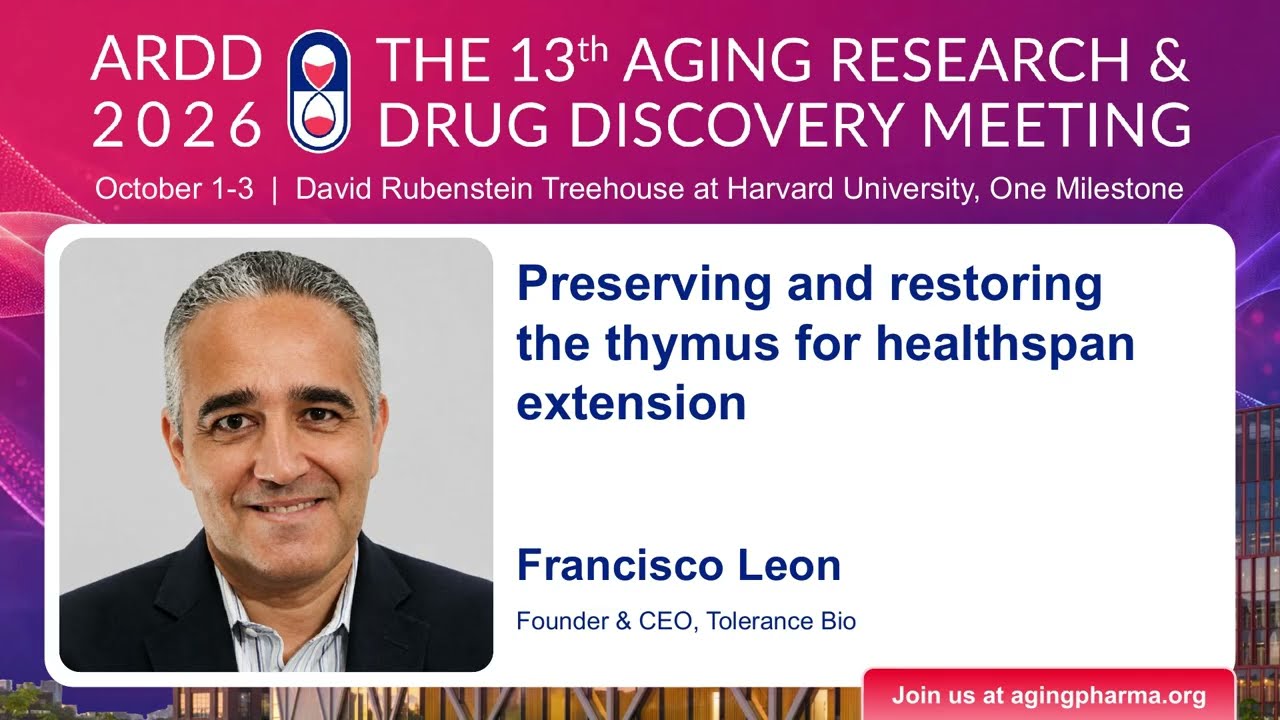
Francisco Leon at ARDD2026: Preserving and restoring the thymus for healthspan extension
Keywords
Summary
174 words
Critical Evaluation
Value of the Information & Strength of the Argument
The presentation offers valuable insights into the emerging field of thymus-based interventions for aging, synthesizing key clinical and preclinical evidence. The argumentation is coherent and data-driven, progressing from basic immunology to specific therapeutic strategies. The speaker effectively uses studies on thymectomy, centenarian biology, and AI-based imaging to build a case for the thymus as a longevity regulator. However, the promotional aspect introduces a bias, particularly in asserting the benefits of Tolerance Bio’s candidates without fully addressing potential limitations. The Q&A briefly touches on the gap between surrogate markers and functional outcomes, but the response remains optimistic, highlighting a need for more direct evidence.
Scientific Rigor, Source Quality, Title Accuracy
The presentation relies on peer-reviewed studies, including Harvard’s 2023 thymectomy analysis and the nursing home thymic activity study, which lend scientific rigor. However, specific citations are not provided in the transcript or description, aside from the general links to agingpharma.org and the ARDD LinkedIn. The mention of the 2025 Nobel Prize for regulatory T cells is accurate and adds credibility. The title accurately reflects the content, and the talk remains focused on its stated theme. The Q&A reveals an openness to critique, but the overall tone is promotional, typical of industry conference presentations. No audience comments are available for analysis.
218 words
Title / Content Match
The title accurately reflects the content, which focuses on preserving and restoring the thymus for extending healthspan.
Quality & Reliability
7/10
The talk is based on published studies and expert knowledge, but also includes promotional elements for the presenter's company. The science is credible but some claims are forward-looking.
Key Moments
Markers derived by PSI from the transcript: the creator did not define chapters.
- Introduction and thank you to organizers; speaker background.
- Explanation of immune tolerance and the thymus's role in generating T-cells.
- Key evidence: 2023 Harvard study on thymectomy, nursing home survival data.
- Tolerance Bio's strategy: anti-IL-33 to preserve and IL-7 to regenerate the thymus.
- Pipeline and future plans: iPSC-derived thymus, LNP therapies, and Q&A.
Cited Sources
- Aging Pharma (ARDD official site) — The official website of the Aging Research and Drug Discovery meeting, where the presentation was recorded.
- ARDD LinkedIn — ARDD's LinkedIn page, providing updates and context for the conference.
Contribution & Novelties
This presentation contributes to the growing discussion on targeting immune aging by focusing specifically on the thymus as a therapeutic organ. It brings together recent clinical findings and proposes concrete interventions (anti-IL-33 and IL-7) that are currently in development. The novelty lies in framing thymic involution as a central driver of age-related immune decline and in presenting a dual strategy of preservation and regeneration.
Pour aller plus loin :
- Thymus — Provides a comprehensive overview of thymus anatomy and function, relevant to understanding its role in immune aging.
- Interleukin-7 — Essential cytokine for T-cell development; its therapeutic potential is discussed in the talk.
- Regulatory T cell — Central to immune tolerance; the 2025 Nobel Prize for their discovery is mentioned.
- Anti-IL-33 therapy — Background on IL-33, a target for thymus preservation.
131 words
Radar Profile
The radar profile shows high scores in quantity and technical level, with moderate quality and reliability. This reflects a dense, expert-level talk with strong scientific grounding but a promotional bias. The low viewership and featured status suggest niche interest, while the high-like ratio indicates appreciation from a specialized audience.