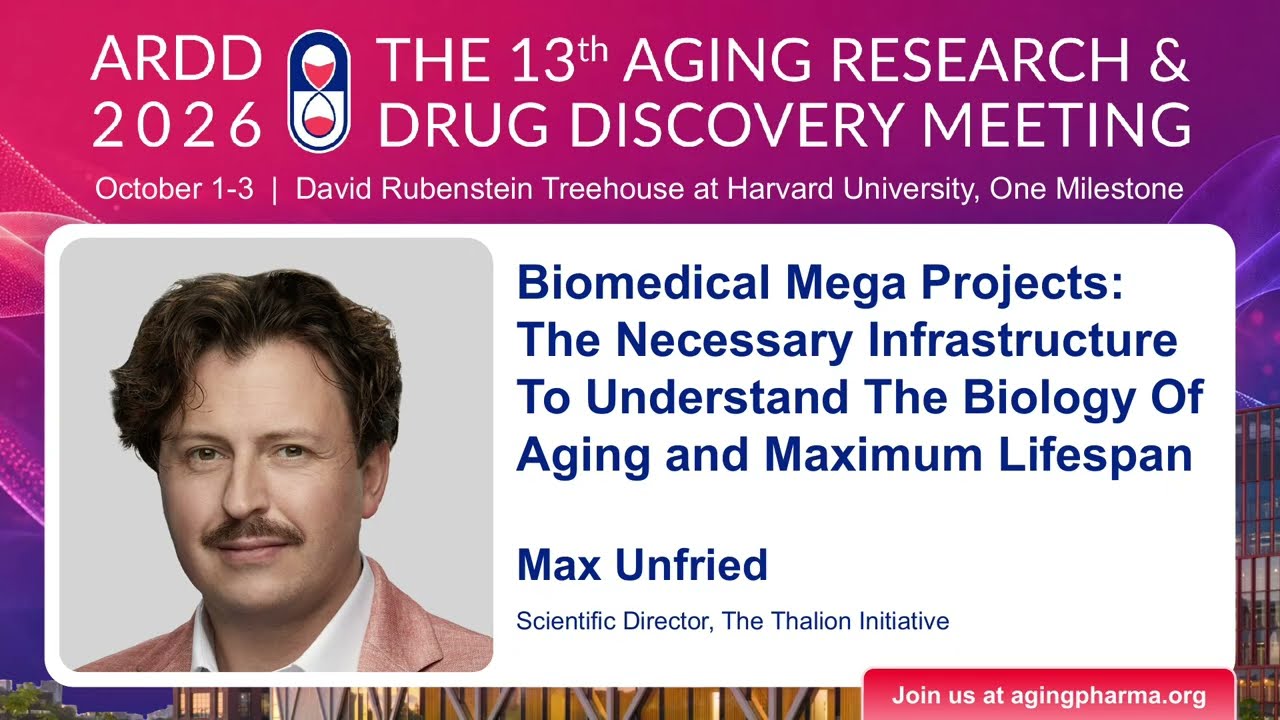
Max Unfried at ARDD2026: Biomedical Mega Projects
Keywords
Summary
163 words
Critical Evaluation
Value of the Information & Strength of the Argument
The talk offers valuable insights by framing aging research as a grand scientific challenge that requires infrastructure investment beyond traditional small-lab grants. The argument that disease-focused research may not extend maximum lifespan is well-presented, using comparative biology examples (mouse vs. human) to strengthen the case. Unfried provides a clear rationale for why existing genomic efforts are insufficient and advocates for a multi-layered, cross-species approach. His proposal for Thalion is concrete, with a focus on standardization and open data, which adds practical value. However, the argumentation relies heavily on analogies to physics and the Human Genome Project, and the feasibility of such mega projects in biology is not deeply explored. The speaker acknowledges challenges (funding, coordination, cultural barriers) but does not offer detailed solutions. The talk is inspiring but somewhat idealistic, with limited critical assessment of potential drawbacks.
Scientific Rigor, Source Quality, Title Accuracy
The talk demonstrates scientific rigor in its use of well-established examples (LIGO, Human Genome Project) and logical reasoning, but it lacks direct citations to specific studies. The speaker references hallmarks of aging and comparative biology at a general level without providing data or references. The description includes links to the ARDD conference and organization, which serve as sources, but the talk itself does not cite specific papers. The title ‘Biomedical Mega Projects’ perfectly matches the content, as the speaker repeatedly advocates for such projects. The scientific quality is moderate: while the ideas are plausible, they are presented as a broad vision rather than a detailed evidence-based proposal. The lack of in-depth technical detail or data undermines the precision of the argument, but it is consistent with a conference presentation intended to provoke discussion.
285 words
Title / Content Match
The title accurately reflects the content, which advocates for large-scale coordinated projects in aging biology, similar to physics mega projects.
Quality & Reliability
6/10
The talk is an expert opinion from a researcher at a major university, but it lacks detailed citations and presents mainly a visionary proposal rather than empirical evidence. The scientific rationale is plausible but speculative in parts.
Key Moments
Markers derived by PSI from the transcript: the creator did not define chapters.
- Introduction: the speaker sets the stage for discussing maximum lifespan and the need for a different approach.
- Examples of physics mega projects: LIGO, Large Hadron Collider, and the space telescopes, highlighting their long durations and large collaborations.
- Human Genome Project as a rare biology mega project, and the proposal to build a similar CERN for aging biology.
- Discussion of current challenges: small lab culture, lack of ambition, and the need for massive data collection across biological layers.
- Thalion's comparative biology approach: ~200 species, 60 specimens each, multiomics data, and the TTDIO data format for efficient compression.
- Call to action: the need for infrastructure, open data, and the potential of comparative biology for future medicines.
Cited Sources
- Aging Pharma Website — Official ARDD conference website providing context on the event and organization.
- Aging Pharma LinkedIn — LinkedIn page for ARDD, offering additional information and updates on the conference.
Contribution & Novelties
The talk provides an original perspective by translating the concept of physics mega projects to aging biology, proposing a concrete initiative (Thalion) to build a vast comparative multiomics dataset. It emphasizes the need for infrastructure, standardization, and AI-ready data, which is a forward-looking approach. The introduction of a new data format (TTDIO) showcases technical innovation, and the call for open, collaborative data is a valuable contribution to the field.
Pour aller plus loin :
- Comparative biology — Relevant to the talk’s core proposal of comparing species to understand aging.
- Hallmarks of aging — The speaker refers to these molecular mechanisms as targets for intervention.
- Multiomics — Central to the data collection strategy described in the talk.
116 words
Radar Profile
The radar profile shows moderate scores across all dimensions, with a slight peak in qualitative information and quantity, reflecting a balanced but not deeply technical presentation. The lower technical score indicates that the talk is accessible to a broad scientific audience rather than being highly specialized.