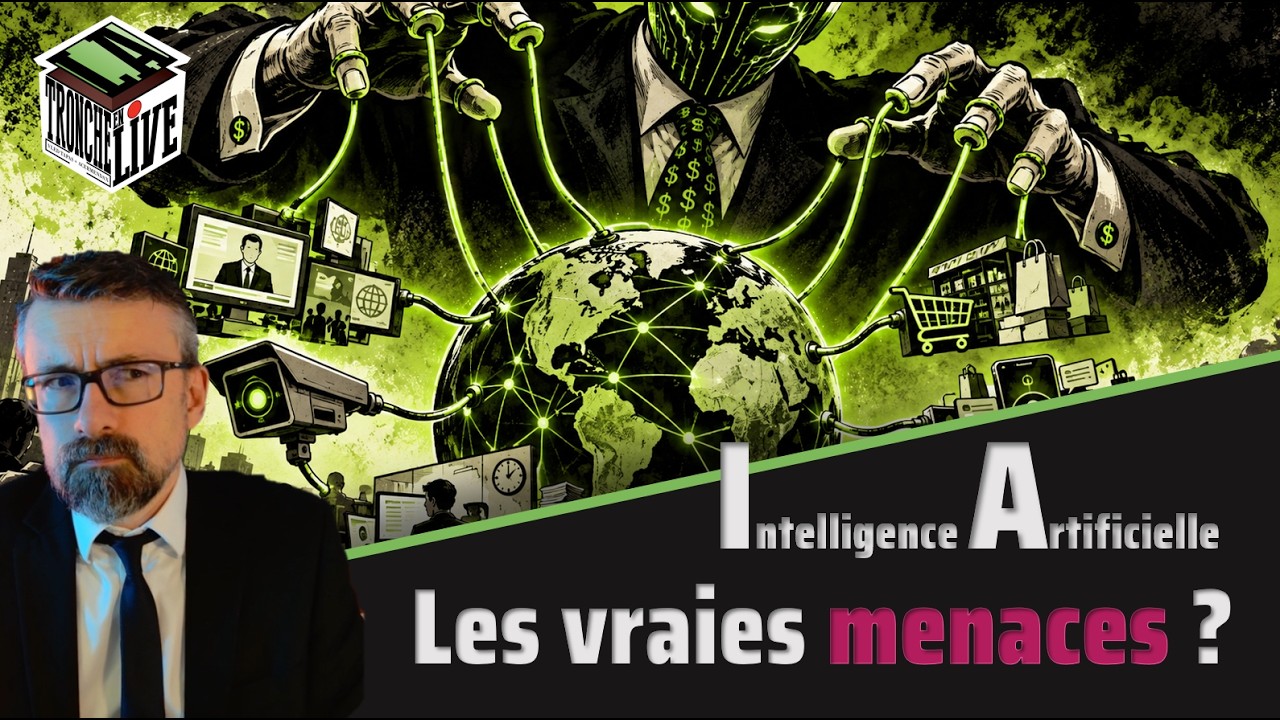
Intelligence Artificielle — les vraies menaces
Artificial Intelligence — the real threats
Keywords
Summary
205 words
Critical Evaluation
Value of the Information & Strength of the Argument
The value of the information lies in its balanced perspective, acknowledging both extreme scenarios and immediate concrete issues. The guests bring expert knowledge from research and policy perspectives, grounding the discussion in real-world examples and academic literature. The argumentation is generally solid, with participants citing specific incidents (e.g., the math papers crisis, AI incidents) and clearly distinguishing between speculation and observed behavior. However, the discussion sometimes relies on anecdotes and personal observations, and the informal tone occasionally undermines the rigor. The host’s own editorial provides a structured framework, but the technical interruptions and the length of the conversation dilute the focus somewhat.
Scientific Rigor, Source Quality, Title Accuracy
The scientific rigor is moderate: the guests reference reputable institutions and recent events, but they do not systematically cite peer-reviewed sources. The quality of the sources mentioned (e.g., statements by Geoffrey Hinton and Yoshua Bengio, Reuters articles) is high, but they are not presented with precise references. The title accurately reflects the content, which focuses on the various threats of AI, from existential to societal. The technical issues and the conversational nature of the live format do not affect the overall alignment between title and content.
203 words
Title / Content Match
The title accurately reflects the content, as the episode focuses on the concrete and perceived threats of AI, including societal, geopolitical, and safety concerns.
Quality & Reliability
7/10
The discussion features two experts in AI policy and safety, grounding the conversation in current research and incidents. However, the informal live format and technical interruptions slightly reduce the rigor.
Key Moments
Markers derived by PSI from the transcript: the creator did not define chapters.
- Introduction by the host on AI threats and overview of the episode
- Guest introductions: Shaïman Thürler and Tom David
- Technical issues with Tom David's connection and switch to Streamyard
- Historical overview of AI: from symbolic systems to deep learning
- Discussion on the unpredictability of AI and sandboxing limitations
- Examples of AI incidents and potential loss of control
- Debate on international coordination and government roles
- Host shares experience with ChatGPT voice mode and personal reflections
- Concluding thoughts on moving beyond apocalyptic narratives
Cited Sources
- Ulule funding page for La Tronche en Biais — Support link for the channel mentioned in the description
- Newsletter subscription page (NEWS'Zet) — Independent newsletter link from the description
- Patreon page — Support platform link from the description
- Tipeee page — Support platform link from the description
- PayPal donation link — Donation link from the description
Contribution & Novelties
The video contributes to the public discourse by framing AI threats not just as existential risks but as present-day societal and geopolitical issues. It offers a platform for experts to discuss nuances rarely covered in mainstream media, such as the practical challenges of regulation and verification mechanisms. The discussion helps demystify the hype and panic around AI, grounding the topic in concrete examples and research.
Pour aller plus loin :
- AI safety — Core concept of preventing harmful AI outcomes, central to the discussion.
- AI alignment — The problem of ensuring AI systems act in accordance with human values, often debated in the video.
- Existential risk from artificial intelligence — Background on the extreme scenarios mentioned by the host.
119 words
Radar Profile
The radar profile shows moderate scores across all dimensions, with a slight strength in information quantity and quality over technical depth. This reflects the educational and accessible nature of the discussion, which balances expert insights with general-audience communication.