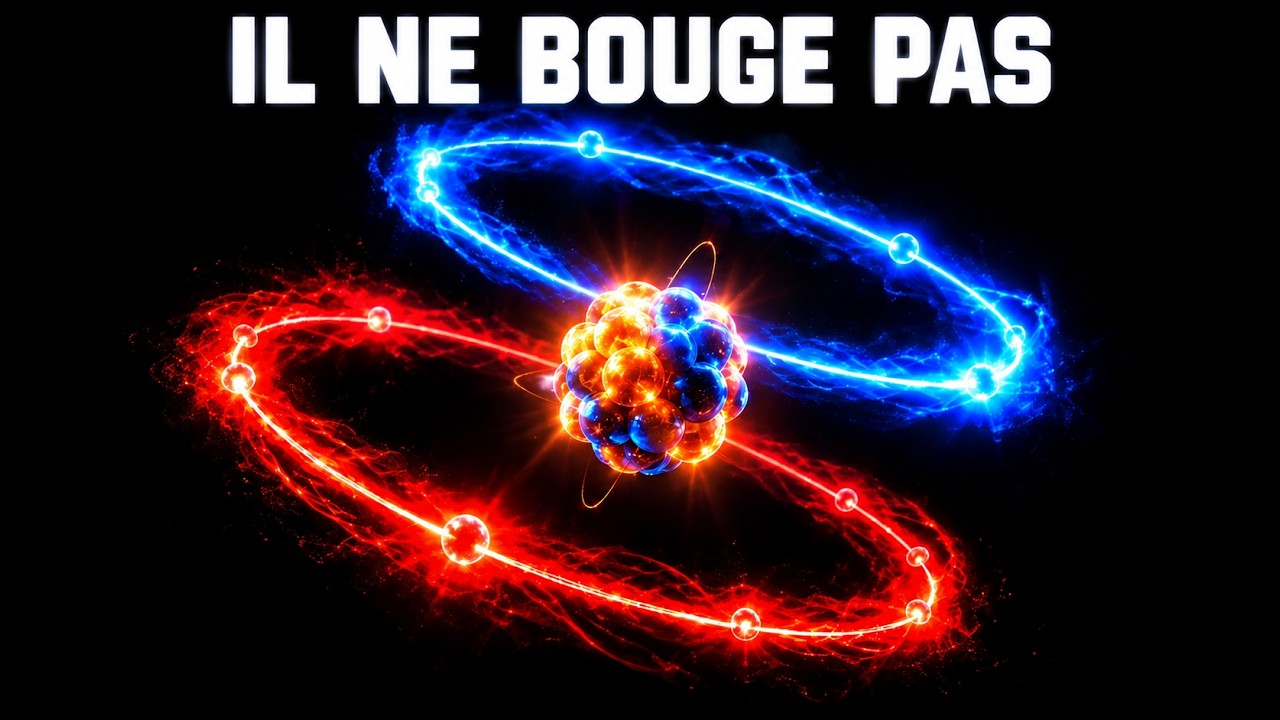
Comment un électron peut-il sauter sans traverser l’espace qui le sépare de sa destination ?
How can an electron jump without crossing the space separating it from its destination?
Title history
- Comment un électron peut-il sauter sans traverser l’espace qui le sépare de sa destination ? — observed on 20261106-1222 UTC (YouTube)
Keywords
Summary
179 words
Critical Evaluation
Value of the Information & Strength of the Argument
The value of the information lies in its excellent pedagogical synthesis of a complex topic. It bridges historical development (Balmer, Bohr, De Broglie, Schrödinger) with modern experimental confirmations (Yale 2019) and philosophical interpretations (Copenhagen, Bohm, many-worlds). The argumentation is logically constructed, using powerful analogies such as a guitar string or a staircase to explain stationarity and discrete energy levels. It carefully distinguishes between the historically important Bohr model and the more rigorous orbital concept, avoiding common misconceptions about trajectories. The solidity of the argumentation is strong for a science communication piece, as it stays faithful to established physics and explicitly mentions unknowns. However, it tends to present various interpretations (e.g., many-worlds) without dwelling deeply on their mathematical or empirical differences, which slightly weakens the critical depth.
Scientific Rigor, Source Quality, Title Accuracy
The scientific rigor is generally high for a documentary. The explanation of the photoelectric effect, atomic spectra, and wave mechanics is correct and well-contextualized. The video accurately characterizes the quantum jump as a transition of the wave function rather than a spatial displacement, which correctly solves the title’s paradox. However, the description provides no external links, scientific papers, or specific bibliographic references, which limits the verifiability of its claims. The title perfectly matches the content, precisely framing the central conceptual question of the documentary. The lack of citations within the video itself is a notable weakness in source quality, as viewers cannot independently trace the specific studies mentioned (e.g., the Yale experiment) without a reference. No comments were provided to analyze public reception.
264 words
Title / Content Match
The title perfectly encapsulates the central paradox addressed throughout the documentary, which precisely explores the physical mechanism behind an electron's transition without spatial traversal.
Quality & Reliability
8/10
The content is scientifically accurate, historically rigorous, and clearly structured, faithfully following established quantum mechanics. It correctly frames the quantum jump as a wave-function reconfiguration rather than a spatial displacement, and accurately references key milestones such as the 1986 barium ion experiment and the 2019 Yale experiment. However, the video description offers no external links or primary references, and the presentation of various interpretations (Copenhagen, Bohm, Many-Worlds) is somewhat superficial from a critical standpoint, slightly limiting the verifiability and depth of the argument.
Chapters
- L'énigme du saut quantique : changer d'étage sans traverser l'espace
- La catastrophe de la physique classique et le spectre de l'hydrogène
- La révolution de Niels Bohr : orbites stationnaires et photons
- Ondes de matière de De Broglie, équation de Schrödinger et orbitales
- Anatomie de la transition 1s vers 2p : plan nodal et superposition
- Bohr contre Schrödinger et l'expérience de l'ion de baryum (1986)
- L'expérience de Yale (2019) : attraper et inverser un saut quantique
- L'effet tunnel quantique, effet Hartman et physique attoseconde
- Copenhague, onde pilote de Bohm, mondes multiples et théorie des champs
- Pourquoi le saut quantique est le moteur de notre monde moderne
Contribution & Novelties
The video’s primary contribution is a clear, narrative-driven reframing of the ‘quantum jump’ paradox. It effectively dismantles the naive ‘particle-trajectory’ mental model by emphasizing the wave-function reconfiguration, thereby offering a profound conceptual clarification of a commonly misunderstood phenomenon. It also connects this foundational puzzle to modern cutting-edge experiments (e.g., time-resolved measurements at Yale) and philosophical debates, showing the ongoing relevance of the question.
Pour aller plus loin :
- Quantum tunnelling — A closely related phenomenon where particles cross energy barriers without classical access, directly extending the discussion of non-intuitive quantum transitions.
- Copenhagen interpretation — The most common framework discussed in the video, explaining the collapse of the wave function during measurement.
- Attosecond physics — A field mentioned in the video that precisely measures electron dynamics, offering a concrete experimental toolkit to probe these tiny time scales.
136 words
Radar Profile
The profile shows high quantitative and qualitative scores, reflecting a dense and accurate documentary. The technical level is moderate, making it accessible to a broad audience while maintaining precision. The reliability score is slightly lower due to the absence of explicit references, but the content faithfully depicts established quantum mechanics knowledge.