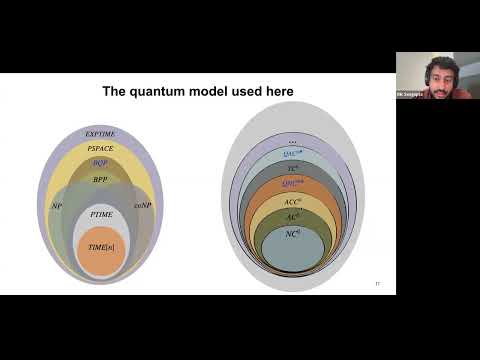
Rik Sengupta: Separating Quantum Circuits from Classical LLMs
Title history
- Rik Sengupta: Separating Quantum Circuits from Classical LLMs — observed on 20261103-1921 UTC (YouTube)
Keywords
Summary
228 words
Critical Evaluation
Value of the Information & Strength of the Argument
The talk offers significant value by providing an explicit separation result between quantum circuits and transformer models, a step toward understanding the power of quantum computation over classical machine learning paradigms. The argumentation is rigorous: the speaker builds the separation from established concepts, clearly defining the function and outlining both upper and lower bounds. The use of a well-chosen iterated index function is elegant, and the arguments are presented with appropriate caveats, such as the need for multiple input copies in the quantum circuit. The connection to ongoing research on BPP vs BQP contextualizes the result, though the speaker honestly notes that this does not demonstrate practical quantum advantage. Overall, the value lies in deepening the theoretical understanding of what quantum circuits can achieve relative to classical attention-based models.
Scientific Rigor, Source Quality, Title Accuracy
The rigor is high: the speaker cites specific prior work, including Bravyi et al. for QNC0 containment and Li et al. for transformer width and iterated index lower bounds. The technical definitions are precise, and the talk adheres to established conventions in quantum complexity theory. The title is appropriate and does not overstate the findings; it accurately indicates a theoretical separation rather than a practical demonstration. The presentation is consistent with the seminar format and maintains a high level of technical accuracy. While no external links are provided in the description, the internal references are credible within the field.
243 words
Title / Content Match
The title accurately reflects the content: the speaker presents a theoretical separation between quantum circuit classes and transformer models, focusing on computational complexity.
Quality & Reliability
8/10
The talk presents original theoretical research from IBM Research, referencing established results and giving a clear technical exposition. While not peer-reviewed, the speaker demonstrates deep expertise and the content aligns with contemporary complexity theory.
Key Moments
Markers derived by PSI from the transcript: the creator did not define chapters.
- Introduction and overview: goal of separating shallow quantum circuits from transformers.
- Background on quantum circuits, QNC0, and known separations from classical classes.
- Definition of iterated index function and its recursive structure.
- Quantum upper bound: construction of a small circuit for iterated multi-index.
- Classical lower bound: transformers need large width for the same function.
- Caveats, open questions, and discussion of limitations.
Cited Sources
- Bravyi et al. (2018), Quantum advantage with shallow circuits — Cited for the result that QNC0 strictly contains NC0.
- Li et al., work on transformer width and iterated index lower bounds — Inspired the definition and hardness of the iterated index function.
Contribution & Novelties
The talk contributes a novel separation result between QNC0-like quantum circuits and transformer models, using an iterated multi-index function. It extends previous work on transformer width and builds on quantum complexity results, offering a concrete instance where quantum circuits with logarithmic-logarithmic depth outperform transformers with fixed depth but high width. The result is theoretical but relevant to understanding the fundamental limits of attention-based architectures.
Pour aller plus loin :
- Quantum computing — Context for quantum circuits and their power.
- BQP (complexity class) — The class of problems efficiently solvable on a quantum computer, central to the separation discussion.
- Transformer (deep learning architecture) — The model class under consideration, with details on architecture.
- Circuit complexity — Foundational topic for understanding QNC0 and related classes.
123 words
Radar Profile
The profile shows very high technical complexity and information density, with slightly lower scores for quality and reliability due to the presentation being a seminar talk without peer review. The balance indicates a rigorous but highly specialized content requiring expert audience.