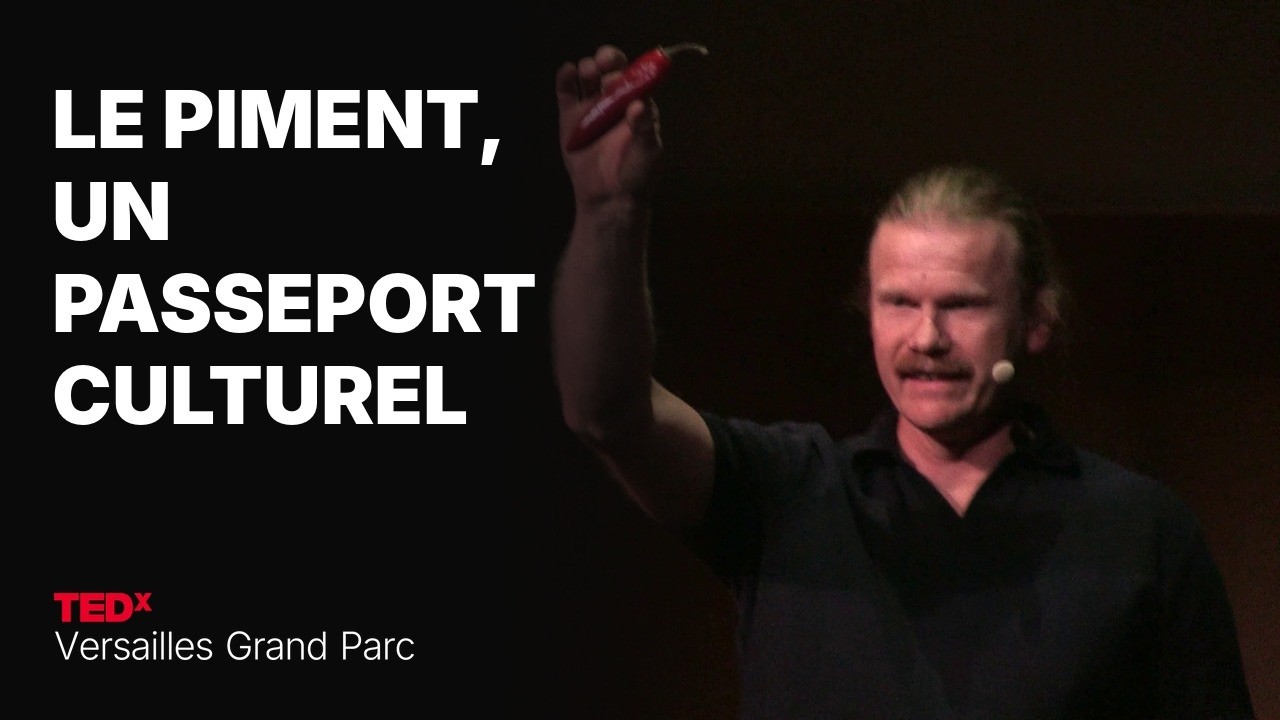
Le piment, un passeport culturel | Jean-Baptiste Martin | TEDxVersailles Grand Parc
Chili peppers: a cultural passport | Jean-Baptiste Martin | TEDxVersailles Grand Parc
Title history
- Le piment, un passeport culturel | Jean-Baptiste Martin | TEDxVersailles Grand Parc — observed on 20261103-1736 UTC (YouTube)
Keywords
Summary
162 words
Critical Evaluation
Value of the Information & Strength of the Argument
The value of the talk lies in its engaging blend of personal narrative and cultural-historical insights. The speaker effectively illustrates the chili pepper’s role as a bridge between diverse communities, using concrete examples such as his interactions with Mexican cooks and the Siona people. The argumentation is persuasive but largely anecdotal; while it mentions scientific facts (capsaicin, Nobel Prize) and archaeological data, these are presented as supporting context rather than rigorously analyzed. The reasoning flow is coherent, moving from historical spread to sensory experience and then to cultural significance, though some claims—such as the ’true’ reasons for chili’s success—are subjective and not systematically evidenced.
Scientific Rigor, Source Quality, Title Accuracy
The scientific rigour is moderate: the talk references real research (David Julius’s Nobel) and named researchers (Esteban Tapia, Omar Areghi) but does not provide direct citations or details. The historical narrative relies on accepted scholarship, yet dates and mechanisms are simplified. The title ‘Le piment, un passeport culturel’ precisely matches the content, as the entire talk is built around this metaphor. The description provides a link to TEDx generally, but no specific source links for the claims. No comments are provided for analysis; therefore, no public reaction trends are considered.
209 words
Title / Content Match
The title accurately reflects the core theme: chili pepper as a cultural connector and passport across cultures, which is the central thread of the talk.
Quality & Reliability
7/10
The talk combines personal anecdote with scientific facts (capsaicin mechanism, Nobel Prize) and archaeological claims (6200-year-old domestication sites). While the speaker cites named researchers, no specific publications are referenced on screen, and some historical details are approximations. Overall, the information is credible but not fully verified.
Key Moments
Markers derived by PSI from the transcript: the creator did not define chapters.
- Introduction: chili as an 'exemplary immigrant' and his own background
- History: origins in South America, domestication sites in Ecuador (6200 years ago)
- Columbus and Portuguese spread chili worldwide within a century
- Why chili succeeded: economic advantage over pepper and neurological mechanism (capsaicin, endorphins, dopamine)
- Personal story: starting as chef, encounter with Mexican cooks and acceptance ritual
- Founding Sauces Martin: challenges, growth, and scaling production
- Trip to Amazon to meet Siona people; cultural practices involving chili (rituals, rites of passage)
- Exchange of knowledge with Siona: cooking together and learning from each other
- Conclusion: chili as a cultural passport; message about unity and identity
Cited Sources
- TEDx program information — General reference to the TEDx event format and organizer
Concurring Sources
- TEDx program information — General platform for this talk
Contribution & Novelties
The talk offers a unique perspective by merging personal entrepreneurship with cultural anthropology and neurobiology. The speaker contributes a vivid first-hand account of using chili as a tool for cross-cultural bonding, going beyond typical historical or culinary narratives. Its novelty lies in the synthesis of scientific facts, personal transformation, and indigenous cultural encounters, framed as an advocacy for cultural connectivity.
Pour aller plus loin :
- Capsaicin on Wikipedia — Explains the chemical and its biological effects on pain receptors.
- Chili pepper on Wikipedia — Overview of history, cultivation, and spread.
- David Julius (scientist) — Nobel laureate who discovered TRPV1 receptor, relevant to capsaicin mechanism.
- Siona people on Wikipedia — Brief entry on an indigenous people of Ecuador and Colombia (if confirmed).
121 words
Radar Profile
The radar profile shows balanced scores across quantity, quality, technical level, and reliability, with a slight peak on information quality. The talk provides moderate depth without heavy technical jargon, making it accessible while maintaining credibility. The lower technical level reflects the focus on cultural narrative rather than scientific detail.