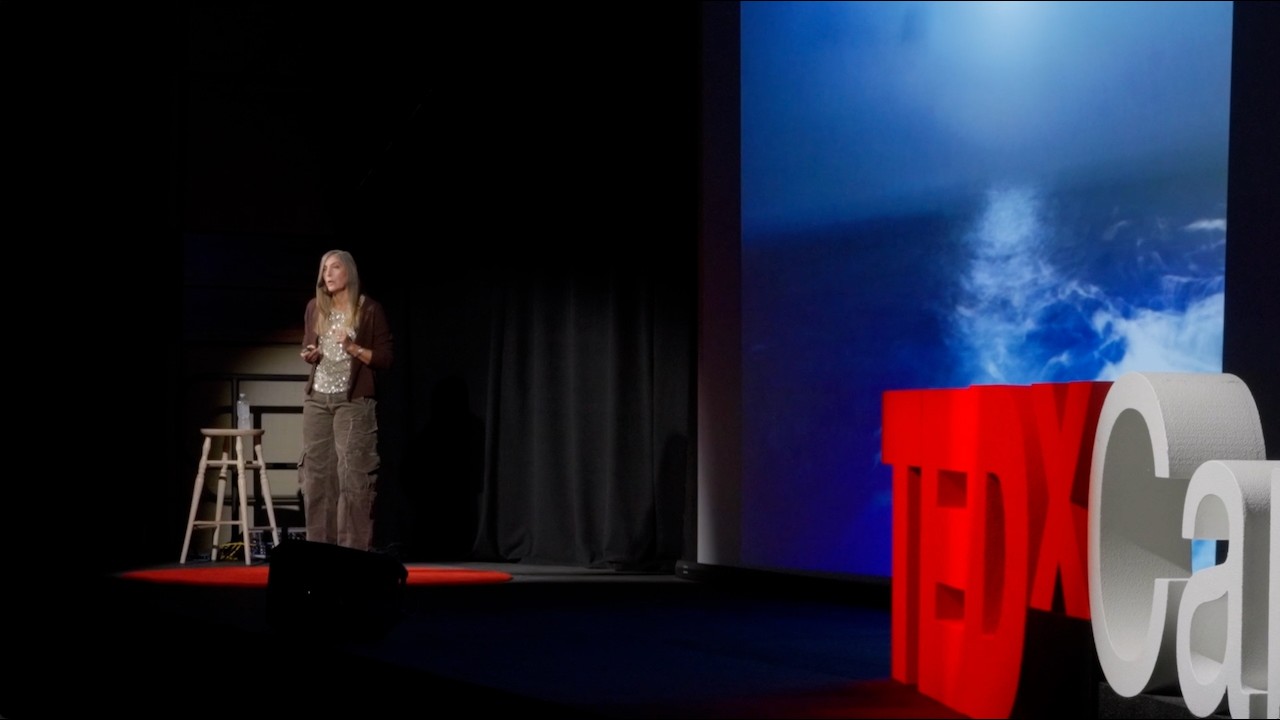
Paying Attention to Our Planet’s Vital Signs | Paula Bontempi, Ph.D | TEDxCapeMay
Title history
- Paying Attention to Our Planet’s Vital Signs | Paula Bontempi, Ph.D | TEDxCapeMay — observed on 20261030-1709 UTC (YouTube)
Keywords
Summary
165 words
Critical Evaluation
Value of the Information & Strength of the Argument
The talk’s value lies in its accessible framing of complex Earth system science through a relatable personal narrative, which effectively bridges emotional resonance and scientific information. The argumentation is coherent: it establishes the concept of vital signs, presents empirical temperature data, illustrates ecological consequences, and offers a historical example (Montreal Protocol) as proof that human intervention can succeed. The speaker’s expertise lends authority, and she carefully distinguishes between personal anecdote and broader scientific consensus. However, the argumentation leans heavily on emotional persuasion, and while the science is accurate, it lacks depth regarding nuanced climate feedback loops or mitigation complexities. The call to action, though inspiring, is somewhat general and does not address systemic or policy-level changes in detail.
Scientific Rigor, Source Quality, Title Accuracy
The scientific claims are grounded in well-established climate data from NASA and NOAA, and the talk references international assessments like those of the UN. The speaker’s credentials ‘NASA acting deputy director of Earth Science Division’ strengthen credibility. The mention of the Montreal Protocol as a successful precedent is accurate, and the recovery timeline aligns with international assessments. The title is appropriate and not misleading; it directly captures the core metaphor and the intended engagement. No external sources are formally cited within the talk, but the description provides a link to TEDx as the organizing body, which is not a scientific reference. The talk would benefit from explicit citations or recommendations for further reading.
246 words
Title / Content Match
The title accurately reflects the talk's focus on using vital signs as a metaphor for planetary health and encourages attentive action.
Quality & Reliability
8/10
The speaker, a professor of oceanography with NASA experience, presents scientifically sound information with clear references to Earth observation data and international agreements. The talk is well-structured and credible, though it remains introductory in scope.
Key Moments
Markers derived by PSI from the transcript: the creator did not define chapters.
- Introduction: story about the speaker's mother and her health decline, setting up the vital signs analogy.
- Transition to Earth's vital signs: comparing planetary health monitoring to doctor's check-ups and NASA's role.
- Presentation of global temperature animation (1880-2025) and key warming numbers (1.19°C).
- Impact of warming on coral reefs (bleaching, 14% loss) and narwhals (habitat stress).
- Ozone layer story: CFCs, Montreal Protocol, and successful recovery as a model for action.
- Call to action: treat the planet like a loved one, engage, and advocate for a healthier Earth.
Cited Sources
- TEDx Talks — This talk was presented at a TEDx event organized by a local community, as stated in the description.
Contribution & Novelties
The talk’s original contribution is its framing of planetary health through the intimate lens of caregiving, making climate science more approachable. It effectively uses the ‘vital signs’ metaphor to translate complex Earth observation data into a call for personal responsibility. The historical comparison with the Montreal Protocol provides a tangible success story, reinforcing the message that collective action can reverse environmental damage. As a TEDx talk, it does not introduce new research but synthesizes existing knowledge in an engaging way.
Pour aller plus loin :
- NASA Global Climate Change — This site provides real-time data on Earth’s vital signs, including temperature, sea ice, and carbon dioxide levels, directly relevant to the talk’s core message.
- Montreal Protocol — This article details the treaty that successfully phased out ozone-depleting substances, a key reference cited in the talk as an example of successful environmental action.
- Coral bleaching — This page explains the mechanisms and impacts of coral stress due to warming oceans, a topic highlighted by the speaker with concrete statistics.
168 words
Radar Profile
The profile shows high qualitative reliability and good information quality, with moderate quantity and technical depth. The balance reflects a well-argued but introductory talk, strong in credibility and clarity, less dense in advanced technical detail.