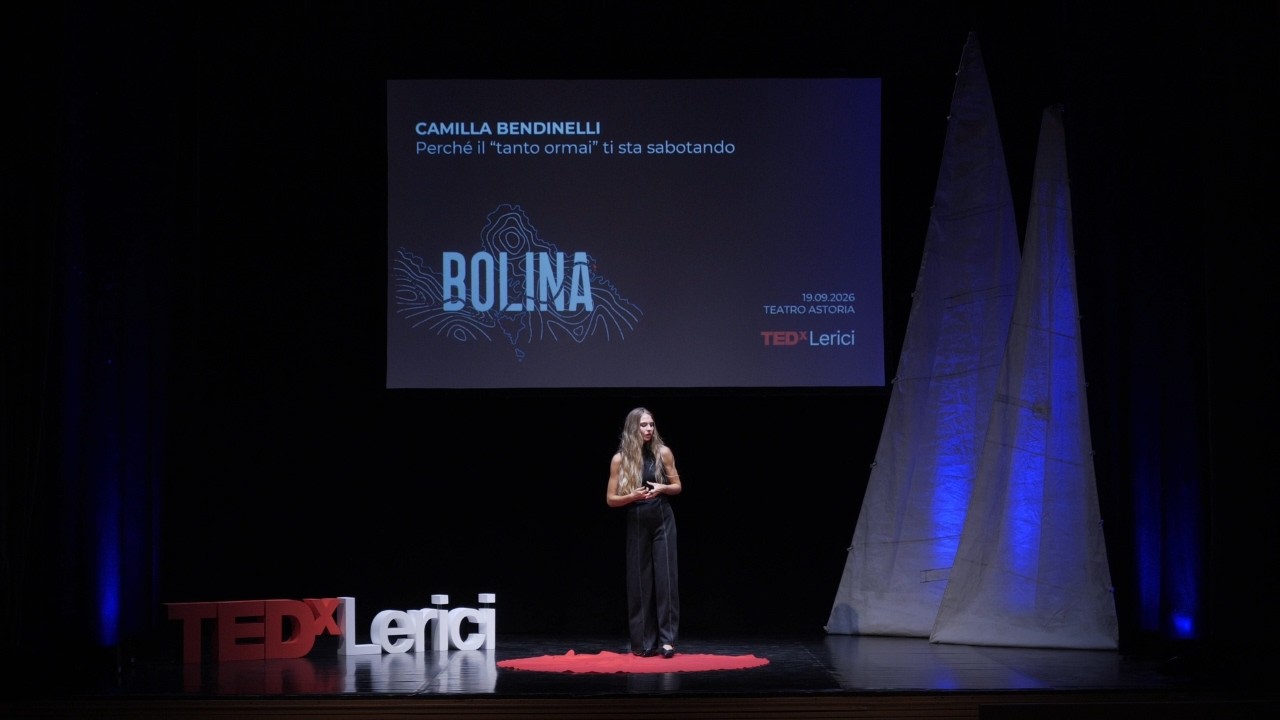
Perchè il "tanto ormai" ti sta sabotando | Camilla Bendinelli | TEDxLerici
Why the "might as well" mindset is sabotaging you | Camilla Bendinelli | TEDxLerici
Title history
- Perchè il "tanto ormai" ti sta sabotando | Camilla Bendinelli | TEDxLerici — observed on 20261027-0212 UTC (YouTube)
Keywords
Summary
207 words
Critical Evaluation
Value of the Information & Strength of the Argument
The talk offers valuable insights into the psychology of dieting, integrating empirical studies with personal narrative. The argumentation is well-structured: it starts with a relatable analogy, introduces a psychological concept (dichotomous thinking), supports it with classic research (Herman & Polivy) and large-scale data, then contrasts rigid vs. flexible control, and finalizes with a personal story that humanizes the message. The speaker effectively explains why perfectionism hinders success and promotes a more adaptive approach. The value lies in translating complex psychological constructs into practical advice, making the content applicable to everyday life.
Scientific Rigor, Source Quality, Title Accuracy
The scientific rigor is generally good: the speaker cites specific studies (Herman & Polivy, the 54,000-person survey, and the weight maintenance study) and accurately describes their findings. However, she does not provide precise citations or references during the talk, relying on the audience’s trust. The sources are credible in the field of eating behavior research. The title is catchy and directly tied to the central theme of the ‘what the hell effect’ sabotaging progress. The content aligns well with the title, as the entire talk revolves around that concept and its consequences. No conflicting sources are known, and the talk does not overclaim beyond what the research supports.
214 words
Title / Content Match
The title accurately reflects the core message about the detrimental effect of the 'what the hell' mindset on dietary adherence and lifestyle changes.
Quality & Reliability
8/10
The talk is based on established psychological research, citing specific studies (Herman & Polivy) and a large-scale survey, and provides a coherent argument. The speaker is a dietitian and educator, adding credibility. However, some claims are simplified and precise references are not given, so a slight deduction applies.
Key Moments
Markers derived by PSI from the transcript: the creator did not define chapters.
- Introduction with GPS analogy and the idea of deviation as failure.
- Explanation of dichotomous thinking and the 'what the hell' mentality.
- Description of Herman & Polivy's milkshake study with 42 female students.
- Large study on 54,000 people linking rigid control to more disinhibition and weight gain.
- Weight maintenance study showing dichotomous thinking predicts weight regain.
- Personal smoking cessation story and the role of perfectionism.
- Graph illustrating real vs. idealized non-linear change process.
- Conclusion: recalculating the route and embracing flexible control.
Cited Sources
- TEDx official page — This is the only link provided in the video description; it refers to the TEDx program which hosts this independently organized TEDx event.
Contribution & Novelties
The talk brings a fresh perspective to dieting discourse by emphasizing the psychological trap of dichotomous thinking, supported by her own experience and existing research. It normalizes deviations and advocates for flexible self-regulation rather than rigid perfectionism. This resonates with current trends in eating behavior research and motivational psychology.
Pour aller plus loin :
- What-the-hell effect — Wikipedia article explaining the phenomenon where a small lapse leads to overindulgence.
- All-or-nothing thinking — Wikipedia article on the cognitive distortion central to this talk.
- Self-determination theory — This theory about autonomy and intrinsic motivation underpins the need for flexible control.
98 words
Radar Profile
The radar profile shows a well-rounded score with slightly higher quality of information and global reliability, while quantity and technical level are moderate. This indicates a talk that is scientifically sound, accessible, and focused on conveying key insights rather than exhaustive detail.