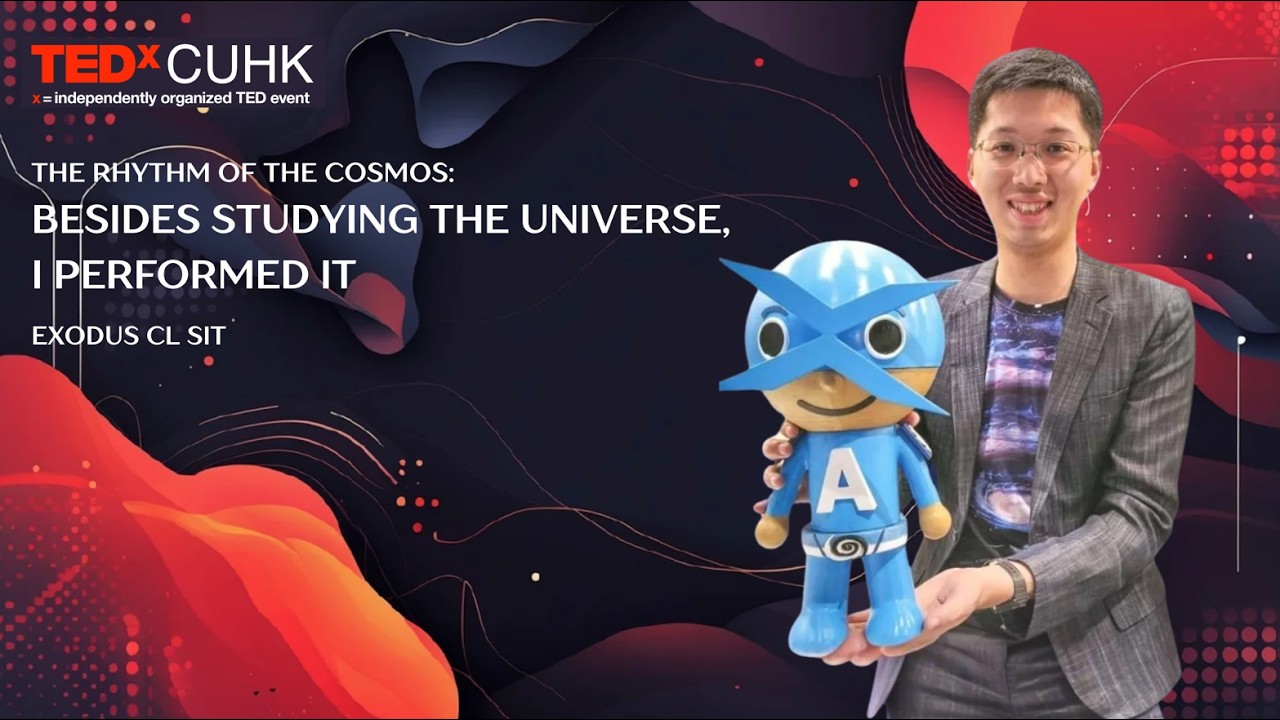
The Rhythm of the Cosmos — Performing the Universe | Exodus Chun-Long Sit | TEDxCUHK
Title history
- The Rhythm of the Cosmos — Performing the Universe | Exodus Chun-Long Sit | TEDxCUHK — observed on 20261106-0137 UTC (YouTube)
Keywords
Summary
170 words
Critical Evaluation
Value of the Information & Strength of the Argument
The value of this talk lies in its innovative proposal to use music as a medium for science communication, addressing accessibility and inclusion in education. The argumentation is built on personal experience and anecdotal evidence, such as his own compositions and outreach activities. While the speaker articulates the benefits of music in enhancing memory and engagement, he does not provide empirical data or comparative studies to substantiate these claims. The reasoning is coherent and persuasive on an intuitive level, but it lacks systematic evaluation or measurable outcomes, limiting its scientific robustness.
Scientific Rigor, Source Quality, Title Accuracy
The talk references Kepler’s historical work and mentions collaborations with institutions like NASA Science Explorer and Cambridge University, but it does not cite specific research papers or provide verifiable sources. The speaker’s credentials as an IAU coordinator lend some authority, yet the absence of concrete citations weakens the scientific rigor. The title is apt and aligns with the content, which blends astronomy and musical performance. No public comments were analyzed, so audience reception cannot be assessed.
182 words
Title / Content Match
The title accurately reflects the content: the talk links astronomy and music to make the universe relatable through artistic performance.
Quality & Reliability
6/10
Speaker is a credible expert (IAU education coordinator) but the talk is anecdotal and lacks deep scientific references. Content is accurate and accessible, yet low on rigorous evidence.
Key Moments
Markers derived by PSI from the transcript: the creator did not define chapters.
- Introduction: public perception of astronomy as distant and the need for innovative science communication.
- Speaker's background: traveler, musician, and educator; the birth of the 'astro-music' idea.
- Historical context: Kepler's 'Harmony of the World' and the Renaissance tradition of interdisciplinary study.
- Challenges: integrating science and music, lack of pioneers in Hong Kong, and scarcity of research data.
- Sending an original Cantonese song to near space via weather balloon as a first step in astro-music.
- Composing music based on astronomical data, collaborations with astrophotographers, and public performances.
- Innovative visual scores: solar system as circular score and building-block compositions for accessibility and inclusion.
- Future vision: interdisciplinary collaboration, dark-sky conservation, and making the universe accessible to all.
Cited Sources
- TEDx Talks — Description link provided by the video; serves as official platform for TEDx events.
Contribution & Novelties
The talk’s original contribution is the concept of ‘astro-music’ as an inclusive, multi-sensory approach to science communication, blending astronomical data with musical composition. It proposes practical tools like circular scores and building-block compositions to democratize music creation and enhance learning. The speaker’s personal journey and outreach efforts illustrate feasibility, though the approach is not yet rigorously evaluated.
Pour aller plus loin :
- Harmonices Mundi — Kepler’s work directly inspiring the harmony of the spheres idea.
- Theory of multiple intelligences — Framework supporting diverse learning modalities.
- Sonification — Scientific data converted to sound, a related technique in astronomy outreach.
98 words
Radar Profile
The profile shows moderate scores across all dimensions, with slightly higher quality and reliability relative to quantity and technical depth. This reflects a talk that is engaging and credible but not highly technical or information-dense.