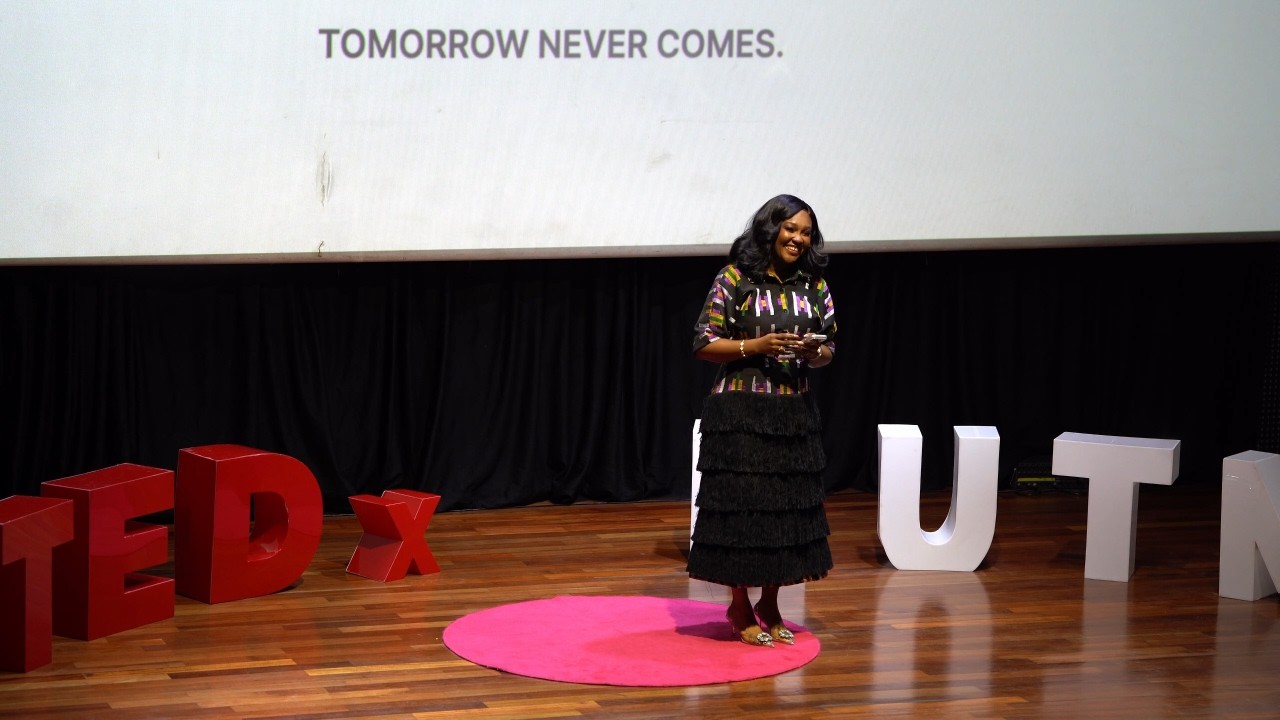
The Gap Between Knowing and Doing | Adeola Ajani | TEDxNUTM
Title history
- The Gap Between Knowing and Doing | Adeola Ajani | TEDxNUTM — observed on 20261029-0032 UTC (YouTube)
Keywords
Summary
156 words
Critical Evaluation
Value of the Information & Strength of the Argument
The talk offers valuable, practical advice on overcoming procrastination and bridging the knowing-doing gap. The speaker’s use of a personal eight-year weight-loss journey makes the message relatable and credible. Her argument is structured around four clear points, each illustrated with accessible examples. While she mentions a psychologist named ‘Peter Glorita’ (likely Peter Gollwitzer) and his work on implementation intentions, she does not provide precise study details, which weakens the scientific underpinning. The logic is sound: knowledge alone is insufficient, fear and vagueness hinder action, small specific steps and social accountability facilitate change. The reasoning is persuasive for a general audience, though it relies more on anecdotal evidence than rigorous empirical support.
Scientific Rigor, Source Quality, Title Accuracy
The scientific rigor is moderate. The speaker references behavioral research but without citing specific studies, authors, or dates. She mentions a psychologist (Peter Gollwitzer) but misspells the name and does not give a source. The talk is rooted in personal experience rather than a review of literature, which limits its scientific weight. The only source provided in the description is the generic TEDx page. The title aligns well with the content, clearly signaling the issue of knowledge-action gap. No comments were provided for analysis.
210 words
Title / Content Match
The title accurately captures the core theme of the talk, which centers on the gap between knowledge and action.
Quality & Reliability
6/10
The talk combines personal anecdotes with a brief reference to behavioral research, offering practical advice but lacking rigorous scientific depth or citation of specific studies.
Key Moments
Markers derived by PSI from the transcript: the creator did not define chapters.
- Introduction: audience question about knowing what to do but not doing it
- Personal story: eight years of trying to lose weight with all the information
- First insight: we do not have an information problem but an action problem
- Second insight: fear lives in the gap, and 'tomorrow' is its favorite word
- Third insight: think small, make specific plans (example of walking and saving)
- Fourth insight: accountability matters, find someone to support you
- Conclusion: summary of four points and call to action
Cited Sources
- TEDx Talks — The talk was delivered at a TEDx event, and this link is the official TEDx page explaining the format.
Concurring Sources
- Implementation Intentions: When Planning Promotes Action (Gollwitzer, 1999) — This foundational paper demonstrates that specifying when and where to act increases follow-through, supporting the talk's third point.
- The Intention–Behavior Gap in Health Behavior (Sheeran & Webb, 2016) — A review article discussing why people fail to act on their intentions, relevant to the talk's core theme.
Dissenting Sources
- None — No sources contradict the general message, though some might argue the emphasis on personal anecdote over empirical evidence weakens the claims.
Contribution & Novelties
The talk provides a relatable, personal lens on the intention-behavior gap, synthesizing known psychological concepts (implementation intentions, fear of failure) into four practical, memorable takeaways. Its originality lies in the integration of medical expertise (the speaker is a doctor) with lived experience, though it does not introduce new research. The advice to ’think small’ and specify when and where aligns with established behavior change literature.
Pour aller plus loin :
- Implementation intentions (Peter Gollwitzer) — A key psychological concept directly related to the advice on making specific plans. See Wikipedia article on implementation intentions for an overview.
- Intention-action gap — The phenomenon discussed throughout the talk, often studied in psychology and health behavior. More details can be found in academic literature.
- Habit formation — The idea that small repeated actions become habits, as mentioned. The concept of ‘habit loops’ is well documented in behavioral science.
145 words
Radar Profile
The radar profile shows moderate scores across all dimensions, with slightly higher quality and reliability than quantity or technical depth. This reflects a talk that is well-intentioned and relatable but lacks the scientific rigor or novel information that would push it to higher levels.