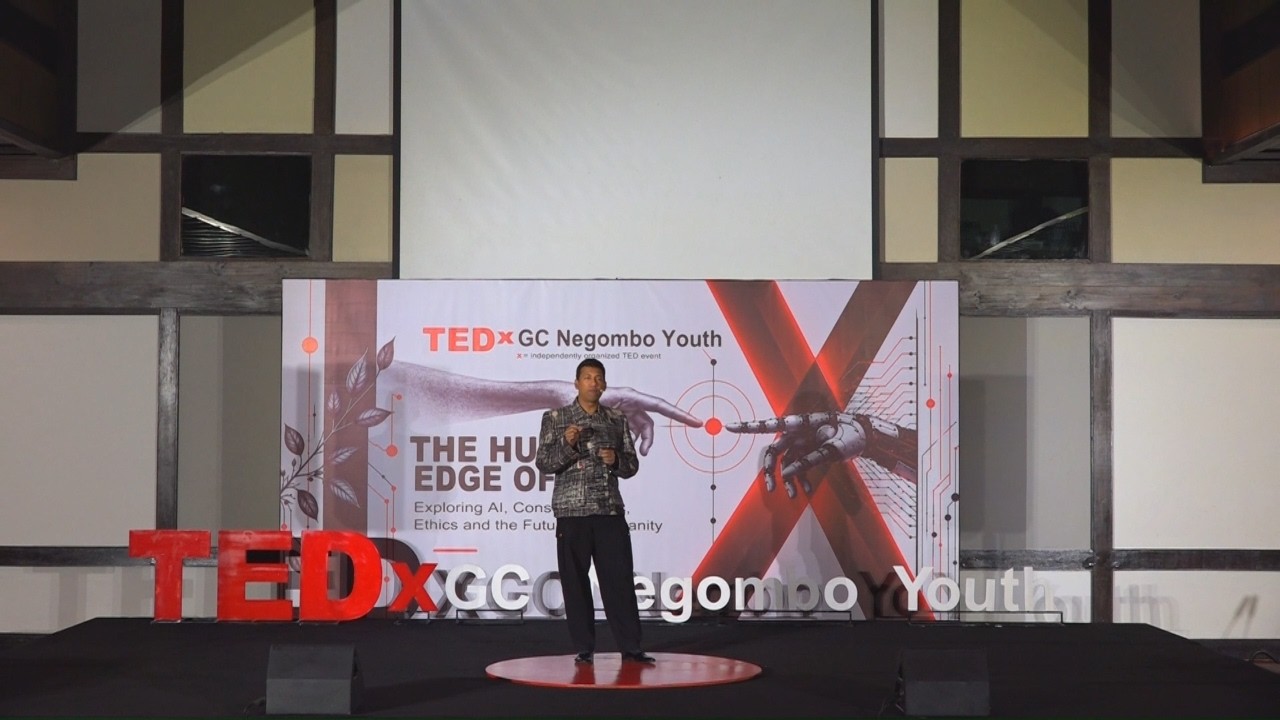
Making Room for the Impossible | Ishan De Lanerolle | TEDxGC Negombo Youth
Title history
- Making Room for the Impossible | Ishan De Lanerolle | TEDxGC Negombo Youth — observed on 20261101-0405 UTC (YouTube)
Keywords
Summary
189 words
Critical Evaluation
Value of the Information & Strength of the Argument
The talk’s value lies in its compelling narrative that bridges a real engineering story with broader reflections on AI and human purpose. De Lanerolle’s argumentation is solidly built on the father’s example: the importance of questioning assumptions, embracing failure as learning, and maintaining a clear vision. He effectively contrasts the mindset of risk-aversion (his own) with his father’s relentless optimism, showing that both are necessary. The extension to AI is logical: just as his father didn’t accept a failed part as a dead end, we shouldn’t accept AI’s first answer as final. The argument that human judgment remains essential is argued through personal evidence, making it relatable and persuasive. However, the talk does not delve into technical details of AI or engineering, so its value is more inspirational than instructional.
Scientific Rigor, Source Quality, Title Accuracy
The talk is rigorously structured with a clear narrative arc, but it relies entirely on personal testimony without citing external sources or providing verifiable data. The claims about machines, numbers, and awards are not substantiated with references, which limits its scientific rigor. The title accurately reflects the central metaphor and content, making it well-aligned. The talk is presented in a TEDx format, which lends some credibility to the speaker’s expertise, but as an expert opinion piece, it should be taken as anecdotal rather than empirical.
230 words
Title / Content Match
The title 'Making Room for the Impossible' aptly captures both the literal story of creating space for a needle in a machine and the metaphor of pursuing impossible goals.
Quality & Reliability
6/10
Personal anecdote without external verification; claims not corroborated by cited sources. However, the talk is well-structured and presents credible personal experience.
Key Moments
Markers derived by PSI from the transcript: the creator did not define chapters.
- Opening with a song from 'The Impossible Dream' and introduction to the theme.
- Introduction to the father's story and the tea bag machine problem.
- Father announces he will solve the staless tea bag problem; family doubts.
- Details of the failures, 542 attempts, and financial strain.
- Breakthrough and father's request for more money.
- Recognition and global impact; sustainability angle of retrofitting old machines.
- Switch to AI discussion: dangers of accepting first answers, need for human judgment.
- Musical reflection and importance of human connection over AI-generated art.
- Advice to youth: question AI, persist, and make room for the impossible.
- Conclusion and applause.
Cited Sources
- TEDx Program — Referenced as the organizing body for the talk.
Contribution & Novelties
The talk’s original contribution is the application of a personal engineering triumph to the emerging discourse on AI and human agency. It provides a concrete, emotionally resonant example of persistence and creative problem-solving that challenges the notion that AI should dictate our ambitions. The narrative serves as a cautionary tale against passive acceptance of machine-generated solutions. It also introduces a sustainability angle by demonstrating the value of retrofitting existing machinery, which is a practical insight for industrial innovation.
Pour aller plus loin :
- Growth mindset — Relevant to the father’s perseverance and belief in incremental improvement.
- Human-centered artificial intelligence — Directly aligns with the talk’s emphasis on keeping human judgment central in AI applications.
- Prompt engineering — The talk implicitly encourages iterative prompting and refinement, a key concept in AI interaction.
- Sustainable manufacturing — The retrofitting of machines exemplifies sustainable practices in industry.
143 words
Radar Profile
The radar profile shows a moderate quality of information and reliability, with higher scores in qualitative aspects like information quality and lower in technical depth and overall reliability. This reflects a talk that is valuable for its inspirational message but lacks empirical backing.